
Exploring the world of historical swords inevitably leads us to question the limits of forging and functionality. In unravelling the mystery of the largest sword ever forged, we enter a realm where history, legend, and craftsmanship intertwine. Beyond official records, these imposing steel creations invite us to reflect on their purpose: were they formidable weapons of war, impressive symbols of status, or merely displays of artisanal mastery?
We will delve into the fascinating details of these colossal weapons, from the legendary Japanese Ōdachi to the majestic Scottish Claymores. Their length, weight, and the challenge of wielding them reflect eras where size, at times, was synonymous with power. Through this journey, we will discover the true secrets behind their design and how they have captivated imaginations throughout centuries.
What is the largest sword ever forged? Exploring the Guinness Record and its significance
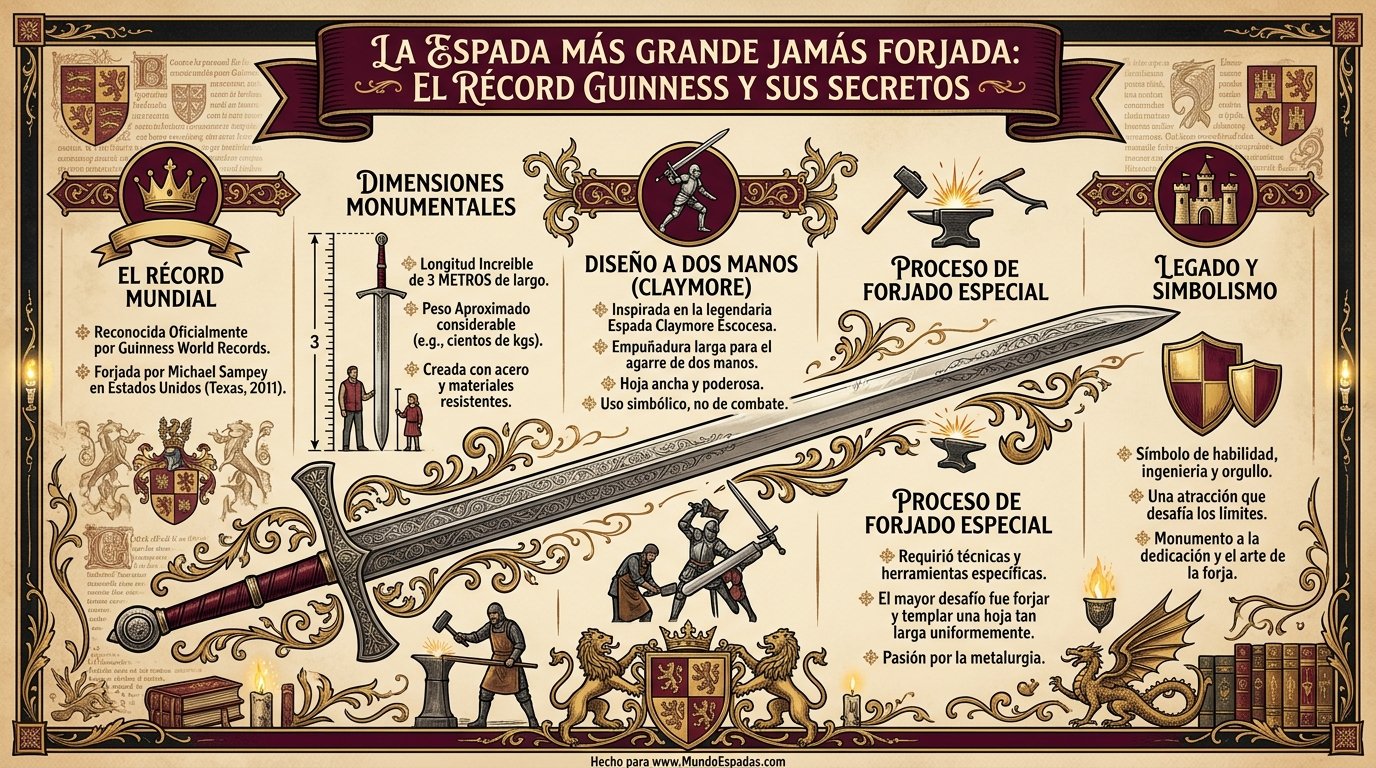
The title of the largest sword ever forged is a field where historical accuracy clashes with interpretation and legend. Although the Guinness Book of Records has recognised astonishing pieces, it is crucial to understand that many of these gigantic “swords” were created for ceremonial or display purposes, rather than for actual combat. The official length of 3.77 metres mentions an impressive piece which, while a sword in form, its practical use as a battle weapon is, to say the least, questionable.
For a sword to be considered “forged” in the record’s sense, it must exhibit the structural and morphological characteristics of a sword. This includes a blade, hilt, guard, and pommel, manufactured using traditional or modern blacksmithing techniques. However, its battlefield functionality differs greatly from swords designed for active and effective military use.
The significance of this record transcends mere measurement; it represents the culmination of a smith’s skill and a testament to human ingenuity. It speaks of an era where displays of power and artistic ability were as valued as the sharpest blade on the battlefield. Furthermore, these extreme pieces help us understand the physical and logistical limits of ancient metallurgy and military engineering.
Giants of Steel: Origin and evolution of large swords in history
Large-scale weapons have fascinated humanity since time immemorial, and giant swords are no exception. Their origin dates back to various cultures and eras, often emerging in response to specific tactical needs or as symbols of prestige and power. The earliest examples, though crude, already hinted at the idea of asserting dominance through size and presence.
Ancient civilisations, from the Mediterranean to the Far East, experimented with longer and heavier swords, seeking advantages in combat. With the evolution of metallurgy and forging techniques, it became possible to create longer blades without excessively compromising their strength, which opened the door for truly impressive swords. This development was gradual, influenced by the availability of materials and the sophistication of blacksmiths’ tools.
Cultural and mystical context of colossal swords

Beyond their practical use, many of these giant swords acquired cultural and mystical significance. They were often associated with legendary heroes, deities, or transcendent events. These weapons were believed to possess special powers or to carry the spirit of great warriors, elevating their status from tools to objects of veneration. The forging of these swords required a significant investment of resources and time, which turned them into priceless treasures, dynastic symbols, or sacred relics.
Between legend and reality: The challenge of identifying the most effective large sword for combat
Identifying the most effective large sword for combat is a challenge that merges historical analysis with an understanding of mediaeval swordsmanship. Many of the “giant swords” we know, such as those reaching or exceeding 2 metres, were intended more for parades, ceremonies, or displays of strength than for actual battle. Their weight and length made them extremely difficult, if not impossible, to wield in a dynamic and chaotic combat environment.
However, it is crucial to distinguish between ceremonial pieces and functional weapons which, despite their large size, were designed for war. Examples like the Scottish Claymore or the German Zweihänder (two-handed sword) could exceed 1.50 metres in length, but were meticulously balanced and forged to be, despite their size, formidable weapons in the hands of a trained warrior. Their effectiveness lay in their ability to break pike formations, opponents armed with heavy armour, and to offer great reach and powerful cutting force.
The Ōdachi: Effectiveness or symbolism?
The Japanese Ōdachi, with some blades exceeding 2 metres, represents an interesting case. While there are accounts of their use on the battlefield, especially in skirmishes against cavalry or as a static defensive weapon, the vast majority of these extreme pieces were temple offerings or status symbols of feudal lords. Their effectiveness was situational, requiring exceptional training and very specific combat conditions. The difficulty of drawing and wielding them in a confined space greatly limited their practical application in typical war scenarios. The reality is that functional “large swords” rarely exceeded what a strong man could wield with skill, prioritising speed and control over mere length.
Unique combat techniques: Wielding colossal swords and their strategic impact
Wielding colossal swords required a unique set of combat techniques, radically different from those used with a standard-sized sword. These weapons, often more than 1.2 to 1.8 metres in length, more closely resembled polearms than light swords. Therefore, their use demanded considerable physical strength, great coordination, and specialised training that made them the domain of elite warriors.
The German Zweihänder, for example, was used by Landsknecht mercenaries known as “Doppelsöldner”, who received double pay for their crucial role on the battlefield. Their technique involved the “half-sword” grip, where one hand was positioned on the blade for more precise control in thrusts or to open defences. It was designed to break pike and halberd formations, creating breaches in enemy lines. Its sheer size allowed them to keep several opponents at bay, albeit at the expense of agility.
The strategic role of large swords

The strategic impact of these swords was considerable in certain contexts. Not only were they formidable offensive weapons, but they also acted as psychological deterrents. The mere sight of a warrior wielding such an impressively sized sword could instil fear in enemy ranks. In pitched battles, handling techniques focused on wide cutting arcs and powerful thrusts, seeking to decisively wound or disarm opponents.
Japanese Ōdachi, although less documented in their actual combat use with specific techniques, likely required the use of both hands and sweeping movements to take advantage of their inertia. Their large size implied a more positional combat, where the warrior sought to exploit their reach and the blade’s weight to generate devastating blows, more suitable for individual or small-scale engagements where agility was not paramount.
Beyond steel: Materials and manufacturing processes for historical giant swords
The forging of historical giant swords was a metallurgical feat that went far beyond the simple use of steel. It required a deep understanding of materials, as well as intricate and laborious manufacturing processes. The selection of steel was fundamental; alloys with the right combination of hardness and toughness were sought to withstand the stresses of such a long and heavy blade without fracturing easily.
The forging process involved hours, often days, of intensive manual labour. Blacksmiths used forging hammers and bellows to heat the steel to precise temperatures and then repeatedly shape it. This constant hammering not only shaped the blade but also refined the granular structure of the metal, improving its strength and flexibility. Material homogeneity along the entire length was a particular challenge, as any inconsistency could lead to weak spots or catastrophic fracture in combat.
Finish and balance: Keys to functionality
After initial forging, came the quenching and tempering processes, critical to giving the blade its final hardness and resilience. Quenching involved heating the blade and then rapidly cooling it in a medium (water, oil, or brine), while tempering reduced brittleness without sacrificing too much hardness. For a giant sword, this process had to be executed with extreme precision and uniformity across the entire blade to prevent deformations or breakages. The final sharpening and polishing not only gave it its characteristic edge but also contributed to aesthetic and functional balance. The weight distribution along the blade, from pommel to tip, was essential so that, despite its size, the sword could be handled with some dexterity. A poorly balanced giant sword would be useless, even dangerous, for its wielder.
Discover our selection of The Largest Sword Ever Forged: The Guinness Record and Its Secrets


History and evolution of giant swords: From the Ōdachi to the Claymore
Throughout history, giant swords have emerged in different cultures, each with its own characteristics and purposes. From the imposing Japanese Ōdachi to the powerful Scottish Claymore, these weapons were not only symbols of power but also milestones in metallurgy and combat technique. Below, a chronological look at their evolution.
| Era | Event |
|---|---|
| Early Medieval Period (Europe) | |
| 9th-11th Century | Development of the first hand-and-a-half swords that would lay the groundwork for longer swords. |
| 12th Century | War swords begin to grow in length, used by both cavalry and infantry. |
| Sengoku Period (Japan) | |
| 14th-16th Century | Appearance and popularisation of the Ōdachi (大太刀), long swords used in ceremonies or as specific military weapons. |
| 15th Century | Production of functional Ōdachi, some exceeding 2 metres in blade length, although their use in combat was limited and specialised. |
| Late Medieval and Renaissance Period (Europe) | |
| 13th-14th Century | Emergence of long “war swords”, direct predecessors of the great two-handed swords. |
| 15th Century | Development of the Scottish Claymore, a two-handed sword with a characteristic guard, used in the Scottish Highlands. |
| Early 16th Century | Peak of the German Zweihänder (doppelhänder), used by Landsknechte to break pike formations. |
| Mid-16th Century | Production of colossal “parade swords”, often as symbols of power for emperors and nobles, such as Pier Gerlofs Donia’s famous “Great Sword of Ghent”. |
| Later Centuries and Replicas | |
| 17th-19th Century | Decline in military use of giant swords due to the prevalence of firearms and more efficient polearms. |
| 20th Century-Present | Interest in historical replicas and exhibitions |