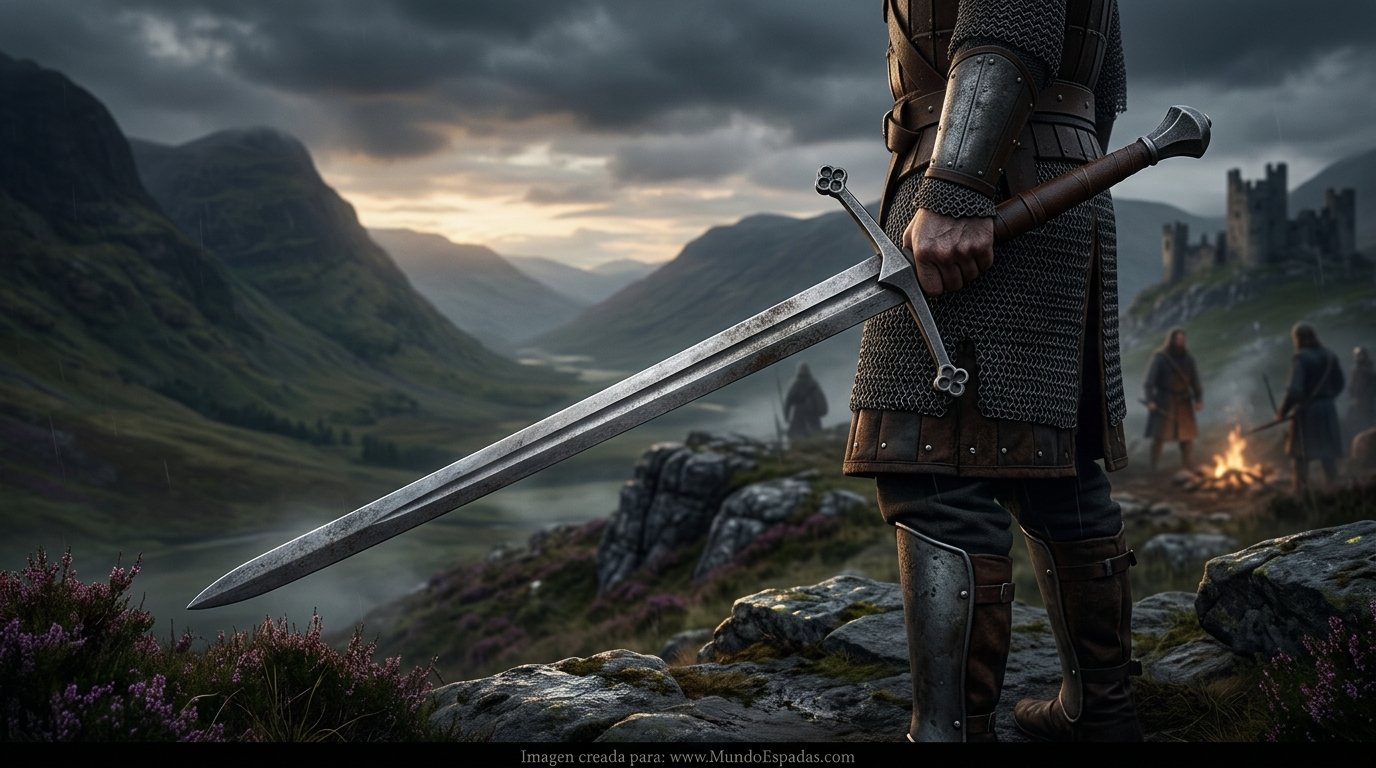
The figure of William Wallace evokes images of heroism, freedom, and the iconic sword that, according to legend, he wielded with indomitable strength. However, the persistent question of whether William Wallace’s sword was truly a Gallowglas Claymore, that grand two-handed sword so associated with Scottish warriors, remains a crucial point of debate among historians and enthusiasts of historical weaponry. We will analyse the evidence, unravel the mystery, and distinguish historical reality from the cinematic myth that has permeated popular culture. We will address the characteristics of swords from Wallace’s time and compare them with the subsequent evolution of the Claymore, offering an informed perspective for collectors and aficionados.
Was Wallace’s legendary sword truly a Gallowglas Claymore?
The most widespread image of William Wallace’s sword, popularised by epic films, often depicts it as a massive, two-handed Claymore. However, this representation conflicts with available historical sources and the chronology of weapon development in Scotland. The Claymore, as we know it today, is a sword that appeared and became popular in the 15th and 16th centuries, long after Wallace’s death in 1305. The term “Claymore” derives from the Scottish Gaelic “claidheamh mòr”, meaning “great sword,” and refers specifically to the characteristic two-handed Scottish great sword of later periods.
Therefore, associating the Claymore directly with William Wallace is a historical anachronism, though understandable given its strong connection to Scottish identity. It is fundamental to differentiate between the sword Wallace might have used and the subsequent evolution of swords that bore the Claymore name. Two-handed swords existed in his era, but not with the distinctive features and name of the Claymore.
The sword attributed to Wallace, housed in the National Wallace Monument in Stirling, has undergone significant restorations that complicate its study. Its current appearance probably differs from the original of the early 14th century, and it is vital to consider these alterations when analysing its authenticity.
Unmasking William Wallace’s Sword: Origins and Early Evidence
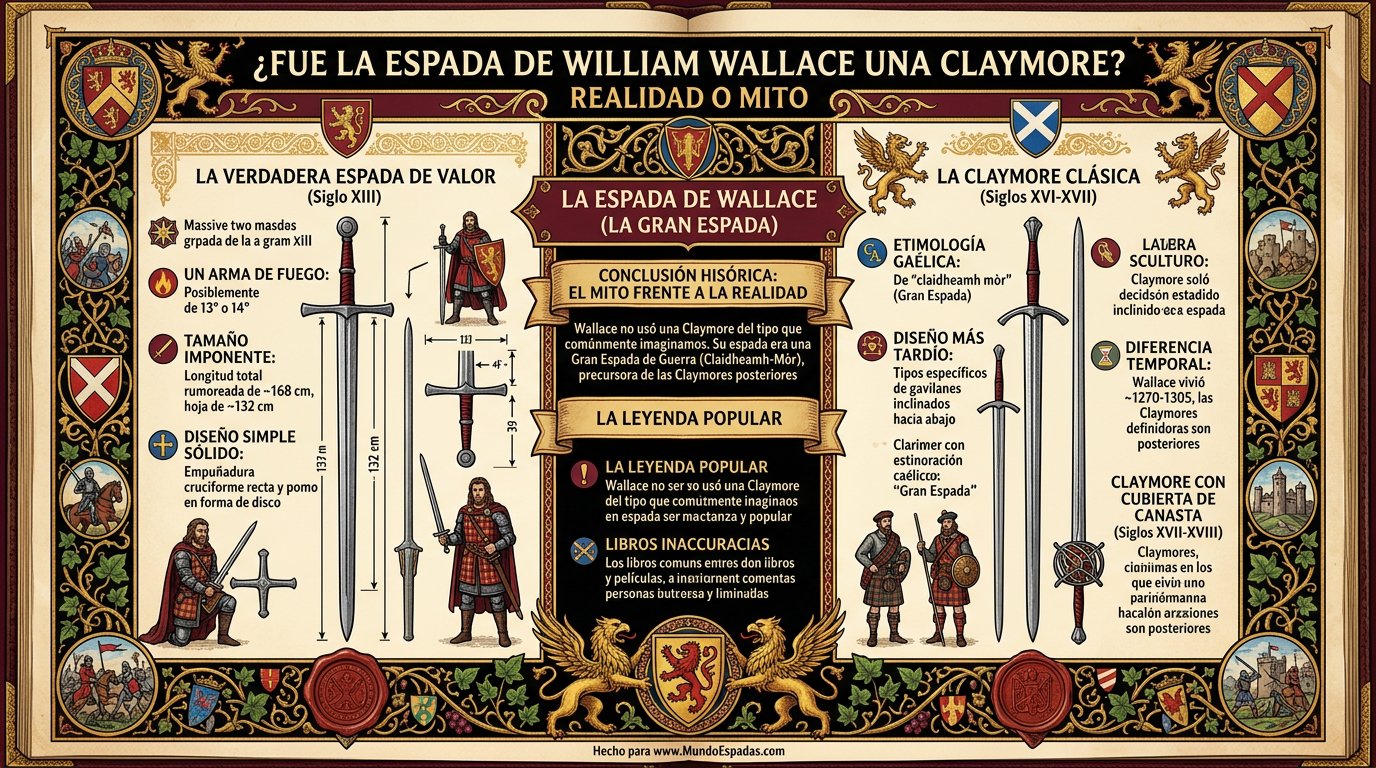
William Wallace’s sword, as displayed in the National Wallace Monument, is a key piece in unravelling this mystery. However, the history of this sword is shrouded in complex layers of tradition and restoration. There is no definitive proof that irrefutably links this sword with the Scottish hero contemporary to his life. The first mentions of a “Wallace sword” do not appear until several centuries after his death. One of the oldest accounts comes from Blind Harry, whose 15th-century epic poem “The Actes and Deidis of the Illustre and Vallyeant Campioun Schir William Wallace” describes him as a formidable warrior, albeit with poetic license.
The legend that this particular sword was his solidified over the centuries, fueled by fervent Scottish nationalism. Despite the lack of direct evidence, the sword became a powerful symbol. The direct attribution to Wallace grew stronger when, in the 19th century, the weapon underwent significant restoration. In 1825, Scottish armorer John Murdoch, under the direction of the Duke of Atholl, restored the sword. It is said that he used metal from another sword collected at the Battle of Bannockburn to forge a new guard and pommel, and that the hilt was wrapped with leather from a scabbard found on the battlefield. It is likely that part of the blade is original, but the current assembly is, to a large extent, a product of the 19th century.
Characteristics of medieval Scottish swords: Does Wallace’s sword fit the description?
To better understand what type of sword William Wallace might have used, we must analyse the typical characteristics of European swords from the late 13th and early 14th centuries. During this period, one-and-a-half-handed military swords were common, while true two-handed swords, or “great swords,” were beginning to emerge, but not in the definitive form of the Claymore. The sword at the Wallace Monument measures approximately 1.63 metres in total length, with a blade of 1.32 metres. This exceeds the size of a standard one-handed sword but is considerably different from the proportions of a late Claymore.
Swords from Wallace’s time typically had long blades but were designed to be used primarily with one hand or, sometimes, with both hands for more powerful blows and manoeuvres in mounted and foot combat. Their design focused more on cutting and thrusting capability, and their balance allowed for relatively agile handling for their size. Furthermore, the morphology of the hilt and guard of the sword attributed to Wallace does not correspond to the distinctive design of the double-quillon Claymore guard that angles towards the blade. The Stirling example, even before its restoration, would have presented characteristics more in line with “medieval longsword” or “war sword” types from the early 14th century.
These designs were evolved from the Oakeshott Type XIIa or XIIIa, suitable for a formidable warrior like Wallace, who would have needed an effective sword against chainmail armour and, occasionally, the nascent plate armour.
The Claymore: An evolution that arrived later on the battlefield

Glenn J. Mason from Edinburgh, Scotland, CC BY 2.0, via Wikimedia Commons
The true Scottish Claymore, with its distinctive features, began to appear on battlefields from the 15th century onwards and became established during the 16th century. This type of sword is defined by its great size, generally intended to be used two-handed, and by its straight crossguard with quillons ending in lobes or “ears,” often angled towards the blade. It had a long hilt, designed to provide excellent leverage and control, and a double-edged blade, usually with a lenticular profile, optimised for devastating cuts.
Types of Claymore
It is important to distinguish between two main types of Claymore that are often confused: * Two-handed Claymore (Great Claymore): This is the large, distinctive sword that most people associate with the term, used in the 15th and 16th centuries. It was a formidable infantry weapon, capable of inflicting considerable damage through armour and enemy formations. Its size and weight required strength and skill to be wielded effectively.
* Basket-hilted Claymore: This is a much later, one-handed sword that became popular from the 17th and 18th centuries. Although also called “Claymore” due to its Scottish use, its basket-shaped hilt design made it very different from the original two-handed Claymore, and it was more suitable for duels and skirmishes than the large-scale battles of earlier centuries.

The development of the two-handed Claymore was driven by the need for weapons capable of penetrating the increasingly heavy armours emerging in the Late Middle Ages. However, its heyday was more than two hundred years after Wallace. Therefore, its presence in the Scottish army of the 14th century, in which Wallace fought, is historically improbable.
The myth of the ‘Wallace Sword’: Why did it endure through the centuries?
The myth surrounding William Wallace’s sword has not only endured but has grown stronger over time and has been a powerful tool for cultural cohesion. The figure of Wallace stood as a beacon of Scottish independence, and his sword, a tangible symbol of his resistance against English oppression. This sword, real or fabricated, became a relic, a source of inspiration for generations of Scots who dreamed of freedom. Blind Harry’s poem, “The Actes and Deidis of the Illustre and Vallyeant Campioun Schir William Wallace,” written in the 15th century, was fundamental in cementing the legend.
Although written long after Wallace’s death, it became a primary source for the heroic narrative, and it was this work that began to shape the image of the indomitable warrior and his gigantic sword. Oral tradition and the lack of detailed historical records in medieval Scotland allowed stories to transform and embellish. Furthermore, 19th-century romantic nationalism played a crucial role in consolidating the myth. In an era of renewed interest in national identities and past heroes, the figure of Wallace and his sword resonated deeply.
The restoration of the sword in 1825 by John Murdoch, although historically questionable in its original authenticity, perfectly served this purpose, providing an “authentic” piece for popular adoration. Modern cinema, such as the film “Braveheart,” has further solidified this romantic image, often at the expense of historical accuracy.
Analysis of the William Wallace sword replica: Materials, weight and dimensions

For collectors and sword enthusiasts, the analysis of a replica of William Wallace’s sword that resembles the example displayed in Stirling is fascinating. These replicas seek to emulate the characteristics of the weapon as it is presented today, with its modifications and restorations. A medium to high-quality replica of the “Wallace Sword” is not a typical Claymore in the strict sense, but a large war sword.
Common specifications in replicas:
* Overall length: Generally around 165 cm (approximately 65 inches). This considerable length positions it as a longsword or hand-and-a-half sword, but it definitely requires the use of both hands in combat. * Blade length: Around 132-135 cm (52-53 inches). The blades are wide and with a gradual profile, optimised for powerful cuts. * Weight: Functional replicas can weigh between 2.5 kg and 3.5 kg (5.5 to 7.7 pounds). Some decorative replicas, for aesthetic purposes, may be lighter or heavier, depending on the materials and blade thickness. It is believed that the original sword, or at least a weapon of these dimensions used in combat, would have been surprisingly light for its size, with weight optimised for speed and control.
* Materials: Blades are usually made of carbon steel (1060, 1075, 1095) for functional replicas, forged to withstand impacts. Guards and pommels are commonly made of mild steel or cast iron, with hilts wrapped in leather or wood. * Handling: Despite its size, a well-balanced replica of this sword allows for agile handling for a warrior of considerable stature and strength. Its design is aimed at generating great cutting force, using the weight and length of the blade to amplify the impact.
Collectors value these replicas not only for their historical connection but also for the engineering and craftsmanship required in their manufacture. They represent a formidable type of sword, which, although not a traditional Claymore, embodies the spirit of a warrior who fought with an imposing weapon. The replica is a tribute to a symbol, rather than an exact reproduction of a 13th-century artefact.
Discover Our Selection of Was William Wallace’s Sword a Claymore? Fact or Myth


Beyond the Claymore: Other Relevant Historical Swords for Collectors
The world of historical swords is vast and offers a rich variety of pieces that go far beyond the Claymore or Wallace’s sword, providing fascinating options for any collector. Each region and historical period produced distinctive weapons, reflecting the metallurgical techniques, combat styles, and cultural needs of its time. The diversity of swords available for collection is astounding, ranging from elegant rapiers to massive two-handed swords.
Examples of swords for collection:
* Viking (8th-11th C.): Characterised by their wide, double-edged blades and lobed pommels. Famous examples include the Ulfberht sword, known for its advanced metallurgy. They bear witness to a period of expansion and navigation. * Norman (11th-12th C.): Evolution of Viking swords, with more defined crossguards and nut- or disc-shaped pommels. Used in the Norman conquest of England. * Rapiers (16th-17th C.): Light and elegant swords originating from Spain and popularised throughout Europe. Designed for thrusting and fencing in duels and civilian settings, with complex guards to protect the hand. Their elaborate designs make them very attractive.
Do you like Claymore swords? | Want to see more William Wallace swords?