
Explore the fascinating world of the Weapons and Attire of the Spanish Conquistadors, a pivotal period that shaped the history of the New World. We’ll delve into the equipment that enabled a relatively small group of Spanish explorers and mercenaries to reconfigure the geopolitical map of America, confronting entire civilisations with tools and tactics novel for the time. From imposing armours to the strategic use of gunpowder, we’ll uncover how these elements, alongside astute political manipulation, played a decisive role in their epic campaigns. Join us on this journey through the martial innovation and tactical cunning of the men who forged an empire.
The Impact of Spanish Weaponry: Technological or Tactical Superiority?

The conquest of vast American empires by a small number of Spanish conquistadors has been the subject of profound historical analysis. This astonishing feat is often attributed to a supposed technological superiority of European weaponry. It’s true that the Spanish possessed advanced weapons for their era, such as Toledo steel swords, metal armours, and crucially, early firearms. These innovations offered a considerable advantage over indigenous defences, which largely consisted of stone, wood, and obsidian weaponry.
However, reducing the success of the Conquest solely to technology would be oversimplifying a complex reality. Tactical superiority was an equally decisive factor. The conquistadors, many of them veterans of wars in Europe and the Reconquista, applied proven military strategies, including disciplined combat formations and the coordinated use of infantry, cavalry, and light artillery. Furthermore, their ability to exploit internal divisions among indigenous peoples, allying with subjugated tribes or those at odds with great empires like the Aztec or Inca, was a master tactical manoeuvre that completely destabilised pre-existing power structures.
Conquistador Armour: Protection and Mobility Against the Unknown
Armour was a distinctive and fundamental element in the equipment of the Spanish conquistadors, providing vital protection in an unknown and hostile continent. However, its use was far from uniform. Full plate armour, heavy and expensive, was a luxury accessible to very few, usually captains and cavalry soldiers with greater purchasing power. These pieces, forged from high-quality steel, offered almost impenetrable defence against indigenous weapons, although their weight (around 28 kg) and the tropical climate made prolonged use or use in all conditions impossible.
In contrast, most infantry and common soldiers opted for more practical and accessible solutions. The sleeveless chainmail shirt was a popular choice, offering flexibility and resistance to cuts and thrusts. Another widespread alternative was the quilted cotton doublet, often known as “escaupil” or “ichcahuipilli” (Nahuatl term).
These vests, with several layers of pressed and sewn cotton, proved surprisingly effective at cushioning blows and arrows, while also being much lighter and more suitable for America’s hot and humid climate. This adaptability in armour highlights the pragmatic Spanish response to the conditions of the New World.
Swords, Daggers, and Bladed Weapons Used by Spanish Conquistadors

Swords, daggers, and bladed weapons constituted the most versatile and lethal personal arsenal of the Spanish conquistadors, with swords being the supreme symbol of Iberian power. The rapier, or cup-hilted sword, with its straight, sharp blade, was preferred for its thrusting and cutting capability, ideal for piercing light armour or inflicting serious wounds against less protected opponents.
The famous Toledo steel guaranteed exceptional quality and resistance, which conferred a significant advantage in close combat. Alongside prime swords, daggers and poignards were crucial for close-quarters fighting, serving as secondary weapons to finish off enemies or as utilitarian tools. Polearms such as halberds and pikes were also used to a lesser extent.
Halberds, with their combination of axe, spear, and hook, were particularly effective against cavalry and for keeping enemy infantry groups at bay, although they were more common in European formations than in American skirmishes. Their use was primarily defensive, protecting crossbowmen and arquebusiers during their slow reloading.
Firearms in the Conquest: Arquebuses and Cannons That Changed the Game

Firearms played both a practical and decisive psychological role in the Spanish Conquest, introducing a destructive capability and an element of terror unknown to indigenous populations. Arquebuses, primitive smoothbore muskets, were the most common personal firearm. While their effective range was limited to about 50 metres and their firing rate was extremely slow (requiring laborious reloading after each shot), their impact was devastating at close range, capable of piercing light armour or inflicting lethal wounds.
The roar and smoke of their discharge, along with the novelty of their effect, generated great fear among the natives, who attributed supernatural or divine properties to these weapons. Beyond the arquebus, the conquistadors also deployed light artillery, notably falconets. These small, heavy cannons, though difficult to transport over rugged terrain, were formidable siege and field weapons that could fire projectiles up to nearly 2 kilometres, using approximately half a kilogram of gunpowder per shot. Their ability to demolish fortifications, disperse large enemy formations, and sow panic was invaluable.
Despite their logistical limitations and slow operation, the strategic use of these firearms drastically shifted the balance of power in countless encounters.
Conquistador Attire and Additional Equipment: Beyond the Battle
The attire and additional equipment of the conquistadors went beyond mere weapons and armour, encompassing essential elements for survival and effectiveness in the New World. Basic clothing consisted of doublets, breeches, and linen or cotton shirts, adapted to the demands of the tropical climate. Some, as mentioned, wore quilted cotton doublets as light protection. The usual footwear was leather boots, sturdy and durable for long marches.
However, it wasn’t all military clothing; many wore more civilian attire, reflecting their origin and daily needs. Furthermore, travel gear included items like leather backpacks for carrying provisions and personal belongings, cooking utensils, and basic tools for setting up camps or repairing equipment. Helmets, though often of simple design like the morion or open sallet to allow for better visibility and ventilation, protected the head from blows and projectiles.
Shields, typically round and slightly convex (approximately 70 cm in diameter), were made of metal, wood covered with leather, or even wicker, often with a central metal boss to deflect attacks and offer basic offensive capability. They also relied on other resources, such as war dogs, trained for combat and tracking, which generated an enormous psychological impact.
Materials and Manufacturing: The Craftsmanship Behind the Conquistador’s Gear
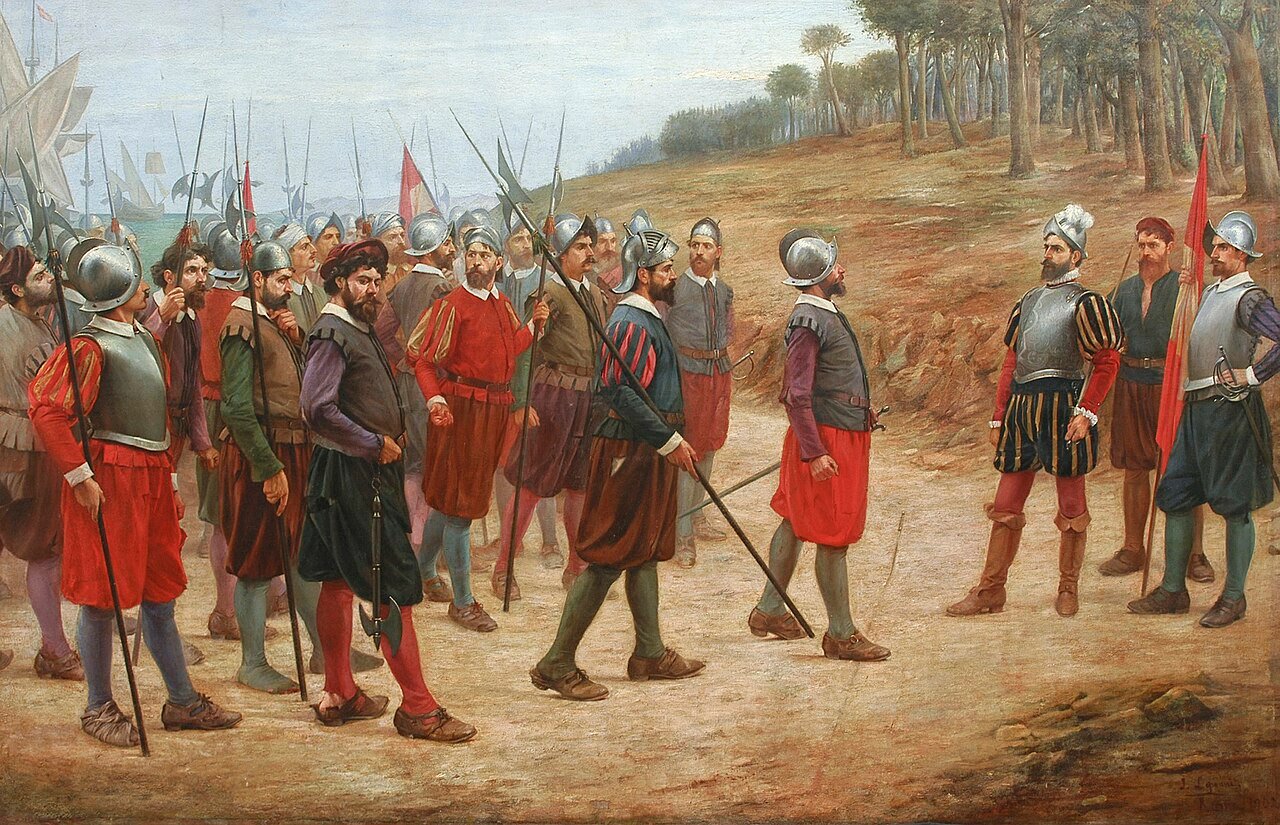
Juan Lepiani, Public domain, via Wikimedia Commons
The quality of the materials and meticulous manufacturing were crucial for the effectiveness and durability of the conquistadors’ equipment. The most prized element was steel, especially that produced in Toledo, Spain. This steel, famous for its flexibility and hardness, was the preferred material for swords and armour pieces.
Forging steel involved complex processes of heating, hammering, and tempering, often using techniques passed down through generations, resulting in exceptionally strong and sharp sword blades and armour plates capable of deflecting heavy blows. For less elaborate armours and helmets, lower quality irons were used, but still superior to indigenous defensive materials. Quilted doublets, on the other hand, were made from multiple layers of pressed cotton, firmly sewn to create an elastic and shock-absorbing barrier.
Shields combined wood or wicker with several layers of tanned and hardened ox leather, often reinforced with metal elements. For firearms, gunpowder, though of European manufacture, had to be transported and maintained with extreme care to preserve its potency. This combination of advanced materials and refined craftsmanship gave the conquistadors an undeniable technical advantage.
Maintenance and Preservation of Colonial Armament and Attire
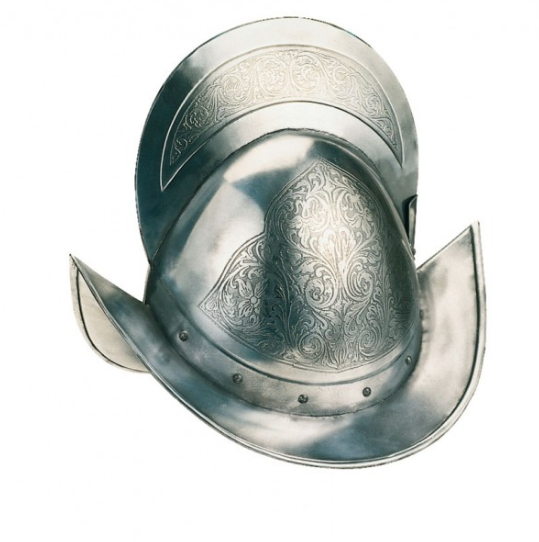
The maintenance and preservation of weaponry and attire were essential tasks for the conquistadors, especially given the tropical climatic conditions and the absence of specialised armouries in the New World.
The steel of swords and armour was particularly susceptible to oxidation caused by humidity. To combat this, pieces had to be regularly cleaned, polished, and greased with animal fat or vegetable oils. Any nicks or damage to sword blades or armour plates were repaired with a hammer and files, or, in more serious cases, by resorting to improvised blacksmiths in settlements. Firearms required even more meticulous care.
Gunpowder was very sensitive to moisture, so it was stored in sealed containers, and arquebuses had to be thoroughly cleaned after each use to remove gunpowder residue that could corrode the barrel or jam the mechanism. Fuses and flints also had to be checked and replaced regularly.
Leather and cotton clothing, although more resistant to rust, was prone to rotting from humidity and mould. It was dried in the sun whenever possible, aired out, and repaired with leather or cloth patches. This constant maintenance was vital to ensure that equipment was always in optimal condition for combat and survival.
Comparison: Conquistador Weapons vs. Indigenous Defence
The confrontation between conquistador weapons and indigenous defence was a clash of very different technologies and war philosophies. The Spanish had the advantage of steel weapons, such as swords, daggers, and spearheads, which offered vastly superior cutting and penetration capabilities. Their metal armours, even the lighter ones, provided considerable protection against native weapons. Added to this were firearms and cavalry, which generated an overwhelming psychological and tactical impact.
| Conquistador Weapons | Materials | Characteristics & Advantages |
|---|---|---|
| Rapier / Zweihänder | Toledo Steel | Great cutting and thrusting capability, durable, light. |
| Arquebus | Steel, wood, gunpowder | Lethal impact at close range, psychological effect of thunder. |
| Plate Armour / Chainmail | Steel | High protection against cuts and thrusts, resistant. |
| Crossbow | Wood, string, steel | Great penetration force, silent, slow reload. |
| Cavalry Lance | Wood, steel tip | Reach, penetration power, used from horseback to overrun. |
In contrast, indigenous defences were based on locally available materials. Aztec macuahuitl swords, with sharp obsidian blades embedded in wood, were devastating on impact, capable of severing heads, but were fragile and easily blunted. Their shields, made of wood, pressed cotton, or leather, offered limited protection. Spears and arrows with flint or obsidian tips could be lethal but lacked the piercing power of steel.
The absence of cavalry and firearms in the indigenous arsenal also marked an immense difference. Technological disparity, though not the sole factor, was an undeniable contributor to the outcome of confrontations.
The Temporal Evolution of Spanish Conquistador Weapons and Attire
The evolution of Spanish conquistador weaponry and attire reflects their adaptation to the conditions and challenges of the New World. From Columbus’s first voyages to the consolidation of the viceroyalties, equipment transformed, retaining traditional elements but incorporating innovations forced by experience.
| Era | Event |
|---|---|
| Initial Phase of Exploration (Late 15th Century – Early 16th Century) | |
| 1492 – 1500 | Columbus’s first voyages: Use of swords, crossbows, bows, and rudimentary chainmail. Emphasis on exploration. |
| 1500 – 1519 | Caribbean Settlements: Development of the “Indies militia”. Adaptation of armour to warm climates with more use of shields and open helmets. |
| Period of Great Conquests (16th Century) | |
| 1519 – 1521 | Conquest of Mexico (Cortés): Rise of the arquebus due to its psychological impact. Predominance of the rapier and daggers. Massive introduction of cavalry. |
| 1520 – 1540 | Expansion into Peru and other territories: Increased use of quilted cotton doublets due to practicality. Effective use of falconets in sieges. |
| 1540 – 1570 | Stabilisation of the first viceroyalties: Standardisation of some equipment. Three-quarter armour begins to be more common for the elite. |
| Colonial Consolidation and Defence (Late 16th – 17th Century) | |
| 1570 – 1600 | Chichimeca Wars and Philippines: Lighter weaponry adapted to guerrilla warfare. Greater importance of portable firearms. |
| 1600 – 1650 | Fortifications and protection of trade routes: Reinforcement of artillery in strategic enclaves. Greater use of pikes and bucklers in infantry. |
| 1650 – 1700 | Relative decline of Spanish power: Innovations in firearms (muskets) but less emphasis on heavy armour. |
Forge Your Own Legend: Relive the Era of Conquest
The history of the Spanish conquistadors is a testament to daring, strategy, and undoubtedly, military equipment that defined an era. If you’re passionate about historical reenactment, collecting, or simply wish to connect with the might of those times, in our online shop you’ll find a curated selection of replicas of medieval weapons, swords, armour, and historical accessories.
From an authentic steel-forged rapier to a faithful decorative arquebus, each piece is designed to evoke the spirit of the conquest. Immerse yourself in the past and experience history firsthand. Discover today the piece that will transport you to the epic of the Spanish Conquistadors.
Explore Spanish Conquistador Helmets | Do you want the armour worn by Spanish Conquistadors?