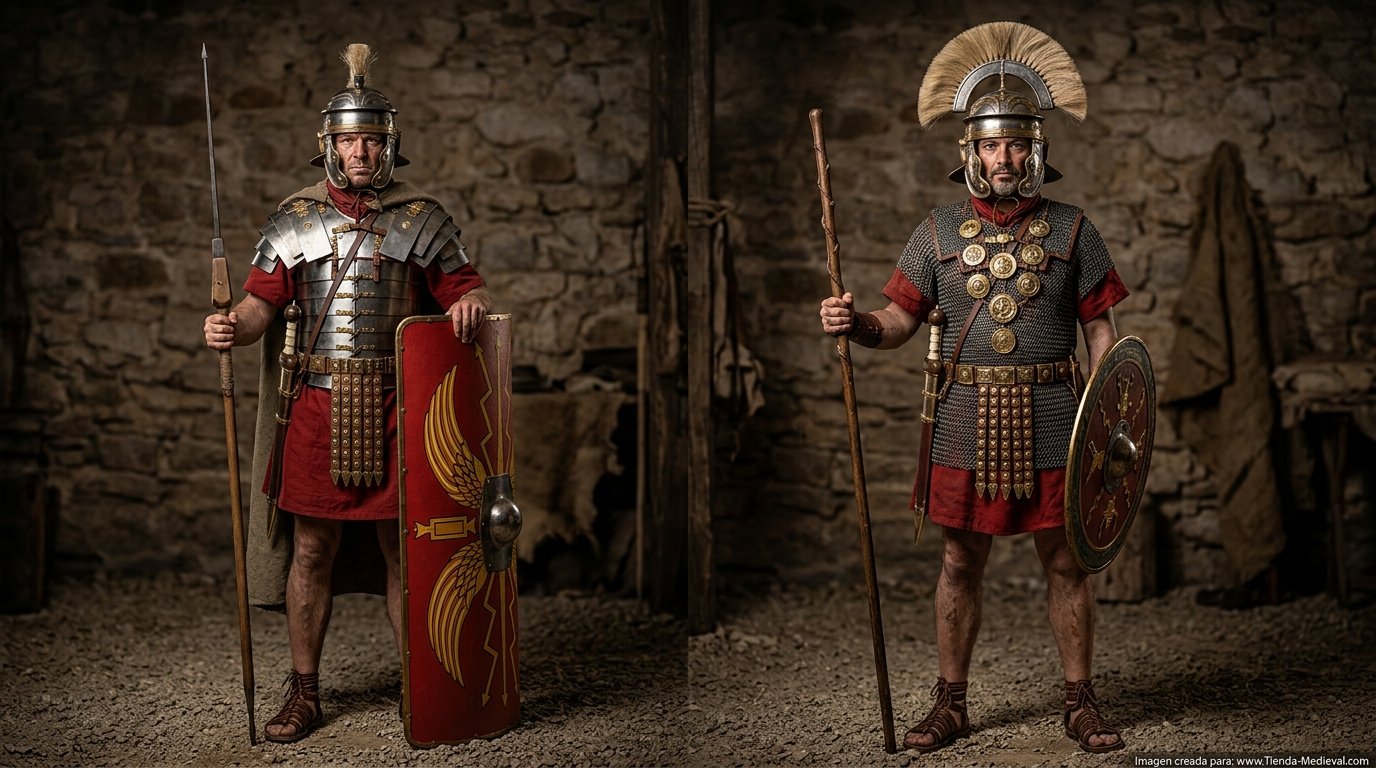
Differences Between Roman Legionaries and Centurions
The Roman army was one of the most efficient war machines of antiquity, and its hierarchical structure made the difference in countless battles. Among its ranks, two figures stand out for their strategic importance: legionaries and centurions. Although both were part of the same military machinery, their roles, equipment, and responsibilities were notably different.
In this article, we will explore in depth the differences between these two pillars of the Roman army, analysing their weaponry, historical functions, and symbolism in military culture. If you are passionate about military history or a collector of historical weapons and armour, this guide will help you understand the unique value of each of these ancient warriors.

Origins and Historical Evolution
Legionaries emerged as the backbone of the Roman army during the Republic, evolving from citizen-soldiers to professionals under the Empire. Their numbers varied historically, but during Augustus’ time, it is estimated there were between 25 and 30 active legions, each composed of around 5,000 legionaries. Meanwhile, centurions appeared as intermediate officers, initially commanding groups of 100 men (hence their name), though later their rank became more associated with experience than the exact number of subordinates.
- Legionaries: Recruited from Roman citizens, their service lasted 25 years
- Centurions: Promoted from the ranks or directly appointed for merit
- Marian Reforms (107 BC): Professionalisation of the army
- Imperial period: Greater specialisation of roles
Equipment and Weaponry Compared
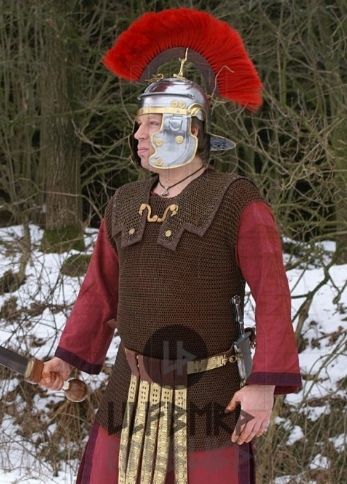
While legionaries carried standardised equipment, centurions enjoyed certain privileges denoting their superior rank. The famous lorica segmentata (plate armour) was common among imperial legionaries, but centurions could afford more elaborate versions or alternatives like the lorica musculata.
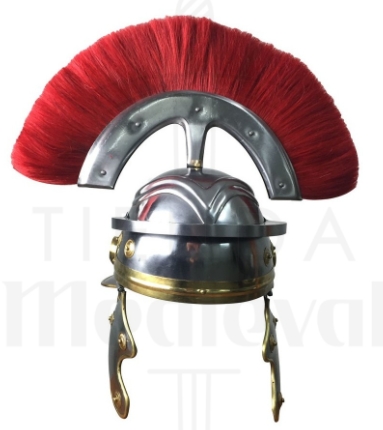
Element Legionary Centurion Armour Standard lorica segmentata Decorated variants or musculata Helmet Basic galea Distinctive transverse crest Sword Common gladius Gladius with decorated hilt
Functions and Responsibilities in Combat
The legionary was primarily a heavy infantry soldier, trained to fight in compact formation. His main function was to maintain the cohesion of the battle line following orders from superiors. In contrast, the centurion was responsible for:
- Training and disciplining the legionaries under his command
- Relaying tactical orders at the century level
- Maintaining troop morale
- Making immediate tactical decisions on the battlefield
Hierarchy and Military Promotion
The Roman military career had fundamental differences between these two roles. While a legionary could aspire to become immunes (specialised soldiers with privileges) or principales
Centurions were organised in a complex internal hierarchy:
- Centurions of cohorts II-X (less prestigious)
- Centurion of the first cohort (more experienced)
- Primus pilus (senior centurion of highest rank)
Symbolism and Historical Legacy
In modern popular culture, both legionaries and centurions have been represented in various ways, though not always accurately. For collectors of historical weapons and armour, understanding these differences is essential to properly value reproductions:
- Authentic centurion helmets feature transverse crests
- Centurion swords often bore inscriptions
- The command staff (vitis) was a symbol of authority
- Phalerae (decorations) denoted rank and achievements
What Every Collector Should Know About Legionaries and Centurions
Were centurions always experienced veterans?
Not necessarily. Although many rose through the ranks, some were directly appointed through political or family connections, especially during the late Republic. However, higher-ranking centurions (like the primus pilus) usually had decades of experience.
What weapons did legionaries use that centurions did not?
Legionaries carried the pilum (heavy javelin) as a ranged weapon, while centurions generally did not use it, preferring to focus on tactical command. However, both carried gladius as their main weapon.
How was a centurion visually distinguished on the battlefield?
Besides the transverse crest on the helmet, centurions wore greaves (leg protections), a more elaborate belt (balteus), and often a higher-quality cloak (paludamentum) than legionaries.
What tactical formation was most common for legionaries?
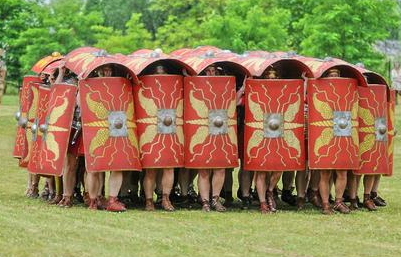
The testudo (tortoise) formation was characteristic, where legionaries raised their shields to create complete protection against projectiles. Centurions supervised this formation but did not usually participate directly in it.
What was the salary difference between a legionary and a centurion?
Historical sources suggest a centurion could earn between 5 and 15 times more than a common legionary, depending on seniority and position in the centurion hierarchy.
Discover Our Selection of Differences Between Roman Legionaries and Centurions


Your Connection to Roman Military History
Understanding these differences not only enriches your historical knowledge but also allows you to better appreciate period weapon and armour reproductions. In our shop, you’ll find faithful replicas of both legionary equipment and centurion insignia, each piece crafted with maximum respect for historical details. Ready to add an authentic piece of Roman military glory to your collection? Explore our selections and discover the legacy of these legendary warriors.
DO YOU WANT THE BEST ROMAN SWORDS? | DECORATE YOUR SPACE WITH ROMAN BANNERS