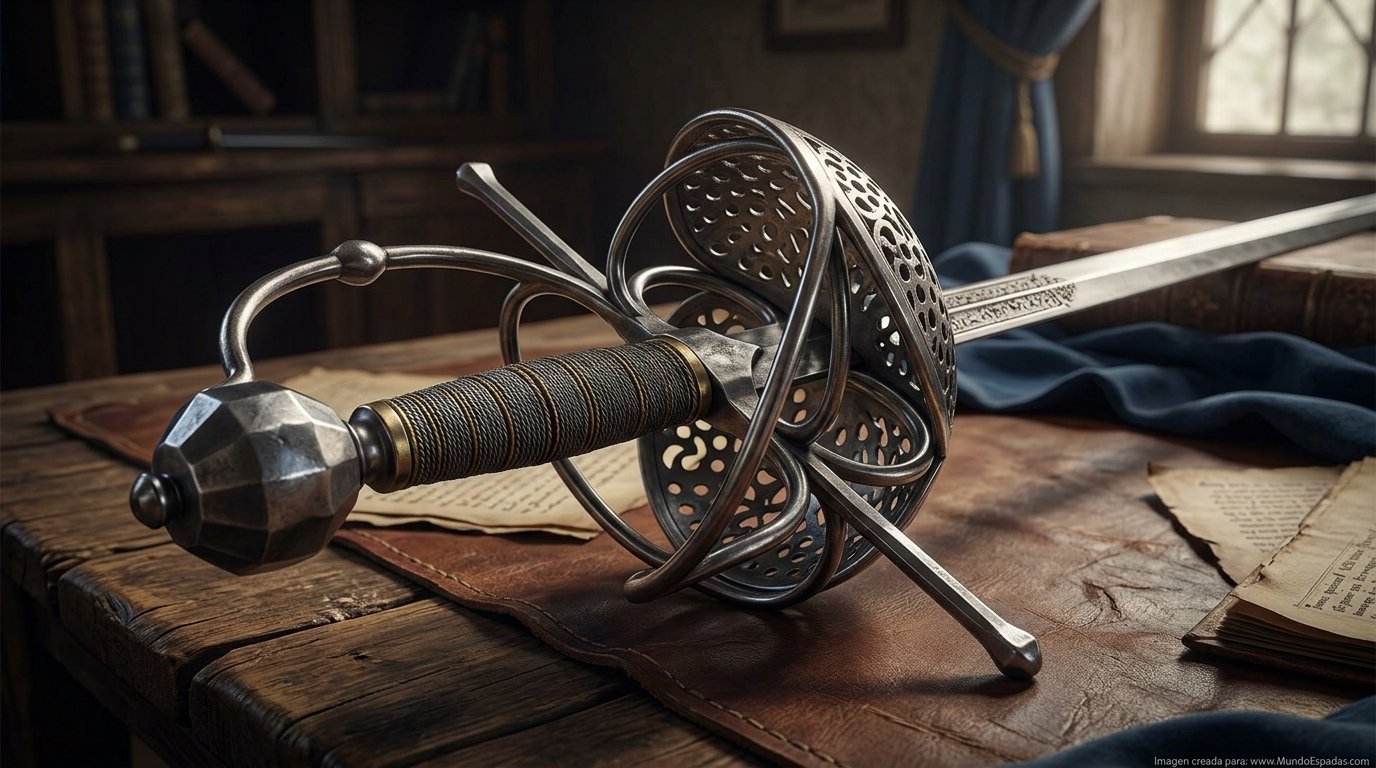
In the fascinating world of historical arms and collectible replicas, the Pappenheimer sword stands as an emblem of 17th-century armourial craftsmanship. Its distinctive and elaborate hilt, which gives it its name, is its most recognisable feature, designed to offer unparalleled protection to the wielder. This unique piece not only represents a milestone in the evolution of swords of the era but also boasts key features of the Pappenheimer sword that make it highly attractive to enthusiasts and collectors.
The Heart of the Pappenheimer: Origin and Evolution of its Design
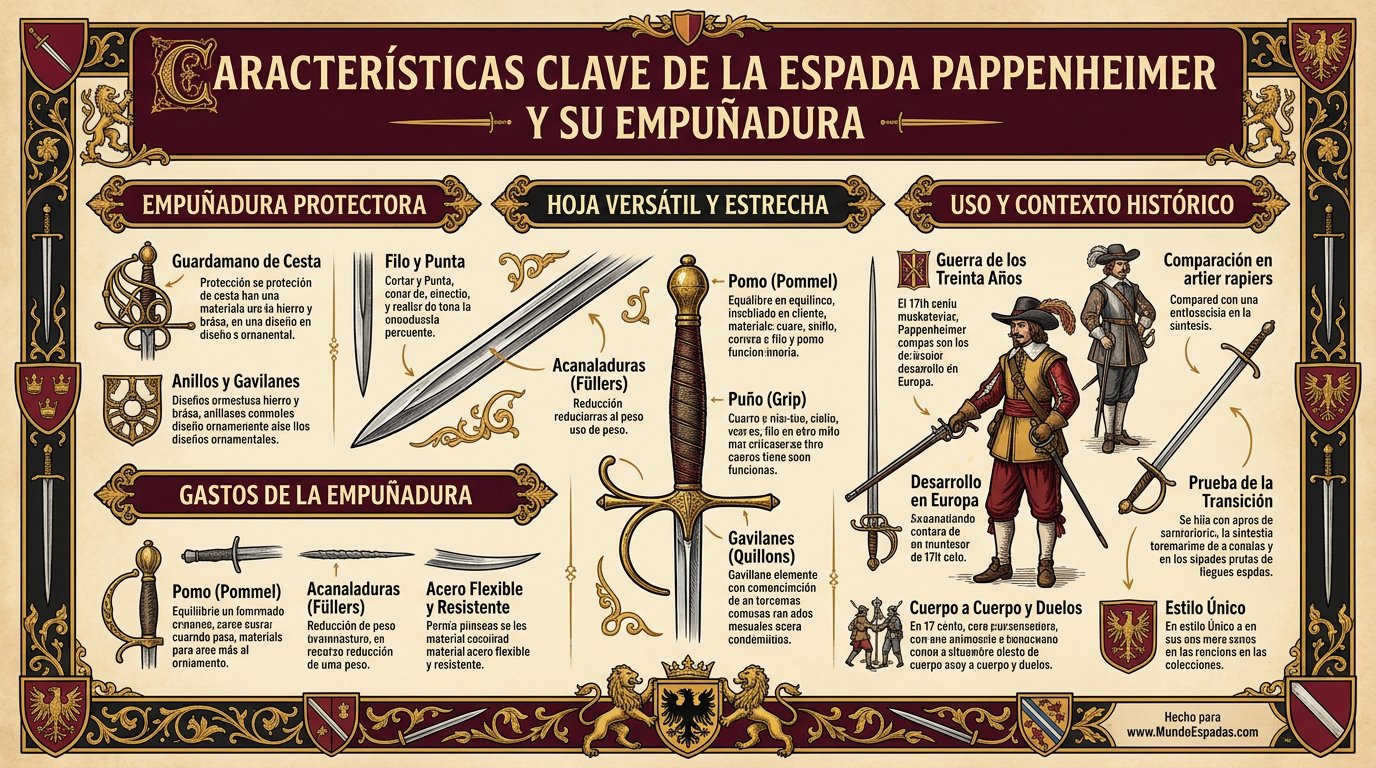
The Pappenheimer sword, also known as the Pappenheimer Officer’s Sword, owes its name to Count Gottfried Heinrich zu Pappenheim, a brilliant and feared Imperial Field Marshal during the Thirty Years’ War (1618–1648). While he didn’t create the sword, his adoption of it and that of his troops contributed to the dissemination and popularisation of this particular design, making it a symbol of high-ranking military personnel of the time.
The design of the Pappenheimer sword emerged as a direct evolution of rapiers and broadswords, aiming to combine the thrusting capability of the former with the robustness and guard protection of the latter. Its development took place during a period of intense innovation in bladed weapon design, driven by new combat tactics and the increasing adoption of lighter armour that demanded greater hand protection. Thus, the hilt became the focus of unprecedented defensive engineering for its time. This evolution represented a qualitative leap in combatant safety, offering superior defence against attacks aimed at the hand.
The Pappenheimer sword established a standard of protection that would influence later designs and marked a turning point in the manufacture of military and duelling swords. Its functionality and aesthetics made it stand out on European battlefields.
Peculiarities of the Blade and its Balance with the Pappenheimer Hilt
The blade of the Pappenheimer sword is a crucial component that perfectly complements its distinctive hilt. Generally, these blades were double-edged and quite straight, though with a slight taper that pronounced towards the tip. This configuration allowed for remarkable versatility, being efficient for both precise thrusts and powerful cuts, adapting to various combat situations. Its length usually varied, typically ranging from 80 to 95 centimetres, making it manageable in foot combat and effective against infantry or in duels.

The width of the blade remained constant for much of its length, with a robustness that ensured durability and penetration capability. This shape facilitated an equitable distribution of weight along its length. The balance of the Pappenheimer was a key point of its design, vital for its operability. Despite the elaborate and often heavy guard, armourers achieved a balance point close to the hilt, allowing for quick and precise handling.
This balance allowed the swordsman to parry and counter-attack fluidly and without excessive effort. The interaction between the robustness of the blade and the protection of the hilt created a formidable combat tool, where each element enhanced the other.
The Emblematic Pappenheimer Hilt: Functionality and Style in Detail
The Pappenheimer hilt is, without a doubt, the most defining and distinctive feature of this sword, a true marvel of 17th-century defensive metallurgy. Its design is not only aesthetically impressive but also deeply functional, offering comprehensive protection to the user’s hand, something crucial in an era where duels and military confrontations were common. This hilt is characterised by a complex lattice of metal bars and plates that form a cage around the hand. The main components include: *
Arched guard arms:
Two or more robust arches extending from the pommel and cross-guard, enveloping the hand and covering the knuckles and the side of the fist. These arms were fundamental for deflecting attacks aimed at the hand. *
Rings and side plates (Shell Guards):
Metal rings or small convex plates (known as “shells” or “shell guards”) were often incorporated to protect the back of the hand and fingers. These protected against scrapes from enemy blades. *
Pins and cross-bars:
A set of small horizontal or diagonal bars that connected the guard arms, creating a defensive grid that prevented the tip of the enemy’s sword from passing through. The complexity of the Pappenheimer guard was not merely ornamental. Each element had a defensive purpose, from the fine pins that protected the spaces between the fingers to the robust bars that absorbed the impact of direct blows. The primary objective was to safeguard the limb holding the weapon, allowing the swordsman to maintain control and execute offensive manoeuvres with greater security. The design varied between subtle elegance and robust structures, but always maintaining a high degree of protection.
Types and Variations of the Pappenheimer Guard: A Comparative Study
The Pappenheimer guard, despite its fundamentally recognisable design, exhibited a remarkable diversity of styles and variations that reflected regional preferences, contemporary trends, and the skills of individual armourers. These differences, though sometimes subtle, marked the distinction between one piece and another, and are a source of fascination for collectors. We can classify the variations based on several elements: * The complexity of the cage: Some Pappenheimers featured a denser guard, with a greater number of interwoven bars and pins, offering almost complete protection. Others opted for a more spartan design, with fewer elements, seeking a balance between protection and lightness. * Decorative elements: While functionality was paramount, aesthetics also played a role. Many guards incorporated engravings, openwork, or inlays that showcased the artisan’s skill and the owner’s status. Decorations could include floral motifs, geometric patterns, or even representations of heraldic shields. * Side plates (Shell Guards): The shape and size of the shells or plates that protected the back of the hand varied considerably. Some were small and discreet, while others were large and elaborate, with oval shapes, stylised seashells, or even perforated designs that lightened the weight and embellished the piece. Below is a comparative table of some common features among the variants:
| Feature | Standard Variant | Elaborate Variant | Military Variant |
|---|---|---|---|
| Main Material | Carbon steel | Steel with inlays (silver, brass) | Tempered steel |
| Number of Curved Supports | 2 to 3 | 3 to 4 (thinner) | 2 (thicker) |
| Knuckle Protection | Closed arches | Arches with openwork | Robust arches |
| Side Plates (Shells) | Small, oval | Large, ornate | Functional, unadorned |
| Average Guard Weight | 300-400 grams | 400-500 grams | 350-450 grams |
These variations illustrate the evolution and adaptation of the Pappenheimer to different needs and tastes, from the pragmatism of the battlefield to the refinement of a personal collection.
Mastering the Pappenheimer: Combat Techniques and Grip on the Battlefield

Mastering a Pappenheimer sword on the battlefield or in a duel required not only skill but also a deep understanding of the fencing techniques of the era. Its design, and particularly its complex hilt, directly influenced how it was wielded. The protection offered by the guard allowed for greater offensive aggression, by reducing the risk of hand injuries.
The Pappenheimer’s grip allowed for several positions, but the most common involved a firm grip with the hand encased by the intricate cage of its hilt. Some swordsmen could pass a finger (usually the index) over the cross-bar, known as the “ricasso,” to gain greater control and precision at the tip, which was possible thanks to the additional protection of the guard. This optimised blade handling. Combat techniques with the Pappenheimer focused on a lethal combination of thrusts and cuts. The sharp tip was ideal for penetrating light armour or for reaching vital points on a less protected opponent.
Cuts, though not as prioritised as with heavier swords, remained effective, especially for disarming or creating openings in an adversary’s defence. The ability to alternate between rapid thrusts and controlled cuts made it a versatile and feared weapon. The Pappenheimer also excelled in parrying and counter-attacking.
The robust guard could safely deflect blows from enemy swords, protecting the fencer’s hand. This security encouraged the use of deceptive movements and feints, allowing the wielder to capitalise on enemy openings. Its agility, despite the protection, allowed for quick manoeuvres and fluid guard changes, essential for survival in combat.
Discover our selection featuring the key characteristics of the Pappenheimer sword and its hilt


The Chronology of Innovation: From Military Sword to Collector’s Gem
The Pappenheimer sword is much more than a mere weapon; it is a testament to the engineering and evolution of military design in the Early Modern period. Its history intertwines with some of Europe’s most significant conflicts, leaving a legacy that endures to this day, as an object of study and collection. Its development and popularisation mark a turning point in European armourial craft, transcending its purely warlike function to become an object of art and status.
| Era | Event |
|---|---|
| 16th Century – Pappenheimer Precursors | |
| Late 16th Century | Development of rapiers: Thrusting becomes more important. Cup and loop guards begin to offer better hand protection. |
| 1580-1600 | Introduction of more elaborate guards: Designs seeking greater hand protection without sacrificing agility. |
| 17th Century – Pappenheimer’s Heyday and Spread | |
| Early 17th Century | Genesis of the Pappenheimer design: First appearances of improved cage-type guards, though not yet with the specific name. |
| 1618-1648 | Thirty Years’ War: The sword is widely adopted by officers and cavalry, popularised by figures like Count Pappenheim. |
| 1620s-1640s | Standardisation and variability: The design refines, various regional and artisanal variants emerge. |
| Mid-17th Century | Influence on other designs: The Pappenheimer guard inspires other military and civilian swords, such as some European broadswords. |
| 18th-21st Centuries – Military Decline and Collector’s Resurgence | |
| Late 17th Century | Gradual military obsolescence: Improved artillery and infantry firearms reduce the importance of the sword on the battlefield. |
| 18th Century | Transition to fashion and duelling swords:
Want to see more Basket-hilt Swords? | Get your Cup-hilted Rapier |