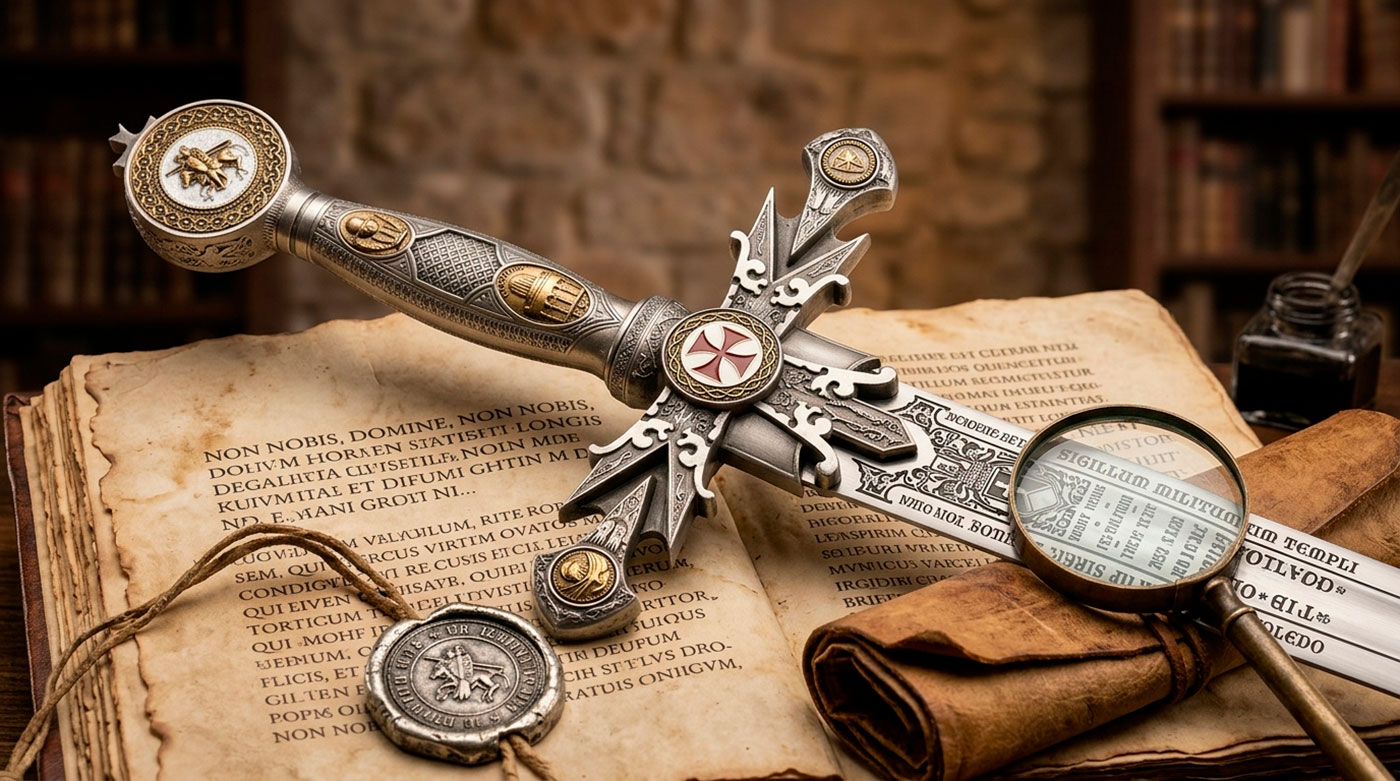
Toledo, the city of the three cultures, guards within its forges an enigma engraved in steel that has captivated historians and collectors for centuries. By analyzing the meaning of the inscriptions on Templar swords from Toledo, we enter a labyrinth of faith and war where every chiseled letter had a sacred purpose. These Toledo Templar swords were not simple combat tools but liturgical objects of immense spiritual power.
The Mystery of the Inscriptions on Templar Swords from Toledo
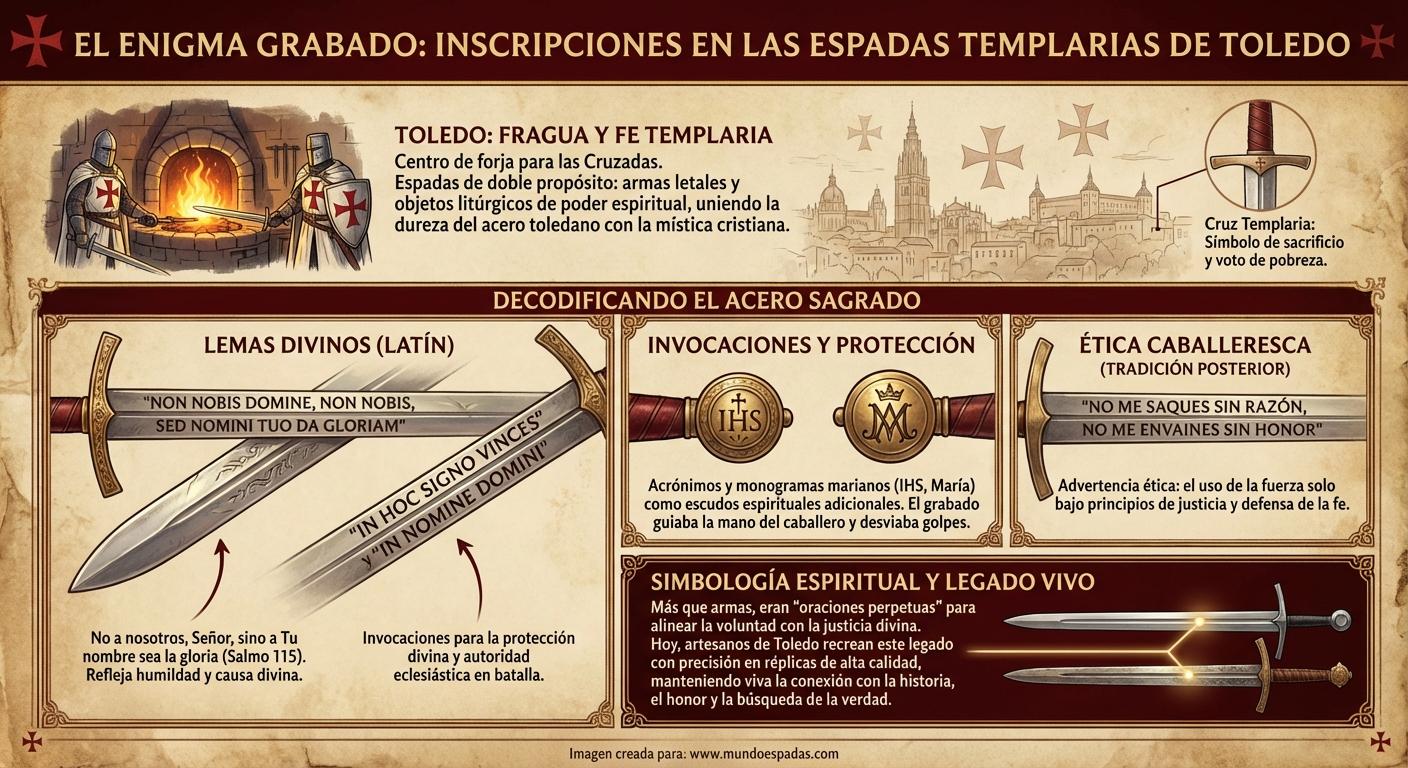
Medieval sword inscriptions often feature complex sequences of letters and Latin abbreviations that confuse the untrained eye. However, for the Knights Templar, swords like these bore mottos such as “In Hoc Signo Vinces” or Marian invocations seeking divine protection in the heat of battle. Templar sword symbology is also manifested through the iconic Templar cross, often engraved on the pommel or at the start of the blade, symbolizing sacrifice and redemption.
Exploring the history of Templar swords forces us to decipher these marks that transcend aesthetics. Many crossed sword inscriptions found on authentic pieces reveal internal codes of the Order that still spark academic debate today. Toledo Templar swords represent the pinnacle of medieval metallurgy, joining the hardness of Toledan steel with the mysticism of Christianity. We promise to unveil the secrets these blades whisper, analyzing every stroke that defined the identity of a warrior monk willing to die for his faith, carrying his devotion marked for eternity.
History of Templar Swords and Their Link to Toledo
The Order of the Poor Knights of Christ and of the Temple of Solomon, known as the Knights Templar with swords in hand, forged their legend in the sands of the Holy Land. Founded in the early 12th century to protect pilgrims, this military-religious order required weaponry of the highest caliber. This is where the history of Templar swords and their indissoluble connection with the Iberian Peninsula comes in. Toledo stood as the epicenter of forging during the Crusades, thanks to its millenary tradition in steel treatment and its metallurgical secrets, unique in the medieval world.
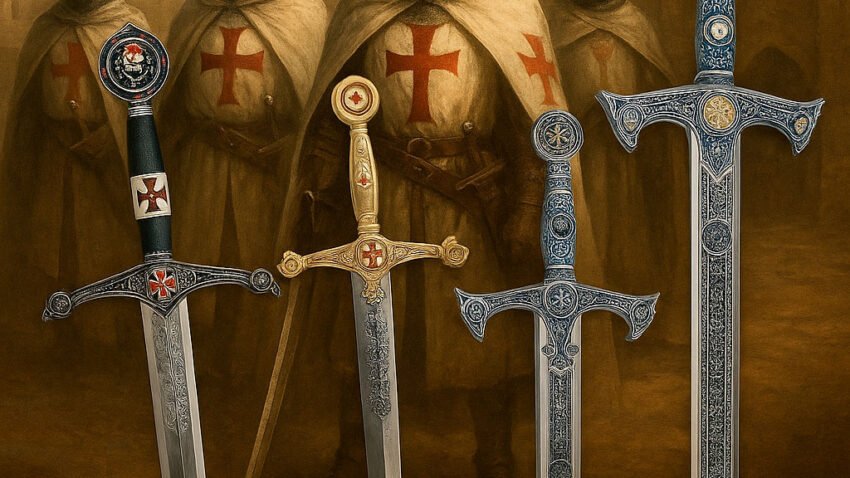 Toledo Templar swords were coveted for their flexibility and lethality. Toledan master swordsmiths, influenced by Arab and Christian techniques, perfected a metal capable of resisting impacts without breaking—a decisive factor in a knight’s survival. For the Knights Templar, the sword was an extension of their arm and a tool of divine justice. The meaning of the inscriptions on Toledo Templar swords lies precisely in this duality: the steel represented physical strength, while the engravings invoked the spiritual fortitude necessary to face the infidel.
The presence of the Templar cross on pieces forged in this Castilian city was no coincidence. Toledo was a strategic point of the Reconquista, and Templar sword symbology served as a constant reminder of their vow of obedience and poverty. Observing the medieval sword inscriptions of the time, we understand that each of these Toledo Templar swords was a personalized masterpiece. These crossed sword inscriptions usually included the initials of the Order or fragments of the Psalms of David, thus consolidating the mystical link between the Toledan blacksmith, the sacred warrior, and the will of God on the battlefield.
The Most Common Inscriptions on Templar Swords from Toledo: Decoded
When analyzing the meaning of the inscriptions on Toledo Templar swords, we find a coded language that served as a moral compass for the warrior. It was not mere decoration; every word engraved on Toledo Templar swords functioned as a perpetual prayer. The most famous of all is the phrase “Non Nobis Domine, Non Nobis, Sed Nomini Tuo Da Gloriam.” This motto, taken from Psalm 115, summarizes the essence of the Order: “Not unto us, O Lord, not unto us, but unto Thy name give glory.” It reflects the absolute humility of the monk who renounces personal ambition for a higher divine cause.
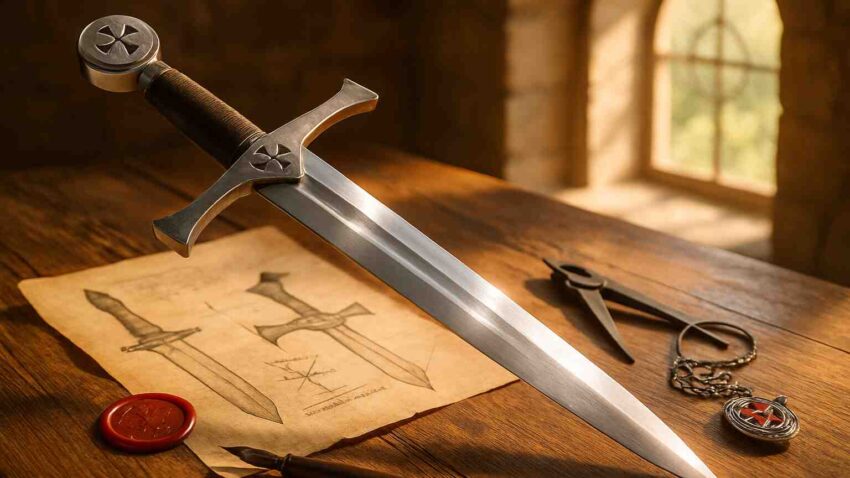 Another recurring variant in medieval sword inscriptions is “In Nomine Domini” (In the name of the Lord). This phrase imbued the steel with ecclesiastical authority, transforming violence into an act of defensive sacrament. For the Knights Templar, swords engraved with such mottos were living relics. On the other hand, a common motto in the history of Toledan Templar swords, though more widespread in later periods but with deep roots in knightly ethics, is “Do not draw me without reason, do not sheathe me without honor.” This ethical warning underscored that the use of force was only justified under principles of justice and strict defense of the Christian faith.
Templar sword symbology also included complex acronyms that were difficult to interpret initially. We often find engravings combining the Templar cross with letters like ‘IHS’ or Marian protective monograms. These crossed sword inscriptions served as an additional spiritual shield; the knight firmly believed that the sacred text could deflect enemy blows and guide his hand. The Toledo Templar swords we preserve today show us that the engraving process was as vital as the tempering of the steel. Every groove in the blade reinforced the warrior’s commitment to his destiny, reminding him that his life belonged entirely to God and that his final honor depended on the righteousness with which he wielded his precious weapon from Toledo.
Spiritual Symbolism, Knightly Honor, and Legacy in Modern Replicas
The profound symbolism emanating from Toledo Templar swords transcends mere warfare function to become a reflection of the soul’s temperance. In deciphering the meaning of the inscriptions on Toledo Templar swords, we observe that every message sought to align the warrior’s will with divine justice. These medieval sword inscriptions acted as a constant reminder that a knight’s power resided not in his physical strength, but in his honor and the purity of his intentions. For the Knights Templar, swords and faith were inseparable, forming a mystical unity that defined their sacred existence.


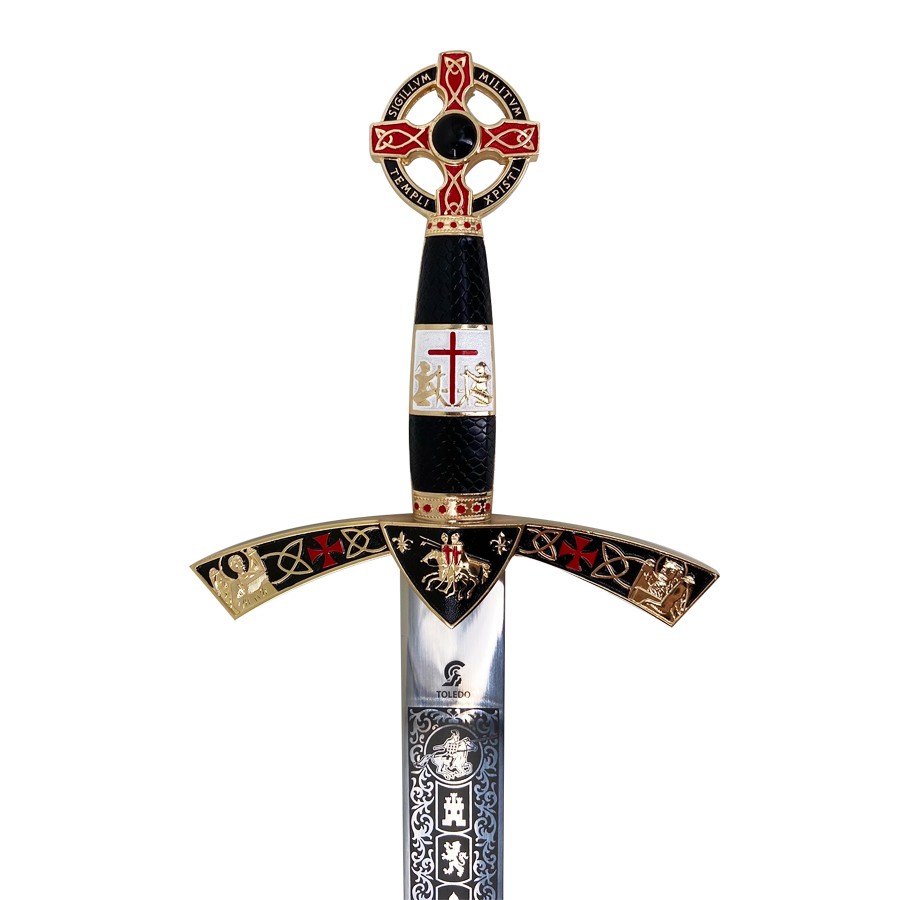


Today, the legacy of Toledo Templar swords lives on with renewed vigor through high-quality modern replicas. Contemporary Toledo artisans continue to use traditional methods to recreate Templar sword symbology with amazing precision. By acquiring one of these pieces, history enthusiasts not only obtain a decorative object but a tangible connection to Templar sword history. These reproductions typically include the Templar cross and the most emblematic crossed sword inscriptions, respecting the original design to preserve the aura of mystery and respect that surrounded the Order.
This revival of interest in the swords of the warrior monks underscores the relevance of their values. The search for truth, sacrifice, and protection of the weak, symbolically engraved in the steel, continues to resonate in the modern world. Owning a sword with the motto “Non Nobis Domine” is to keep alive a tradition of metallurgical excellence and spirituality that put Toledo on the map of the medieval world, ensuring that the Templars’ message is never lost to the oblivion of time.
VIEW ALL TEMPLAR SWORDS | SWORDS MADE IN TOLEDO BY MARTO | SWORDS MADE IN TOLEDO BY J.L. RUBIO