
Humanity’s rich history is woven with threads of epic battles, chivalrous deeds, and the daily life of a world that, though past, still resonates in our present. In our shop, specialising in medieval arms, swords, armour, and historical accessories, we understand the deep connection between the past and the present. One of the most fascinating manifestations of this legacy is medieval sayings, phrases imbued with the popular wisdom of bygone eras that, surprisingly, still form part of our everyday language. These proverbs offer us a direct window into the mindset, values, and experiences of knights and commoners, revealing a universe where honour, danger, and survival dictated the rules.
Exploring the origin of these expressions not only enriches our historical knowledge but also allows us to appreciate the ingenious way in which our ancestors encapsulated universal truths in concise phrases. Each saying is a micro-story, a fragment of life extracted from jousts, sieges, or the simple daily routine in castles and villages. Through this linguistic journey, we will discover how the forging of steel and skill in combat influenced the way we think and speak today.
The Echo of the Past: Origins and Presence of Medieval Sayings in Current Language
The Middle Ages, a period spanning approximately the 5th to the 15th century, was a time of profound social, political, and cultural transformations. During these centuries, much of the Castilian language we speak today was forged, and with it, a vast collection of medieval phrases that encapsulate the human experience of those times. It is astonishing how proverbs arising from such specific contexts as medieval sayings, proverbs that allude to chivalry, arms or feudal customs, have managed to endure and adapt to become part of our modern lexicon, often without us being aware of their origin.
The survival of these sayings underscores the universality of certain human experiences: courage, deceit, diligence, or the lack thereof. Originally transmitted orally, from generation to generation, these proverbs served as pedagogical tools, moral guides, and humorous outlets. Their concise structure and memorable content facilitated their diffusion and entrenchment in popular culture. We can observe how the culture of arms and the life of a knight, omnipresent elements in the Middle Ages, left an indelible mark on these expressions, which we now use to describe situations very different from those of their genesis.
The Linguistic Resilience of the Age of Knights

The ability of a saying to transcend centuries of linguistic and cultural changes is a testament to its expressive power. Many of these proverbs originated in a context where life unfolded between the protection of the castle, the threat of incursions, and agricultural routine. For example, terms related to war or justice filtered into common language, reflecting the centrality of these themes in medieval society. The adoption of these phrases today, often stripped of their original context, demonstrates the innate adaptability of language and the wisdom contained in these small capsules of history.
The influence of poets, troubadours, and preachers was also crucial in solidifying and expanding the use of these expressions. Every story, poem, or sermon was an opportunity to insert and popularise a new saying or reinforce an existing one. This created a shared network of meaning that united people, from the most humble peasants to the most elevated nobles, through a common language enriched with the wisdom of the centuries.
Of Arms and Honour: Medieval Sayings Inspired by Knightly Equipment
The equipment of the medieval knight, from the imposing tournament armour to the sharp functional sword, was much more than mere war attire; it was a symbol of status, protection, and, above all, honour. It is not surprising that many medieval sayings have their origin in these elements, reflecting both their practical use and their cultural significance. These expressions allow us to connect directly with the life of a warrior, understanding their preparation and the risks they took in each combat.
One of the clearest examples is the saying “To go ‘de punta en blanco'” (to be dressed to the nines, lit. “pointy and white”). This phrase, which today means to dress elegantly, comes directly from the meticulous preparation of a knight for battle. Originally, it alluded to the complete armour, neat and shining (“blanca” – white), and the sharp and gleaming weapons (“de punta” – pointed), ready for combat. A knight who went “de punta en blanco” was impeccably equipped and prepared for any challenge, showing their commitment and gallantry. This expression encapsulates the importance of always being ready and presentable, both on the battlefield and in the social life of the court.
The Symbolism of Steel and Leather in Popular Wisdom
Every piece of a knight’s equipment had a critical role and, therefore, left its mark on language. The sword, the weapon par excellence, is the protagonist of “To be between the sword and the wall”. This saying evokes the terrifying scenario of a swordsman cornered against a wall, with no possibility of escape, facing certain death or a humiliating surrender. Today, we use it to describe a dead-end situation, with no apparent way out, where options are scarce and unfavourable. It reflects the despair of a duel where territorial advantage was as crucial as skill. Medieval fencing, which laid the groundwork for this expression, was a complex and deadly martial art, whose rules and tactics were reflected in common speech.
| Medieval Saying | Equine/Armament Origin | Current Meaning |
|---|---|---|
| “Ir de punta en blanco” | Polished and sharpened armour and weapons. | To dress elegantly and immaculately. |
| “Estar entre la espada y la pared” | Swordsman cornered in a duel. | To face a no-win situation. |
| “Velar armas” | Vigil of the aspiring knight by his equipment. | To prepare intensely for an important event. |
| “Luchar a capa y espada” | Duels where the cape and rapier sword were used. | To vehemently defend a stance or cause. |
Another example is “Velar armas” (to watch over one’s arms), which takes us to the initiation rite of a knight. An aspirant would spend the night in vigil, praying and guarding their weapons in a chapel before being invested. This solemn act of preparation and reflection, essential to the knight’s spirit, is today applied to the intense dedication and concentration prior to an important event. The functional Musketeer sword, with its elegant guard, could have been one of those watched-over weapons, symbolising the fusion of devotion and skill.
The Forge of Wisdom: Popular Sayings Born in Battle and Tournament
The Middle Ages was a time of constant conflict, where battles and tournaments were recurring events that forged the destiny of kingdoms and the spirit of knights. It is natural, then, that many of the medieval phrases most deeply rooted in our language come directly from these fierce jousts and confrontations. The medieval sayings born in these scenarios reflect the courage, strategy, and sometimes, the fatality of war, turning wartime experiences into timeless life lessons. These expressions connect us with the brutality and glory of medieval warfare, allowing us to glimpse the bravery required in those times.
Consider “Luchar a capa y espada” (to fight with cloak and sword), an expression that evokes the vivid image of a duel where not only skill with the blade was crucial, but also the cunning to use the cloak as defence or distraction. In the context of clandestine duels between the 15th and 17th centuries, especially in Spain with its famous rapiers, the cloak was not only part of the attire but an additional defensive tool. This saying has endured to describe the action of defending an idea or a cause with unwavering bravery and determination, regardless of the obstacles. It reflects the honour and gallantry with which personal confrontations were approached, where there was no room for cowardice.
Strategy and Survival in the Origin of Expressions
“No hay moros en la costa” (There are no Moors on the coast) is another saying that takes us directly to a wartime scenario, albeit a defensive one. During the 16th century, the Mediterranean coasts of the Iberian Peninsula suffered constant assaults from Barbary pirates. The construction of watchtowers was vital for alerting to their presence. The phrase was used to indicate that there was no imminent danger, that the way was clear. Today, we maintain its meaning of absence of obstacles or threats, but stripped of its military and racial context. This saying illustrates the constant vigilance and the importance of coastal security in an era of maritime incursions.
This saying, in its essence, celebrates temporary safety and the absence of problems, something that in the Middle Ages was a luxury. Fortifications like the Cid Campeador medieval shield in decorated wood were not just an adornment, but crucial defensive elements. Vigilance and constant alert against invaders, such as the Barbary pirates, were deeply ingrained in the collective consciousness. The construction of these strategically located watchtowers was a significant investment driven by the imperative need to protect coastal populations. The phrase, therefore, became synonymous with relief and security, an expression that danger had passed or was not present, thus allowing a respite for the community living under constant threat.
Beyond the Fight: The Role of Medieval Proverbs in Daily Life
Medieval sayings did not only emanate from the heat of battle or the glitter of armour; many of them arose from daily life, from the complexities of social relationships, political decisions and popular cunning in the face of authority. These medieval phrases offer us an intimate view of the concerns and idiosyncrasies of common people, beyond knights and monarchs. They are capsules of common sense, warnings or ironic comments that reflect the human experience of a past time, yet surprisingly recognisable.
“Meterse en camisa de once varas” (to get into an eleven-ell shirt) is a fascinating example of how a specific social practice gave rise to a widely used proverb. This saying, which today means “to unnecessarily complicate one’s life”, has its roots in an archaic Castilian custom of adoption. To legitimise filiation, the adopter would put the child through the sleeve of his shirt and pull him out through the neck, in a symbolic ritual of rebirth. The “eleven-ell shirt” alluded to an exceptionally large garment, which made the manoeuvre difficult, making the act itself a potential “problem” if not performed correctly. This vivid image of a complicated task was etched into the collective imagination, demonstrating how symbolic acts could generate lasting expressions.
Satire and Custom at the Heart of Sayings
“Estar en Babia” (to be in Babia) is another proverb that reveals the interaction between power and popular life. Babia, a remote region of León, was famous for being a hunting ground for Castilian kings, who often absented themselves from court to indulge in this pastime. When subjects asked about the king and courtiers evasively replied “he’s in Babia”, it alluded to his inattention to state affairs. Today, it means to wander, to be distracted, oblivious to reality, retaining that nuance of lack of attention or evasion. This saying is an echo of the dynamics of power and the public perception of rulers.

“Aquí hay gato encerrado” (There’s a cat locked up here) is an expression of suspicion that takes us back to the Spanish Golden Age. In the 16th and 17th centuries, it was common to keep money and valuables in small leather pouches, colloquially called “gatos” (cats). Thieves, suspecting the presence of these hidden pouches in clothing or in the house, would whisper this phrase as a sign of potential loot. Currently, the saying retains its meaning of “something hidden, suspicious or dodgy”, illustrating how medieval crime slang filtered into common language to describe situations of distrust. The ANTIQUE SPANISH COIN IN PIRATE LEATHER POUCH is a good example of how valuable treasures were kept, demonstrating the practical origin of this expression.

Understanding the Ancient Lexicon: The Deep Meaning of Medieval Phrases for the Collector
For the collector and enthusiast of medieval history, understanding the profound meaning of medieval phrases and medieval sayings transcends mere linguistic curiosity. It becomes a way to immerse oneself more intimately in the spirit of the era, connecting each piece of a collection, be it a medieval crossbow or a complex Great Captain sword hilt, with the life and legends that surrounded it. These sayings are not just words; they are windows into the mentality, values, and circumstances of those who lived in the Middle Ages, adding layers of meaning to every historical object.
Take “Las cuentas del Gran Capitán” (The Great Captain’s accounts) as an example. This saying not only narrates a historical episode between Gonzalo Fernández de Córdoba and the Catholic Monarchs, but also speaks to us of the importance of accountability, the valuing of honour, and cunning in military administration. For a collector of replicas from the time of the Catholic Monarchs or the Great Captain, understanding this saying is to comprehend the political and social context in which their pieces existed. The Great Captain’s famous reply to the King, detailing implausible expenses but with a background of deep irony and resentment for the distrust, shows the value of a victorious leader’s wounded pride and the subtlety of a veiled protest. This episode highlights how reputation and honour were as crucial as victories on the battlefield.
Historical Context and Added Value for the Enthusiast
For the collector of medieval weapons, each saying can provide an additional dimension. The functional hawk’s beak axe, for example, evokes the brutality of combat. A saying related to ferocity in fighting could illustrate the function of such a weapon in its historical context. By understanding the history behind “the Great Captain’s accounts”, a collector of models from the era, such as a conquistador’s doublet or a 16th-century Spanish Conquistador Helmet, sees not just an object, but a testament to the complexities of war, politics, and personality in an age of great explorations and conflicts. It is about bringing objects to life, connecting metal and wood with the voices and stories of those who wielded them.
Another relevant saying is “Esto es una ganga” (This is a bargain), which dates back to the capture of the Ganga fortress by Spanish troops in the 16th century, under the command of the Great Captain. The easy victory and the great booty obtained gave rise to this saying, which today we associate with an opportunity or a reduced price. For the collector, this phrase is a reminder of how fortune and military strategy could generate unexpected benefits. Every piece in a collection, from a modest black Calatravo cape to a majestic functional English Saxon sword, takes on a new lustre when viewed through the lens of these proverbs, for every object has its own history of acquisition, use, and survival, often as serendipitous as that of Ganga itself.
The Forge of Language: How Medieval Trades and Materials Shaped Our Sayings
Forging, agriculture, craftsmanship, and construction were the economic and social heart of the Middle Ages. The trades and materials that defined everyday life then not only provided essential tools and goods but also became the metaphor for numerous medieval sayings. These medieval phrases reveal how constant interaction with metal, wood, fabrics, and land shaped people’s way of thinking and expressing themselves. For a lover of medieval weapons, this connection between material and language is especially palpable, as steel and leather not only constituted objects but also cemented popular truths.
Steel, a fundamental material in the making of swords and armour, has indirectly influenced expressions of strength and resilience. Although there is no direct saying like “as strong as steel”, the reputation of this metal’s resistance is reflected in the admiration for the objects forged with it. Spanish swords, famous for the fineness of their steels and their beauty, inspired respect and fear. The ability to forge a blade that remained sharp and did not break in combat was a legendary skill, passed down from generation to generation of blacksmiths.
From Forge to Proverb: The Legacy of Craftsmanship
Garment making, essential for protection and status, also left its mark. The aforementioned “eleven-ell-shirt” exemplifies how a textile object of unusual proportions and a specific ritual forged a saying. A thick corded medieval shirt or a green Renaissance soldier’s shirt were not just garments but symbols. The thickness and resistance of the linen or wool in these garments were essential for durability and protection, a testament to the artisan quality of the era.
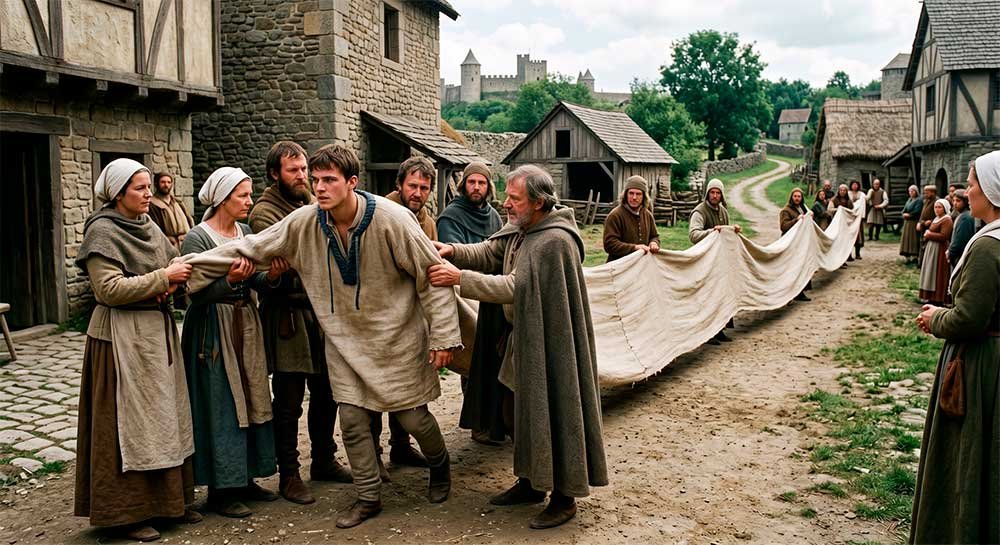
Agricultural trades and tools, omnipresent in an agrarian society, also contributed to the richness of popular lexicon. Although not directly related to weapons, the mention of “picks, shovels, and hoes” in “the Great Captain’s accounts” underscores the relevance of these tools in the economy and military logistics. The construction of sieges, trenches, and fortifications relied heavily on these basic tools, whose cost, though seemingly minor compared to that of weapons, added up in large campaigns. Each tool was a vital investment for the success of any military or civil operation, and its presence in an official document, though ironic, highlights its intrinsic importance. Sayings, thus, become a compendium of practical wisdom, reflecting the ingenuity and industriousness necessary to thrive in the Middle Ages.
From Legends to Sayings: The Influence of Chivalry and Myths in Popular Wisdom
The medieval era was a hotbed for chivalry, epic heroes, and myths that, over time, merged with popular wisdom to shape enduring medieval sayings. Legendary heroes like El Cid or Lancelot, with their exploits and virtues, not only inspired poems and songs but also indirectly influenced everyday language, imbuing certain medieval phrases with a heroic or moral background. These sayings are reflections of a world where honour, bravery, and faith were fundamental pillars, often magnified by the legends that circulated by word of mouth.
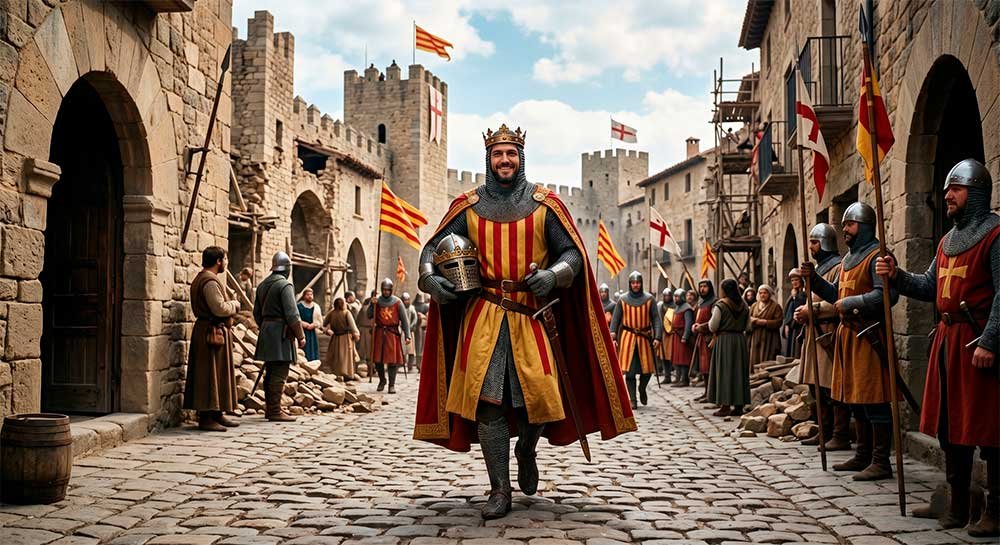
An outstanding example of this influence is the expression “Como Pedro por su casa” (Like Peter through his house). Its origin is attributed to the victory of Peter I of Aragon in the Battle of Alcoraz (1094), where, after the death of his father, King Sancho Ramírez, Peter I behaved with such audacity and confidence that people coined the phrase “he entered as Peter into Huesca”. The legend exalts the king’s bravery and lack of inhibition at a critical moment. Although today the expression “como Pedro por su casa” has often acquired a pejorative nuance of overconfidence or bad manners, its root is a tribute to heroic self-possession, to the ability to take charge decisively even in adverse circumstances. This reminds us of the figure of a confident warrior, perhaps carrying a functional Musketeer sword, triumphantly entering hostile territory.
The Legacy of Heroes in Everyday Language
The figure of the knight, idealised in literature, also contributed to the formation of popular wisdom. The code of chivalry, with its emphasis on loyalty, piety, and the protection of the weak, inspired behaviours and, therefore, expressions. Although there are no direct sayings like “as loyal as a knight”, the essence of chivalry permeated society, creating a standard of conduct that, when breached, was subject to criticism or admonitory proverbs. The legends surrounding the Cid Campeador medieval shield in decorated wood, a symbol of a hero whose loyalty and valour were unwavering, reinforced an ideal of chivalry that was praised and emulated through stories, poems, and yes, also sayings, that narrated the life and examples worthy of following.
Furthermore, the relationship between the knight and his equipment, so present in medieval mythology, elevated objects like the sword to sacred symbols. The sword was not just a weapon, but a companion in life and death, often with its own name (like Tizona and Colada of El Cid). This veneration instilled in language a deep connection with war objects, endowing them with a soul. The persistence of sayings related to weapons, such as “to be between the sword and the wall”, is not only due to the practicality of the sword as a weapon, but also to its rooting in the collective imagination as an object of power, justice and destiny. Blacksmithing, as the art of shaping these symbols, thus acquired an almost mystical status, where the smith not only created metal but also stories and, ultimately, proverbs. The Mempo Assassin Mask, though of more Eastern origin, reflects the same symbolism of protection and warrior.
A Lasting Legacy: The Relevance of Medieval Sayings in the Modern World of Historical Arms
The survival of medieval sayings in our current language is an eloquent testament to their relevance and universality. For our shop, specialising in medieval arms and historical accessories, this persistence is not a mere linguistic curiosity but a vital connection to the cultural value and intrinsic history of each piece we offer. Understanding the origin of these medieval phrases allows us to appreciate the profound mark that the Middle Ages, with its knights, battles, and trades, left on our way of thinking and expressing ourselves. Each piece of armour, sword, or historical accessory is not just a manufactured object but a catalyst for stories and, surprisingly, words that still resonate today.
Acquiring a tournament rest armour or a Spanish cup-hilt sword 1, for example, is immeasurably enriched by understanding that these objects were the origin of such deeply rooted expressions as “to be dressed to the nines” or “to fight with cloak and sword”. These sayings not only add historical and cultural value to our products but also allow us to tell a more complete and vibrant story to our customers. Each piece becomes a tangible fragment of a past that lives on through language. Understanding these connections transforms the purchase of a historical item into a deeper educational and cultural experience.
The persistence of these phrases underscores that, despite centuries of technical and social progress, certain truths about life, honour, danger, and cunning remain immutable. Sayings acted as a way to transmit experiences and lessons from generation to generation, cementing a cultural heritage that transcends time.
SEE THE MOST BEAUTIFUL SWORDS, SHIELDS, ARMOUR AND WEAPONS OF THE MEDIEVAL ERA