
When we think of the samurai warrior, the first image that usually comes to mind is the gleaming katana, an unmistakable symbol of honour, skill, and the legendary code of Bushido. However, the samurai’s arsenal was far more extensive and sophisticated than commonly believed, encompassing a variety of medieval weapons designed for different combat situations and specific roles within the Japanese battlefield. Far from being mere swordsmen, these warriors mastered an impressive array of lethal tools, from precise bows to imposing spears, each with its own technique and philosophy of use.
The samurai possessed a deep understanding of the utility of each piece of their equipment, considering them extensions of their own body and spirit. The choice of weapon depended on strategy, the type of enemy, the terrain, and the specific circumstances of combat. This versatility was a distinctive mark of their martial excellence, allowing them to maintain superiority on the battlefield. They not only mastered the long sword but also a complete range of military implements.
For example, in earlier periods, the longbow and polearms were often more decisive than the sword. The katana became established as the primary weapon in later eras, especially during the Edo period, when large-scale conflicts diminished and individual duelling gained greater importance. The full arsenal reflected a pragmatic understanding of warfare and the need to adapt to any challenge. Thus, to only consider the katana would be to ignore a vast portion of their preparation and martial mastery.

The Path of Kyudo: The Ancient Art of Japanese Archery
Kyudo, or “the way of the bow”, is one of Japan’s oldest and most revered martial disciplines, and the Yumi bow was, in its origins, the primary weapon of the samurai warriors. Long before the katana achieved its prominence, the Yumi was the pre-eminent war instrument, used effectively both on horseback and on foot. Its asymmetrical design, with the grip positioned below the centre, allowed archers to shoot comfortably from the saddle, which was crucial in cavalry battles.</p
Skill in Kyudo not only required precision and strength but also deep concentration and mental discipline. Samurai did not view archery as a mere technique but as a moving meditation, a path to self-perfection. The arrows, known as Ya, varied, with points designed for different purposes, from penetrating armour to cutting horse tendons. This martial art, with its focus on posture, breathing, and intention, was a cornerstone of samurai training.

The Yari, the Japanese spear, was perhaps the most versatile and widespread polearm. Numerous variations existed, from short spears for thrusting in close formations to very long lances that could keep several opponents at bay. Its sharp point, forged with the same mastery as katana blades, was capable of penetrating armour with ease. The Yari became the backbone of the samurai infantry, allowing for impenetrable defences and coordinated attacks that disrupted enemy lines.
The Shuriken, while more culturally associated with ninja, were also used by some samurai, especially those involved in reconnaissance or covert missions. These throwing stars were not intended as primary lethal weapons, but rather as distraction or delaying tools to disorient an opponent before hand-to-hand combat. Their use required skill and surprise, characteristics valued in wartime tactics. The diversity among them was remarkable, from star shapes to straight points, each with a specific purpose.
Other secondary weapons included the Jutte, a blunt metal rod used to disarm swordsmen without harming them with cuts, and the Kusarigama, a sickle with a chain and a weight, which combined the cutting of the sickle with the ability to entangle and strike from a distance. These weapons, often considered “secret” or specialised, demonstrated the inventiveness and adaptability of the samurai in developing tools for every combat scenario. The variety of this minor arsenal is a testament to the depth of their tactical thinking. Finally, the Kama, an agricultural sickle adapted for combat, also had its place in the arsenal, showing how everyday tools could be transformed into lethal weapons in expert hands.
Forging and Mastery: The Secrets Behind the Metals and Techniques of Samurai Weapons
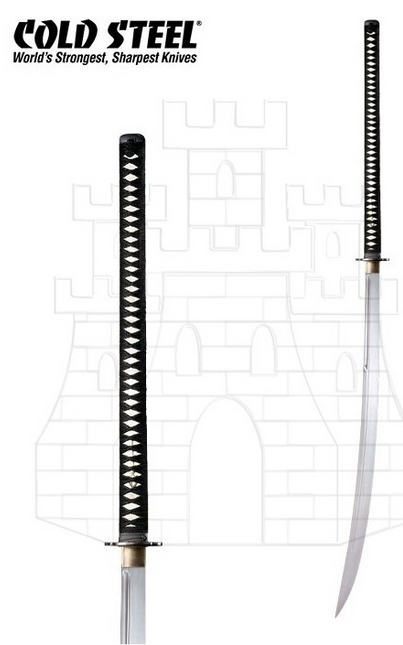
The exceptional quality of samurai weapons lay not only in the warrior’s skill but also in the unparalleled mastery of the smiths who created them. The forging of a katana or a yari was a ritualised and complex process, where secrets were passed down from generation to generation.
The steel used, known as Tamahagane, was obtained from high-purity iron sand and was the result of a long smelting process in traditional furnaces called Tatara. This steel was characterised by its heterogeneous carbon content, which allowed smiths to manipulate its properties.
The smiths repeatedly folded and hammered the steel, removing impurities and distributing the carbon evenly, creating layers that provided incredible strength and flexibility to the blade.
Differential hardening was another crucial technique. The blade was covered with a mixture of clay, ash, and charcoal powder, leaving only the edge exposed. When the hot blade was immersed in water, the edge cooled rapidly, becoming extremely hard for cutting, while the back cooled more slowly, remaining softer and more flexible.
This difference in hardness created the distinctive temper line, or Hamon, visible on katanas, a true signature of the smith. Each Hamon was unique, an artistic and functional pattern that spoke of the artisan’s skill. The complete process included meticulous polishing, which revealed the hidden beauty of the steel and its grain pattern, or Hada.
The maintenance of the sword blade was a meticulous ritual. After each use or periodically, the katana had to be carefully cleaned to prevent oxidation. This process involved using special rice paper to remove any traces of old oil, blood, or dirt, followed by the application of choji oil, a clove-based solution, to protect the steel from moisture. Constant review of the Habaki (blade collar) and the Fuchi and Kashira (collar and pommel of the hilt) was also essential to ensure that the sword remained in perfect condition and that all its parts remained firmly attached. A samurai neglectful of his weapon was a samurai who dishonoured his spirit and ancestral line.
For the samurai, the weapon was not just an instrument for killing, but a tool for protecting justice and defending their principles. The katana, though lethal, represented the warrior’s ability to take a life, a decision never to be taken lightly. Training in martial arts was not just to win battles, but to cultivate an indomitable spirit and a clear mind. Every stroke with the sword, every arrow shot with the bow, or every thrust with the spear, were extensions of their own will and a reflection of their character, supported by the pillars of Bushido.

Bushido also influenced strategy and tactics. A brave samurai did not flee from danger but also did not seek unnecessary death; his courage was manifested in the wisdom to assess the situation and act decisively. Loyalty to his lord (Daimyo) or clan was paramount and expressed in unwavering dedication on the battlefield. Benevolence, or Jin, was manifested in the treatment of prisoners or civilians, showing that even in brutal war there was a space for compassion.
In this sense, samurai weapons were much more than metal artefacts; they were incarnations of a complex philosophy that dictated how a man should live and die, how he should fight, and how he should honour his own, always with the katana as a central, but not unique, symbol of his lineage. The perfect union of technical skill and moral strength was what elevated the samurai above other warriors.
Evolution and Legacy: A Timeline of Samurai Weapons Through the Ages
The history of samurai weapons is a reflection of the history of feudal Japan itself, evolving and adapting with each era to meet the changing needs of the battlefield. This chronology illustrates how the arsenal of these warriors transformed, from the adoption of the bow to the pre-eminence of the long sword, and how each period left its imprint on the tools of combat.
Below, we present a table detailing the most important milestones in the evolution and legacy of these mythical weapons, demonstrating a constant pursuit of perfection and lethality in martial art.
| Era | Event |
|---|---|
| Nara Period (710-794 AD) | |
| 8th Century | Early introduction of the curved sword (Tachi) influenced by Chinese and Korean models. Longbows (Yumi) were the dominant weapons. |
| Heian Period (794-1185 AD) | |
| 9th-12th Centuries | Development of the distinctive Japanese style for the sword: the Tachi with the curvature near the hilt. Kyudo (art of archery) consolidates as an elite horseback martial art (Yabusame). |
| Late 12th Century | The Naginata gains prominence among warriors as an infantry weapon and for combat against cavalry. |
| Kamakura Period (1185-1333 AD) | |
| 13th Century | The modern katana begins to take shape, with a more uniform curvature. Bushido begins to formalise as a moral code. |
| 1274, 1281 | Mongol invasions: Demonstrate the effectiveness of samurai cavalry with bows and swords. |
| Muromachi Period (1336-1573 AD) | |
| 14th-15th Centuries | The Yari (spear) becomes the main weapon of infantry formations. Variants of the Naginata and Tanto diversify. |
| 15th Century | Appearance of fencing schools (Kenjutsu) that systematise the use of the katana. |
| Sengoku Period (1467-1603 AD) | |
| Mid 16th Century | Introduction of firearms (Teppo/Arquebus) to Japan by the Portuguese, revolutionising samurai warfare. |
| Late 16th Century | Unification of Japan. The strategic importance of infantry with Yari and Teppo grows exponentially. The Daisho (katana and wakizashi) becomes the symbol of samurai status. |
| Edo Period (1603-1868 AD) | |
| 17th-19th Centuries | Era of relative peace. The emphasis on the katana shifts to its role as a status symbol and for duelling (Kenjutsu), with less large-scale use in battle. |
| 1876 | Haitorei Decree prohibits samurai from carrying swords in public, marking the end of their era as armed warriors. |
Discover our selection of Samurai Weapons: Beyond the Katana and Bushido


Unravelling Mysteries: Answers to Your Curiosities About Samurai Weaponry
What was the most important samurai weapon apart from the katana?
Although the katana is the most iconic, the Yumi (Japanese longbow) and the Yari (spear) were historically the most important weapons on the samurai battlefield for many centuries. Before the pre-eminence of the sword in later eras, samurai were primarily horseback archers, and the spear was fundamental for infantry formations.
Did Onna-Bugeisha (female warriors) use the same weapons as male samurai?
Yes, Onna-Bugeisha were trained in the same spectrum of weapons as male samurai. However, they particularly excelled in handling the Naginata, because its long reach compensated for possible differences in physical strength in hand-to-hand combat.
What is Tamahagane and why was it so special?
Tamahagane is traditional Japanese steel, forged in Tatara furnaces. It was special for its purity and its heterogeneous carbon content, which allowed smiths to create blades with an extremely hard edge (for cutting) and a more flexible back (for absorbing impacts), achieving an unrivalled combination of strength and flexibility.
Did samurai wear armour? Was it heavy?
Yes, samurai wore armour (Yoroi), and its design evolved over the centuries, from the bulky Ō-yoroi to the lighter Dō-maru. Contrary to popular belief, they were designed to be flexible and relatively light, allowing mobility. They were composed of small plates of metal and lacquered leather, joined with silk cords, offering excellent protection without sacrificing agility.
Get your own katana | Want to know more Japanese swords? | Wakizashis for practice | Practice with Bokken