
Join us on a captivating journey into the world of swords, weapons that have shaped the destiny of civilisations and are far more than mere iron objects. From antiquity to the Renaissance and beyond, swords have evolved in form, materials, and use, giving rise to a rich and varied nomenclature. Understanding the names of swords and their styles is to unravel a fundamental part of military history, chivalry, and the art of blacksmithing.
In our online shop, specialising in mediaeval weapons and historical accessories, we know that every piece tells a story. This article will guide you through a fascinating journey into the legacy of these impressive combat tools, exploring their distinctive characteristics, geographical origins, and the legends that surround them. Prepare to discover the complexity and beauty hidden within each blade, guard, and pommel, unveiling the ancient art of swordsmanship.
From the mighty Claymore to the elegant Katana, each sword possesses a soul of its own, forged in the heat of battles and ceremonies. Join us on this odyssey to uncover the secrets that make each weapon an unparalleled treasure of human engineering and artisanal mastery. We will explore the evolution that has allowed sword names to be as diverse and evocative as the warriors who wielded them.
The Etymology and Nominal Journey of ‘Sword’: From Spatha to Épée
The word “sword” encapsulates a profound linguistic history dating back to classical civilisations. Its most widely accepted origin is the Latin spatha, a term that initially referred to a long, straight Roman cavalry sword, distinct from the shorter infantry gladius. This Latin term, in turn, derived from the Greek spathe, which referred to a broad, flat, and long blade used for various purposes, including agricultural ones.
This nominal journey of the word “sword” did not stop in classical antiquity. With the expansion of Latin and the formation of Romance languages, the word adapted, retaining its essence. In Italian, it kept a very similar form, becoming spada, while in French, it evolved into épée, terms that are still in common use today.</p
The consistency of this etymology across millennia and cultures highlights the universal importance of the object it designates. The persistence of spatha in language demonstrates how a Roman military concept became deeply rooted in European consciousness. This linguistic evolution is a reflection of the ubiquity of the weapon itself throughout history and its significance as a symbol of power, justice, and honour in various societies.

Even in non-Romance languages, the concept of “sword” and its association with a long, cutting blade remained, albeit with different names. The word “sword” not only names an object but invokes an entire cultural heritage of combat, chivalry, and heroism. Its journey from the Roman spatha to the modern épée is as complex and fascinating as the art of forging the metal itself.
Among the most prominent, we find the Claymore, the impressive Scottish “great sword”. It required both hands to wield, featuring a long hilt and a double-edged blade, ideal for the Highland warriors. Its robust design and impressive size made it a devastating weapon in the hands of an experienced combatant, capable of breaking enemy lines and deciding the course of battle by its mere presence.
Another name that resonates is the Longsword or Montante, also known as a “hand-and-a-half sword” or “bastard sword”. These were long, straight-bladed swords used throughout Europe, whose handling required not only strength but also considerable technical skill. They could be wielded with one hand for agile combat or with two for more powerful blows and solid defences, making them incredibly versatile in various combat situations.
The Rapier, which emerged in Renaissance Spain from the late Middle Ages, was distinguished by its straight, slender blade, designed more for thrusting than cutting. Its name comes from being worn “with one’s clothes” (“con la ropa”), as an accessory to civilian attire, used for both fashion and self-defence. A famous example is the mythical Tizona, although it is mistakenly associated with El Cid Campeador, its design is closer to rapiers of later eras. Its evolution gave rise to the Estoque (thrusting sword), with an even narrower blade designed exclusively for thrusting.
A typical sabre, such as the Persian Shamsir or the Indian Talwar, features a curved blade and a single edge (or a false edge in its last third). This curvature is designed to maximise cutting capacity in a sweeping blow, making it extremely effective in mounted combat. Cavalry, at a gallop, could deliver devastating cuts with the inertia of the horse’s movement, a very different strategy from that required for thrusting swords.
Swords, conversely, usually have a straight blade and often a double edge. Weapons like the mediaeval longsword or the Renaissance rapier were designed for a combination of cutting and thrusting, giving the user tactical flexibility in close combat. Their sharp point allowed them to penetrate armour or reach vital points with precision, while their edges could be used to disarm or lacerate an opponent.
The evolution of the sabre responds to specific tactical needs, particularly in cavalry and for officers of the 19th and 20th centuries, where speed and cutting ability were paramount. Sabres offered an advantage in dynamic combat and open spaces, where sweeping blows were more effective against multiple opponents. Their hilt often included a more elaborate handguard to protect the knuckles.
Mediaeval Combat Swords
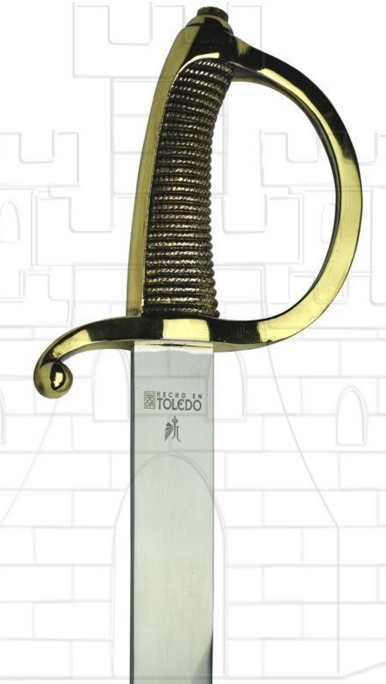
In mediaeval Europe, the sword was the knight’s primary weapon. The Arming Sword, with its straight, double-edged blade, was the standard for centuries, evolving into the Longsword in the late Gothic period. These weapons, with their hilts designed for one or two hands, were versatile tools in pitched battles and sieges. They were the pinnacle of military technology of their time.
The Scottish Claymore, already mentioned, exemplifies a sword of specific regional origin. Another example is the Mandoble or Greatsword, terms referring to large swords that required both hands, used on the battlefield to break formations or confront heavily armoured enemies. Their weight and size made them weapons of great power, a true metallic battering ram.
Iberian and Mediterranean Swords
The Iberian Peninsula, a melting pot of cultures, gave rise to the Falcata. This Iberian sword, with its forward-curving, single-edged blade, was designed for a penetrating and devastating cut. Its unique shape makes it instantly recognisable and is associated with Celtiberian warriors. The Sica, on the other hand, was a curved Thracian sword, with the blade on the inner side of the curve, popular among gladiators.
The Scimitar, with its broad, curved blade, is a name that resonates in the Mediterranean, being adopted and adapted from the Muslim world. Its robust design was ideal for bone-breaking in close combat. These swords show the influence and cultural exchange between different civilisations, each contributing its own mastery of blacksmithing and its distinctive touch to weaponry.
Civilian Use and Dueling Swords
With the arrival of the Renaissance, swords designed not only for war but also for duelling and personal defence in civilian settings emerged. The Rapier was a milestone in this change, becoming the symbol of the gentleman. Its successor, the Estoque (thrusting sword), with an even finer blade and an extremely sharp point, specialised in thrusting, perfecting the art of swordsmanship. The Verduguillo, a very thin variant of the Estoque, was even used to deliver the coup de grâce in bullfighting. These sword names reflect the evolution of society and its forms of combat.
Legendary Swords and Their Attributes: Materials, Forging, and Mysticism in the Art of Swordsmanship
Legendary swords are not mere metal objects; they are the embodiment of myths, stories, and heroic feats, forged with a combination of artisanal skill, exceptional materials, and often, a touch of mysticism. Names like Excalibur, La Tizona, or La Colada, though often idealised, speak to us of the importance of these attributes in their legacy. The quality of a sword was intrinsically dependent on its materials, the forging process, and the beliefs surrounding it.
The main material was steel, but not just any steel. The highest quality swords were made from high-carbon steels, which allowed for a harder and more resistant blade. Damascus forging, for example, was a legendary method that produced blades with a distinctive wavy pattern and a reputation for being incredibly strong and sharp. It was not a material itself, but a forging technique that involved folding and hammering several layers of steel with different carbon contents, achieving an exceptional combination of hardness and flexibility.
The forging process was an art passed down through generations. A master blacksmith not only shaped the metal with fire and hammer but imbued the sword with his knowledge and, according to the beliefs of the time, with a certain spirit. Tempering the blade in secret liquids (sometimes dragon’s blood in legends, or specific oils and brines in reality) was believed to confer magical properties on the sword.
Mysticism played a crucial role. Many legendary swords were associated with supernatural powers, divine blessings, or curses. Excalibur, King Arthur’s sword, was not just a weapon but a symbol of the legitimacy of his reign, given by the Lady of the Lake. La Tizona and La Colada, El Cid Campeador’s swords, were described with almost personal properties, capable of instilling fear in enemies.
The guard, or cross-guard, is the part that separates the blade from the hilt, protecting the user’s hand from opponent’s blows. Its styles are immensely diverse:
- The traditional straight guard, common in mediaeval arming swords, offered basic protection.
- With the evolution of swordsmanship, more elaborate guards emerged, such as the cup hilt, characteristic of rapiers. This consisted of a semi-circular metal plate that enclosed the hand, offering superior protection in thrusting duels.
- The basket hilt (as in the Schiavona) was a complex network of metal bars that formed a cage around the hand, popular on sabres and some swords of the 16th and 17th centuries, providing almost total defence without sacrificing grip.
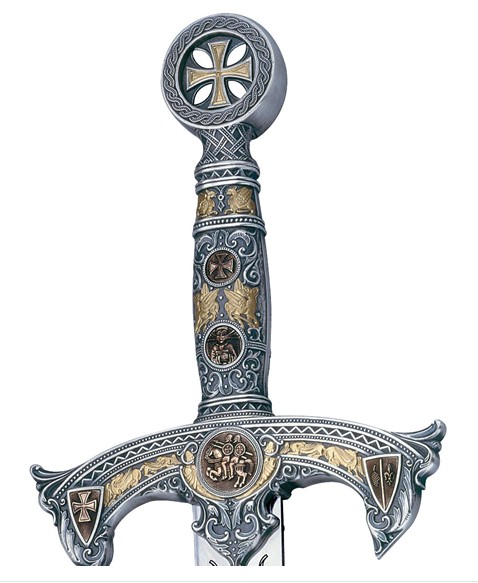
The grip is the part that is held. Often wrapped in leather, wood, or bone for better grip and comfort, its length and shape varied depending on whether the sword was one-handed, hand-and-a-half, or two-handed. Hand-and-a-half swords, or bastard swords, had a grip long enough to accommodate both hands, but compact enough to be deftly handled with just one.
The pommel is the piece at the end of the grip, which not only helps balance the sword, counteracting the weight of the blade, but can also be used as a blunt weapon in close combat. Poms came in a wide variety of shapes:
- Wheel pommels or disk pommels were common on mediaeval swords.
- Pear-shaped or spherical pommels were found in different eras and types of swords.
- Some pommels, especially on Eastern sabres like the Talwar, were elaborately decorated and of distinctive shapes, sometimes with naturalistic appendages.
The combination of these elements – the guard, the grip, and the pommel – not only influenced the functionality and ergonomics of a sword but also allowed master smiths to express their own artistic style. Thus, just as sword names are crucial, so are the characteristics of their hilts, true works of art that complement the lethal beauty of the blade.
The World of the Oriental Sword: Katana, Scimitar, and Other Exotic Names
The Far East and the Middle East have contributed some of the most iconic and recognisable swords to the world of swordsmanship, whose forms and combat philosophies differ radically from their Western counterparts. These sword names evoke a legacy of precision, honour, and often, a deep spiritual connection. The Japanese Katana and the Middle Eastern Scimitar are just the tip of the iceberg of a fascinating arsenal.
The Katana is, without a doubt, the quintessential Japanese sword, synonymous with the samurai. With its curved, razor-sharp, single-edged blade, and its exceptionally complex forging process (known as tamahagane), Katanas were lethal works of art. Their design was perfect for rapid draw cuts (iaijutsu) and precise swordsmanship. The Wakizashi, a shorter sword often carried alongside the Katana (the daishō), complemented its larger sibling in close combat. Both are revered not only as weapons but as symbols of the Japanese warrior spirit.
In the Islamic world, the Scimitar is the general Western term referring to a wide range of curved sabres. However, more specific names such as the Persian Shamsir or the Arabic Saif are more accurate. The Shamsir, with its markedly curved blade, was designed for devastating cuts in mounted combat. Its artistic beauty was as important as its functionality.
Another exotic name is the Talwar, a sabre from Hindustan distinguished by its characteristic hilt: a flattened grip, short quillons, and a flattened circular pommel, often with an appendage. These sabres reflect the rich military and artistic tradition of the Indian subcontinent. The Flissa (flyssa), from North Africa, is a sabre or straight sword with a single edge up to its last third, where it becomes double-edged, showing the diversity even within a region. The Yatagan, for its part, is an Ottoman sabre with a double curvature in its blade, allowing for both thrusts and cuts with great effectiveness, and a distinctive pommel with two “ear-shaped” protrusions.
Finally, the Chinese Dao is a single-edged and curved weapon in its most common variants, constituting one of the “four great weapons” of Chinese martial arts. Like the Jian (the Chinese straight sword), the Dao has been fundamental in Chinese martial practice for millennia. These Eastern swords not only stand out for their lethality but for the profound philosophy and culture that surround them, conferring upon them an almost mystical status in their respective societies.
Care and Maintenance of Your Historic Sword: Preserving the Beauty of These Fascinating Names
Acquiring a historic sword is owning a tangible piece of the past; however, for its beauty and magnificence to endure, proper care and maintenance are essential. The preservation of these pieces of artisanal engineering is not only an aesthetic matter but also a responsibility to the legacy they represent. Regular maintenance is key to preventing deterioration and ensuring that these iconic sword names can be admired by future generations, maintaining their historical value and original splendour.
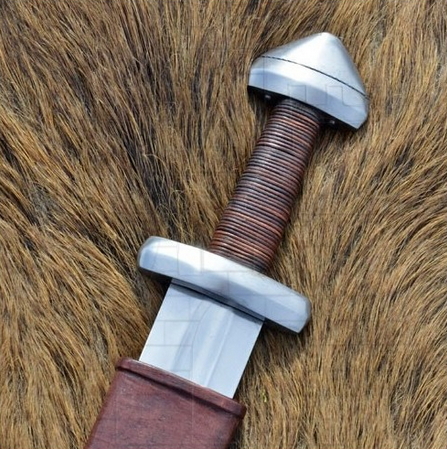
The greatest enemy of any metal weapon is corrosion, especially rust. To prevent it, the blade should be cleaned regularly with a soft, dry cloth to remove fingerprints and dirt. It is advisable to then apply a thin layer of mineral oil or a specific gun oil. This process should be done with gloves to avoid leaving grease marks from the skin, which can accelerate oxidation. For exposed swords, a proper scabbard or display case can protect them from dust and ambient humidity.
The grip and guard, although made of different materials, also require attention. Wooden or leather elements of the grip should be treated with specific products for their material, such as waxes or moisturising balms, to prevent them from drying out or cracking. Metal components of the guard and pommel should be cleaned and lubricated similarly to the blade to maintain their shine and protect them from rust. Periodic checking of the joints ensures that the sword remains solid and well-assembled.
Proper storage is another fundamental pillar. Swords should be stored in a dry, cool place with controlled humidity. If displayed, they should be out of direct sunlight and away from heat sources or air conditioning that could cause extreme fluctuations in temperature and humidity. By following these care and maintenance practices, any collector can ensure that their historic sword, whether a Claymore, a Katana, or a Scimitar, retains its splendour and history.
Discover Our Selection of The Fascinating Universe of Swords: Exploring Their Names and Styles


Evolutionary Timeline of Swords: From Bronze to Damascus Forging, A Journey Through Their Names and Styles
The evolution of the sword is a fascinating testament to human ingenuity and technological advancement. From the first bronze blades to the sophisticated steel forging techniques, each era has developed sword names and styles that reflect the available materials, predominant combat tactics, and the cultures that created them. This chronological journey allows us to appreciate the constant adaptation and perfection of these weapons throughout history.
This journey from the dawn of metallurgy to the mastery of fierce mediaeval and oriental forging shows us the versatility and enduring importance of the sword as a tool and symbol. Every advancement, from improved alloy to ergonomic design, has left its mark on the different types of swords we know today.
| Era | Event |
|---|---|
| Ancient Bronze and Early Iron Age | |
| c. 3300 – 1200 BC | First bronze swords in the Levant, Egypt, and the Aegean (Naue II type). They were short and wide. |
| c. 1200 BC | Transition to iron in the Mediterranean and Near East, with the first prototypes of iron swords. |
| c. 800 – 300 BC | Development of Celtic iron swords (Hallstatt and La Tène cultures), with longer and often double-edged blades. |
| Classical Antiquity | |
| c. 300 BC – 100 AD | The Roman Gladius becomes the standard, an efficient short thrusting sword for infantry. |
| c. 100 – 400 AD | The Roman Spatha, longer, gains prominence, especially among cavalry, a precursor to mediaeval swords. |
| c. 300 BC – 100 AD | The Iberian Falcata is consolidated, with its characteristic curved blade for devastating cuts. |
| Early Middle Ages (5th-11th Centuries) | |
| c. 400 – 800 AD | Development of Germanic and post-Roman Spatha-type swords, with decorated hilts. |
| c. 800 – 1000 AD | Viking Swords (or ring swords), wider and with lobed pommels, spread across Northern Europe. |
| High and Late Middle Ages (11th-15th Centuries) | |
| c. 1000 – 1300 AD | The Arming Sword becomes the knight’s main weapon, with straight, versatile blades for cutting and thrusting. |
| c. 1300 – 1500 AD | Increase in full armour and the appearance of the Longsword (or Hand-and-a-Half) and the Montante/Greatsword, designed for greater reach and power against armour. |
| c. 1300 – 1500 AD | Cavalry sabres like the Scimitar are consolidated in the Mediterranean and Middle East, ideal for mounted combat with curved blades. |
| Renaissance and Early Modern Age (16th-18th Centuries) | |
| c. 1500 – 1650 AD | The Rapier emerges in Spain and Cup-Hilted Swords in Italy, specialised in thrusting for civilian duels. More complex guards are developed to protect the hand. |
| c. 1650 – 1800 AD | The Estoque is refined, and cavalry sabres, such as the Hungarian Sabre or the Scottish Broadsword, gain prominence on European battlefields. |
| c. 1300 – 1800 AD | The Japanese Katana reaches its peak during the Muromachi and Edo periods, as a symbol of the samurai and a masterpiece of forging. |
| Contemporary Age (19th-20th Centuries) | |
| c. 1800 – 1900 AD | The military use of swords declines with the improvement of firearms, but the Light Sabre and Officer’s Sabre remain important as ceremonial insignia and personal defence systems. |
| c. 1900 – Present | Swords become primarily objects for collecting, ceremonial use, sport (fencing), and art. The traditional craft of forging is re-evaluated. |
A Living Legacy of Forging
The history of swords is a reflection of the history of humanity, intertwining technological evolution with artistic and military development. Each blade, each hilt, each pommel tells a part of this vast narrative. In our shop, we celebrate this legacy by offering a carefully curated selection of replicas that honour the craftsmanship and spirit of these weapons.
From robust mediaeval swords that protected kingdoms, to elegant rapiers that defended honour, and mystical katanas forged with patience and precision, each piece in our collection is a testament to unparalleled craftsmanship. We invite you to explore “The fascinating universe of swords: Learn its names and styles” through our products, a unique opportunity to connect with history forged in steel. Discover the sword that resonates with you and take home a fragment of the past!