
Delve into the fascinating world of historical weapons with our study of the Gineta sword, an emblematic piece whose fame transcends centuries. This weapon, deeply linked to the culture and power of Al-Andalus, represents the pinnacle of Andalusian smithcraft and martial art. Throughout this article, we will unveil the origin and historical evolution of the Gineta sword, exploring its design, its use in combat, and its enduring legacy that marked a before and after in Peninsular and European swordsmanship.
From its humble beginnings to becoming the symbol of Nasrid nobility, the Gineta is not just a sword, but a testament to the living history of the Reconquista. Prepare to discover how this unique blade forged its legend on the battlefields and in the courts of the Iberian Peninsula. Join us on this journey to the heart of Al-Andalus to understand the mastery behind each stroke and the splendour of each hilt.
The Enigma of the Gineta Sword: Origins and Islamic Influences in Al-Andalus

The Gineta sword emerges as a distinctive legacy forged in the cultural melting pot of Al-Andalus. Its origin intertwines with the arrival of Islamic influences in the Iberian Peninsula from the 8th century onwards, where Eastern smithing techniques and martial preferences merged with local prerogatives. Initially, the swords brought by Muslim conquerors, often with slightly curved or straight blades, laid the groundwork for the subsequent development of this iconic weapon.
The term “gineta” comes from the Arabic word “zanata”, which designated a Berber tribe known for its skill in light cavalry. These Berber horsemen brought with them certain weapon preferences, including swords that were perfectly suited for mounted combat. The Gineta’s configuration, characterised by its specific hilt and optimised balance, facilitated its handling on horseback, allowing for quick and precise strikes that were crucial for Nasrid cavalry, which was distinguished by its mobility and harassment tactics.
Islamic influence was not limited solely to form or use. The advanced metallurgical knowledge and the damascening and filigree techniques introduced by Muslim artisans elevated sword production to an art. Workshops in Toledo, Cordoba, and Granada became centres of excellence where the Gineta began to acquire its distinctive features, integrating both military functionality and ornamental aesthetics, reflecting the refinement of Andalusian culture.
Morphology and Distinctive Characteristics: Analysing the Andalusian Gineta
The Gineta sword is distinguished by a series of morphological characteristics that make it easily identifiable and differentiated it from other contemporary swords. Its blade, generally double-edged, was straight or had a slight curve towards the tip, a versatility that made it effective for both cutting and thrusting. Lengths varied, but usually ranged between 80 and 90 centimetres, providing an optimal balance between reach and manoeuvrability, essential for equestrian combat.
One of the most emblematic elements of the Gineta is its hilt, known as a “hand-and-a-half” hilt. This allowed the knight to hold the sword with one or two hands, offering greater striking force and superior control. The peculiarity lies in the pommel, which often had an onion shape or was faceted, and was not directly attached to the guard. Instead, the grip narrowed towards the pommel and was often covered with sumptuous materials such as ivory, ebony, or horn, profusely decorated.</p
The guard, usually shaped like a curved or “S” crossguard that projected towards the blade, offered protection to the combatant’s hands. Unlike the straight crossguards of many European swords, this guard configuration, often with quillons slightly curved forwards, not only protected but also contributed to the aesthetic and functional balance of the weapon. This general design, together with the meticulous crafting of each component, positioned the Gineta as a masterpiece of Andalusian armoury and a coveted piece of status.
The Gineta in Combat: Fighting Techniques and its Use in Nasrid Cavalry
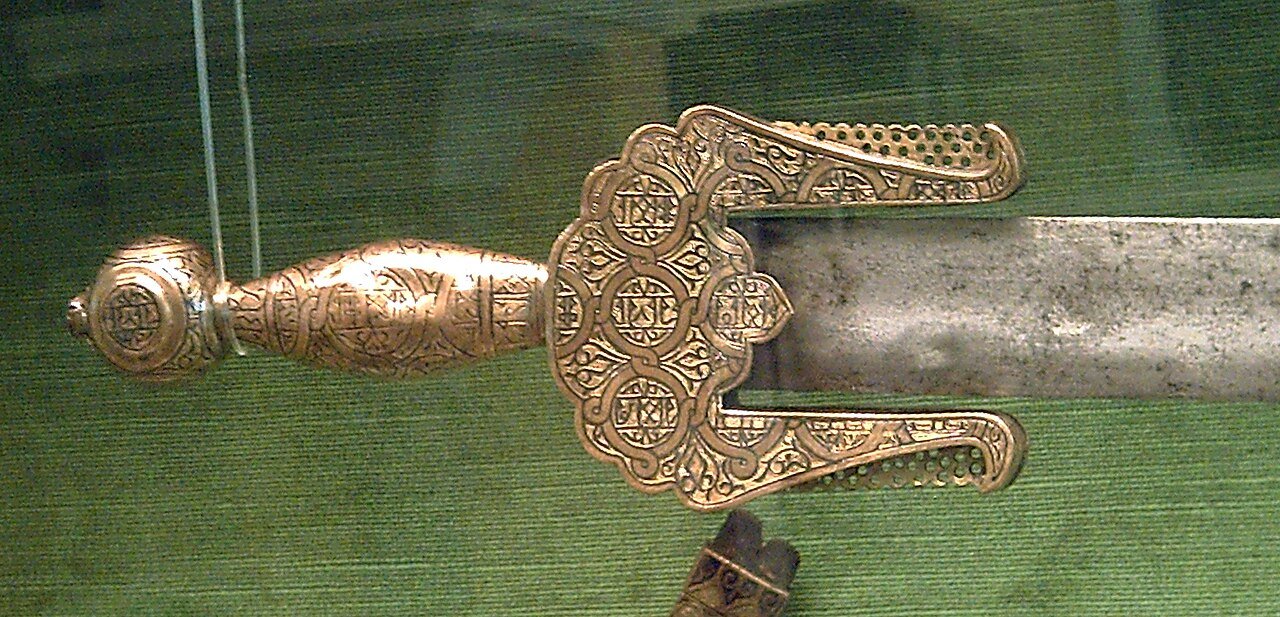
«Hilt of a Gineta sword.» — Desconocido, CC BY-SA 3.0, via Wikimedia Commons
The Gineta sword was fundamentally a cavalry weapon, and its design reflected the particularities of the warfare waged in Al-Andalus, especially by Nasrid cavalry. Andalusian horsemen, renowned for their agility and skirmishing tactics, found the Gineta a perfect extension of their combat style. The lightness and balance of the sword allowed for a rapid succession of blows and exceptional manoeuvrability, crucial in dynamic engagements.
Fighting techniques with the Gineta focused on speed and precision. Blows were not so much about brute force, but rather quick cuts aimed at vulnerable points, disabling the opponent without sacrificing mobility. The ability to wield it with one or two hands offered tactical versatility, allowing the horseman to alternate between rapid one-handed attacks while controlling their mount, or deliver more powerful and controlled blows with two hands in closer combat or on foot, if necessary. This adaptability was a great advantage against Christian knights, protected by heavier armour and dependent on heavier swords.
Gineta cavalry operated under principles of harassment and attrition, avoiding prolonged frontal clashes. The sword was used in conjunction with short spears, javelins, and light shields, forming an arsenal that maximised speed and the element of surprise. This combination of tactics and weaponry allowed the Nasrids to hold off numerically superior forces for centuries, making the Gineta a symbol of Andalusian resistance and a feared adversary on the battlefield, mastering the art of mounted combat like few weapons before or after.
Materials, Craftsmanship, and Decoration: The Luxury of Andalusian Gineta Swords
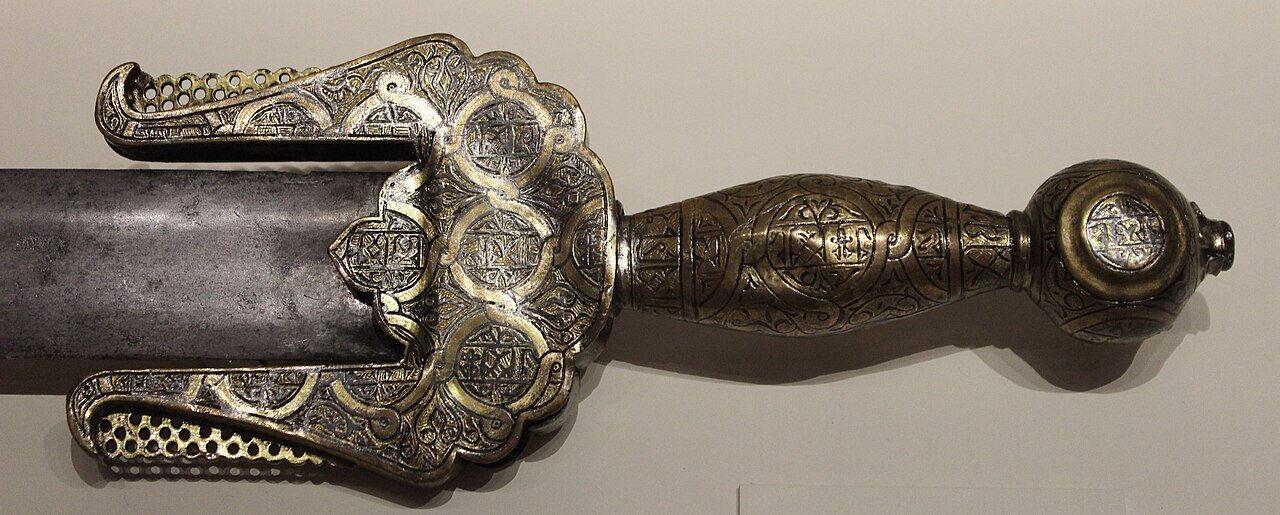
«Madrid M.A.N. Nasrid art. Sword.» — Miguel Hermoso Cuesta, CC BY-SA 4.0, via Wikimedia Commons
The splendour of the Gineta sword lay not only in its martial functionality but also in the luxury and exquisiteness of its craftsmanship, which reflected the high degree of artistic and technical development of Al-Andalus. The materials used were carefully selected, from the forged steel of the blade to the rich adornments of the hilt and scabbard. Damascus steel, famous for its wavy pattern and exceptional edge and strength, was often the preferred choice for the blades of the most prestigious Ginetas, although high-quality steel manufactured locally in specialised forges was also used.
The Gineta’s craftsmanship was a testament to cultural fusion and the exchange of knowledge. Andalusian master blacksmiths employed advanced tempering and forging techniques, often influenced by Persian and Eastern traditions, to achieve blades that were light, flexible, and extraordinarily sharp. Damascening, the technique of inlaying precious metals such as gold and silver onto the steel surface, was commonly used to decorate the blades, creating intricate geometric motifs, Quranic or heraldic inscriptions that turned them into true works of art.
The ornamentation of the hilt and pommel was equally impressive. Exotic materials such as ivory, often carved with vegetal or calligraphic motifs, finely polished ebony, iridescent mother-of-pearl, or rhinoceros horn, were profusely used. These materials were combined with precious metal fittings, gold and silver filigree, and sometimes, precious stone inlays, transforming the sword into a symbol of status and wealth. The scabbard, although often a separate piece lost over time, also received similar treatment, covered in engraved leather and decorated with noble metal fittings, making each Gineta a unique piece of incalculable historical and aesthetic value.
Beyond Al-Andalus: The Spread and Adaptation of the Gineta Sword in Europe
The influence of the Gineta sword transcended the borders of Al-Andalus, radiating its design and concept throughout Europe, particularly in Christian Iberia. After the Reconquista, and especially in the 15th and 16th centuries, the Gineta was adopted and adapted by the Castilian, Aragonese, and Portuguese nobility and military forces. The practicality of its design and its lightness, so suitable for mounted combat, did not go unnoticed by Christian combatants who had experienced its effectiveness firsthand.
The adoption of the Gineta by Christian kingdoms manifested itself in the appearance of swords with similar characteristics, though often with adaptations to European tastes and military needs. The “hand-and-a-half” hilts were imitated, and the straight or slightly curved blade shape became popular. This transition was not merely a copy, but a cultural assimilation, where the weapon was integrated into the Christian arsenal and given new meaning, retaining its name and part of its original mystique. Indeed, many swords referred to as “a la gineta” in Christian contexts retained the Andalusian stylistic essence.
The spread of the Gineta was favoured by the prestige of Nasrid light cavalry, whose reputation for skilled combatants was well known. Christian “jinetes” (horsemen), who adopted similar tactics, naturally sought weapons that complemented their fighting style. Peninsular fencing schools, already in the Renaissance, incorporated elements of light sword handling, and the Gineta, with its history and proven effectiveness, became an archetype for the development of lighter and more versatile swords. Its legacy is a clear example of the complex interconnection and mutual influence between Islamic and Christian cultures during the Middle Ages and the Renaissance.
The Enduring Legacy of the Gineta: Influence on Later Weapons and the Rapier

The legacy of the Gineta sword in the history of armaments is profound and palpable, extending far beyond the borders of Al-Andalus to influence the design and functionality of later weapons, especially in the Iberian Peninsula. Its conception as a light and versatile weapon for mounted combat set a precedent that continued to evolve. The lightness, good balance, and the hilt that allowed superior control were characteristics that were sought to be replicated in the development of swords from the late Middle Ages and early Renaissance.
The most direct and notable influence of the Gineta is seen in the emergence of the rapier, an iconic weapon of the Spanish Renaissance that spread throughout Europe. Although the rapier developed its own identity with more complex guards (cups, rings, etc.) and narrower, sharper blades, the idea of a slender sword, with great reach, and that could be carried “a la ropa” (i.e., as part of civilian attire), aligns with the evolution initiated by the Gineta. The rapier, like the Gineta, stood out for its ability for rapid thrusts and its one-handed handling, being a weapon of agility rather than brute force.
In addition to the rapier, the Gineta also influenced other light swords and sabres, especially in the Peninsular context. The ergonomics of its grip, designed for rapid adaptation to different combat situations, influenced the conception of more refined and comfortable hilts. Its emphasis on steel quality and ornamental beauty set a standard for prestige swords. The Gineta was not merely another sword; it was a catalyst for innovation in weapon design, demonstrating that efficiency and elegance could go hand in hand, and its echo resonates in every blade that prioritises agility over brute weight, marking a milestone in the history of swordsmanship.


