
The legendary Witcher of Rivia, Geralt of Rivia, has captivated millions with his adventures on the Continent, facing beasts and defying destiny. But what if this iconic monster hunter, with his silver hair and two swords, found himself transported to the fascinating and lethal era of Feudal Japan? The idea of a “The Witcher” in Japan sparks a series of intriguing questions about how his skills and ethics would fit into such a different context.
From Cintra to Edo: How would Geralt fit into Feudal Japan?
Geralt’s transition from the northern realms and ancient forests to the bustling cities and serene temples of Feudal Japan would be a monumental culture clash. His reputation as “The White Wolf,” forged in monster-hunting contracts, would need to be reinterpreted for the daimyōs and samurai. The magic of Signs, potions, and mutations, so fundamental to his identity, would be viewed with strangeness or, perhaps, with fear and reverence. His figure, always on the fringes of society, a necessary outcast, would find a parallel in the ronin. This masterless samurai, wandering and often defying established norms, could be the perfect Japanese embodiment of Geralt. The Witcher could offer his services to peasants plagued by Yōkai or Oni, or even to feudal lords seeking a supernatural advantage in their conflicts.
Katana vs. Witcher Steel Swords: An Armament Analysis

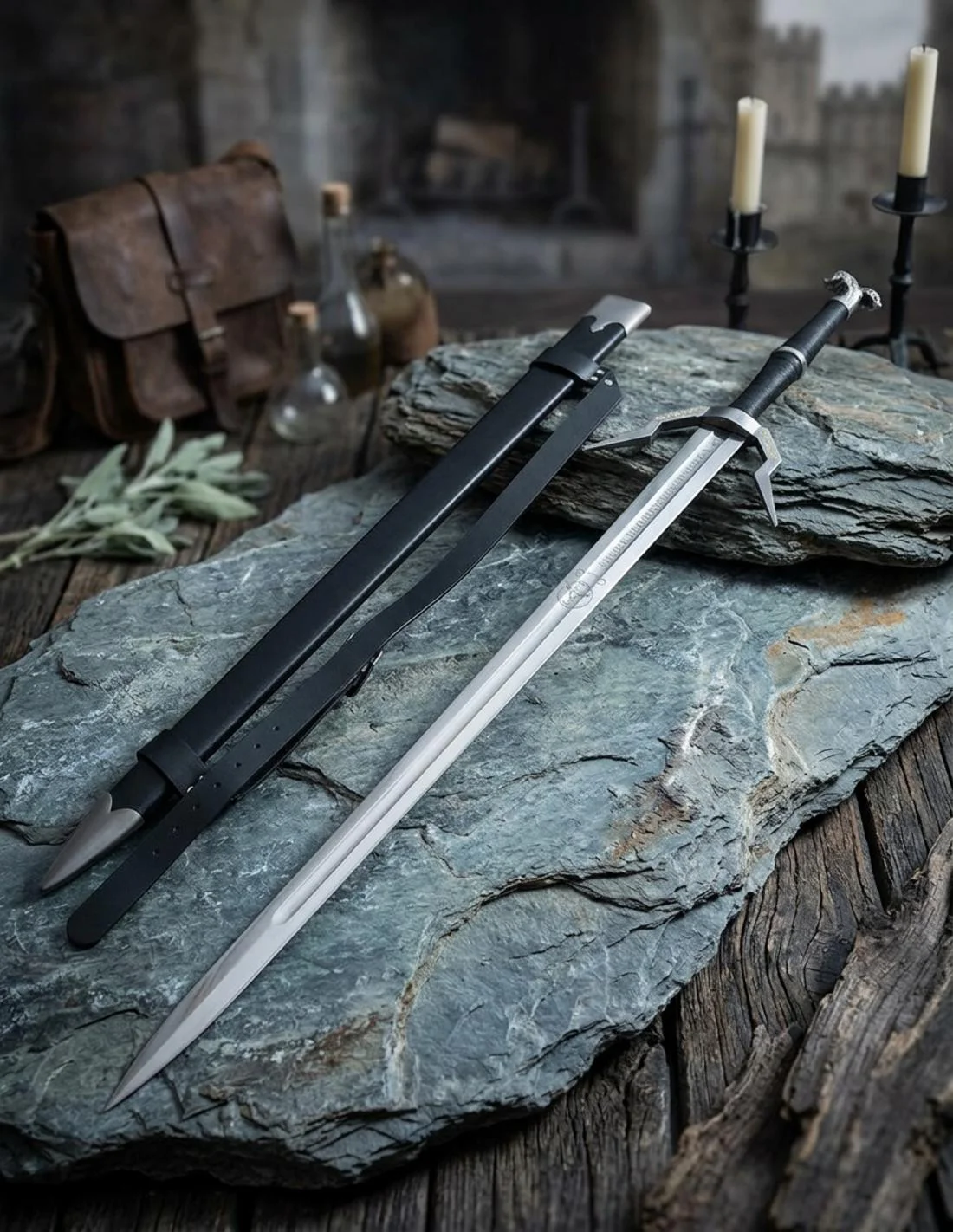
Weaponry is an extension of the warrior, and in Geralt’s case, his two swords are iconic: one of steel for humans and one of silver for monsters. In Feudal Japan, the katana, the symbol of the samurai, is a weapon forged with legendary precision and artistry, designed for slashing and speed.
| Feature | Witcher Sword (Steel/Silver) | Katana (Steel) |
|---|---|---|
| Main material | High-quality steel / Pure silver | Tamahagane (forged steel) |
| Blade design | Straight or slightly curved, usually double-edged | Pronounced curvature, single-edged, kissaki tip |
| Forging method | Unknown with magical touches / Special alloys | Repeated folding (hishigi), differential hardening |
| Average length | Up to 1.30 metres (longsword) | 70-80 cm (daitō) |
| Primary function | Cutting, thrusting, and parrying against various enemies | Lethal cutting, speed, and precision |
| Hilt | Two-handed, robust grip | Tsuka (hilt) with samegawa and tsuka-ito |
Geralt would have to adapt to the katana’s single edge and quick drawing technique (iaijutsu), which would represent an evolution in his combat style, adding a new layer to his already formidable swordsmanship.
Yōkai Monsters and Creatures of the Night: The White Wolf’s New Contracts
In the lands of Nippon, the apparitions are not griffins or nekkers, but Yōkai, Oni, Tengu, and a myriad of creatures from Japanese folklore. These entities, ranging from mischievous imps to soul-devouring demons, would replace Geralt’s contract list. His sense of duty, his knowledge of supernatural weaknesses, and his pragmatism would be invaluable.
Supernatural Taxonomy
- Oni: Giant demons or ogres, often red or blue, with horns and armour, comparable to the daemons or large beasts of the Continent.
- Yōkai: A general term for a variety of supernatural beings that can be transformed animals, vengeful spirits, or even inanimate objects. Here, Geralt’s acumen for identifying and analysing his prey would be crucial.
- Yūrei: Ghosts that have not found peace, often women dressed in white, comparable to the spectres and wraiths Geralt usually faces with magic and an understanding of their past.
The “The Witcher” bestiary would be enriched by Japanese mythology, providing new and exciting hunts for the White Wolf. His ability to discern the nature of the threat and apply the appropriate elimination method would be more valuable than ever in this new environment.
Samurai Armour and Witcher Protection: Evolution of Defence
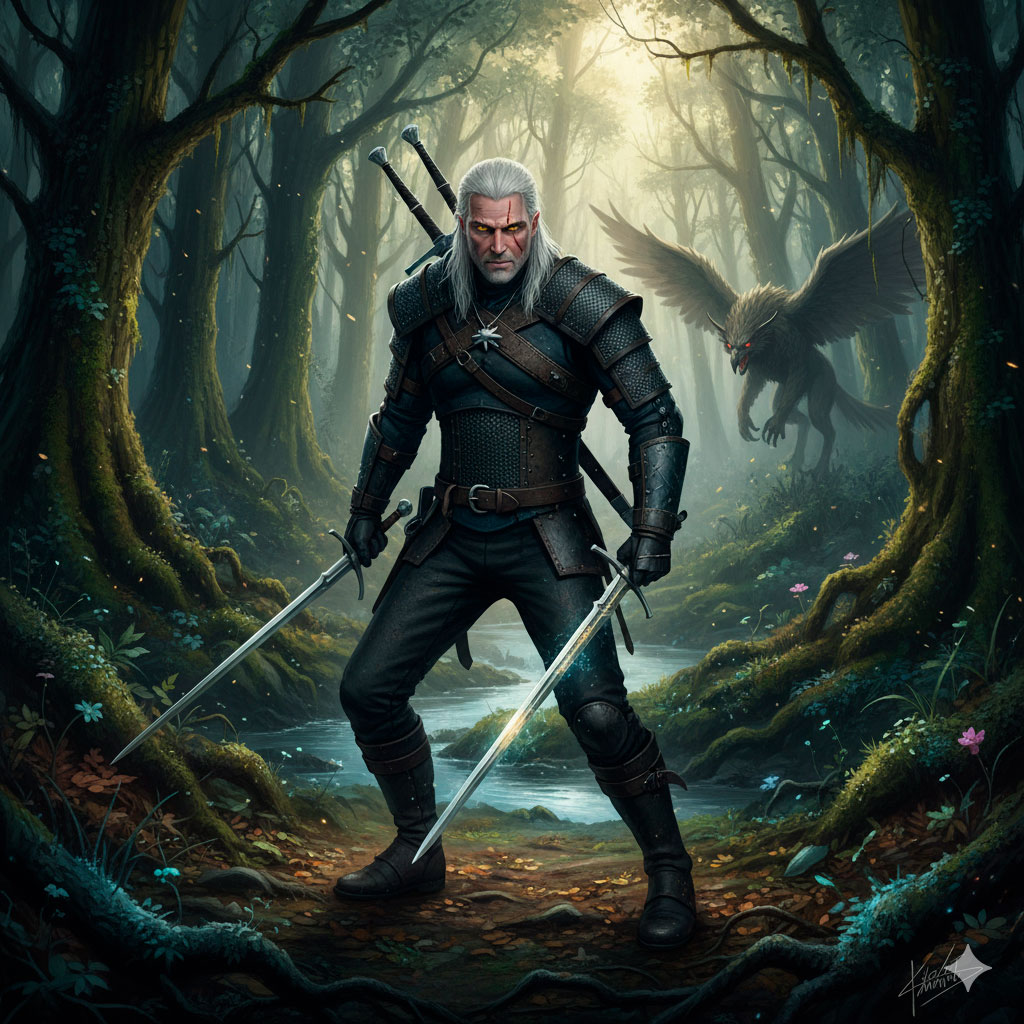
A Witcher’s armour is functional and allows agility, contrasting with some European plate armours. In Japan, samurai armour (yoroi) is a work of art and military engineering, designed for flexibility and protection against katanas and arrows. Geralt, accustomed to moving quickly, could find a perfect balance in this type of protection.
Witcher Armour Adaptations
- Lamellar and scaled: The lacquered plates of samurai armour, made of leather or metal, overlap, offering protection without restricting movement, similar to the mobility concept of Witcher armour.
- Lightness and strength: Samurai armour allows great agility, an essential characteristic for Geralt in combat. A Witcher would have to adapt the pieces for his magical protective layer or to insert potions and bombs.
- Aesthetic design: Although Geralt is practical, samurai armour inspired by his wolf aesthetic, with discreetly integrated Wolf School insignia, would be visually striking.
Adopting lacquered plate armour, perhaps with motifs and colours that recall his origin, would give him the appearance of a wandering warrior more in keeping with his new environment, while maintaining the functionality he needs for his challenges.
The Ronin Philosophy and Witcher Ethics: Similarities and Differences
Geralt’s ethics focus on a code of non-intervention and neutrality, often broken by his inherent sense of justice and his loyalty to those he cares about. The ronin, free from the ties of a lord, also lives by his own code, the bushidō, albeit in an often darker or more personal version. Both are outcasts, skilled fighters who operate outside social conventions.
Similarities and Contrasts
- Independence: Both Geralt and the ronin are solitary figures who respond to their own convictions and needs, not to feudal lords or kings. Their freedom allows them a more critical view of the world.
- Martial skill: Both are exceptional warriors, masters in the art of the sword and combat. Their lives depend on their ability to fight and defeat their adversaries, whether human or supernatural.
- Pragmatic morality: A Witcher’s morality is grey; a ronin’s can be too. Both are willing to do whatever it takes to survive or fulfil a contract, even if it means going against established norms.
However, motivations differ. The ronin seeks honour or redemption; Geralt simply to complete his task and get paid, though he often gets involved out of a sense of justice. A Geralt-ronin could merge both philosophies, seeking contracts not only for gold but also to protect the innocent.
The Imagined Journey: A Timeline for a Hypothetical ‘The Witcher’ in Japan
Imagining Geralt of Rivia in Feudal Japan opens up endless narrative possibilities, intertwining rich Japanese mythology with the essence of the Witcher we love so much. Here is a possible path for the “Wandering Wolf” in his new land.
| Era | Event |
|---|---|
| Sengoku Period (1467-1603) | |
| Mid-16th century | Geralt emerges from an interdimensional portal in the Kantō region, disoriented and unaware of how he arrived there. His first mission is to hunt a Kappa terrorising local fishermen. |
| Late 16th century | He meets a young masterless samurai (ronin) named Kenji, who becomes his companion and translator, helping him navigate the social complexities of Honshū. |
| 1580s | He becomes involved in a local conflict between two daimyō clans, where he discovers the existence of an Oni invoked by one of the factions. |
| Azuchi-Momoyama Period (1568-1600) | |
| 1590s | He hunts a Kitsune (fox spirit) that has been manipulating a feudal lord for its own benefit, revealing a web of deception at court. |
| Early 17th century | Geralt travels to Kantō to investigate rumours of a Tengu plague in the forests threatening mountain passes. |
| Edo Period (1603-1868) | |
| 1610s | He establishes his base in a small abandoned temple in a rural area, where he accepts contracts from villagers to combat Yūrei and other local spirits. |
| Mid-17th century | He uncovers a plot to unleash an ancient creature, the Raijū (thunder beast), and must join a group of Buddhist monks to stop it. |
| Late 17th century | Geralt encounters a mysterious Eastern Witcher, a hermit who might know the secret to returning him to his own world. |
Questions on the Path? Clearing Up Unknowns for the ‘Wandering Wolf’
How would the lack of Witcher-style magic in Japan affect Geralt?
Magic in “The Witcher” is based on elemental signs and potions that enhance Geralt’s physical abilities. In Japan, magic is more oriented towards Onmyōdō and Shintoism, invoking spirits and natural elements differently. Geralt would have to adapt his Signs to merge with local mysticism, perhaps learning to channel ki energy or purify areas using traditional Japanese methods in combination with his knowledge from Witcher schools. This process would be a challenge, but also an opportunity to expand his skills.
Could Geralt join a samurai clan or serve a daimyō?
Given Geralt’s independent nature and personal code, it would be unlikely for him to pledge total allegiance to a daimyō. However, he could offer his services temporarily, as a mercenary or a specialised consultant, maintaining his distance and neutrality. His usefulness in eliminating supernatural threats would make him valuable to any feudal lord, but his insistence on independence would keep him always on the fringes of society, like a ronin or a unique expert, accepting only the contracts he deems fair.
What types of weapons would be modified for Geralt in Japan?
In addition to his two swords, which would need aesthetic adaptation to not be completely out of place, Geralt could adopt auxiliary weapons such as kunai or shurikens, typical ninja tools that fit his fast and precise combat style. His bombs and traps could be camouflaged with local elements, such as bamboo baskets or small shrines. The introduction of light bows or crossbows, though less prominent than his sword use, could also be explored for specific contracts requiring a ranged approach, making his arsenal more diverse.
How would Geralt interact with Japanese culture and customs?
The strict social etiquette and profound spiritual beliefs of Feudal Japan would be a constant challenge for Geralt, known for his pragmatism and bluntness. Initially, his lack of understanding would lead to awkward or even dangerous situations. However, his ability to observe and adapt to the most hostile environments would allow him to learn. Probably, Kenji, his potential ronin companion, would play a crucial role in teaching him bushidō and the subtleties of communication, although his gruff nature would always resurface, making him an even more unique character.
What role would Witcher potions and mutations play in this new context?
Witcher potions, which grant temporary superhuman abilities, would be viewed with a mix of fear and awe by the Japanese. While they might be mistaken for Onmyōdō or Shinto magic, their alchemical basis is different. Geralt’s mutations—his pale skin, cat eyes, and superhuman resilience—would make him an even more mysterious and feared being. His appearance would permanently mark him as an “oni” or a “yōkai” to many, solidifying his role as an outcast, but also as a being with unique capabilities to confront the supernatural.
Discover our selection for The New Witcher: Geralt of Rivia, a Ronin in Japan?


Forging Legends: Geralt’s Legacy, Beyond Continents
The fantasy of Geralt of Rivia as a ronin in Feudal Japan is a fascinating idea, a convergence of two worlds rich in mythology and warrior values. This imagined adventure not only allows us to explore the depth of the character but also to appreciate the universality of the solitary hunter figure. For those who dream of wielding a katana or donning samurai armour, or who collect historical swords and medieval accessories, this vision of the White Wolf in the East is an invitation to explore our own connection to the legacy of legendary warriors.
All The Witcher Merchandise Here | Would you like to own the best The Witcher swords?