The True Story of Richard the Lionheart’s Sword in the Crusades
Richard the Lionheart’s sword sparks passion among medieval history enthusiasts. This iconic English king, nicknamed Lionheart for his unwavering courage, wielded a legendary weapon during the Third Crusade. Images of fierce battles in the Holy Land, relentless sieges, and chivalric charges are interwoven with his name, but how much of that narrative is truth and how much is pure mythology?
The mystery surrounding Richard the Lionheart’s sword lies in the thin line between legend and reality. For lovers of the Crusades, confusing myths represent a constant pain: tales that merge this sword with the Arthurian Excalibur or imaginary duels against Saladin. These distortions hide the authentic history of Richard the Lionheart in the crusades, leaving unanswered questions. Was it forged in 12th-century European workshops? Did it bear the symbols of the lion rampant, the emblem of his lineage?
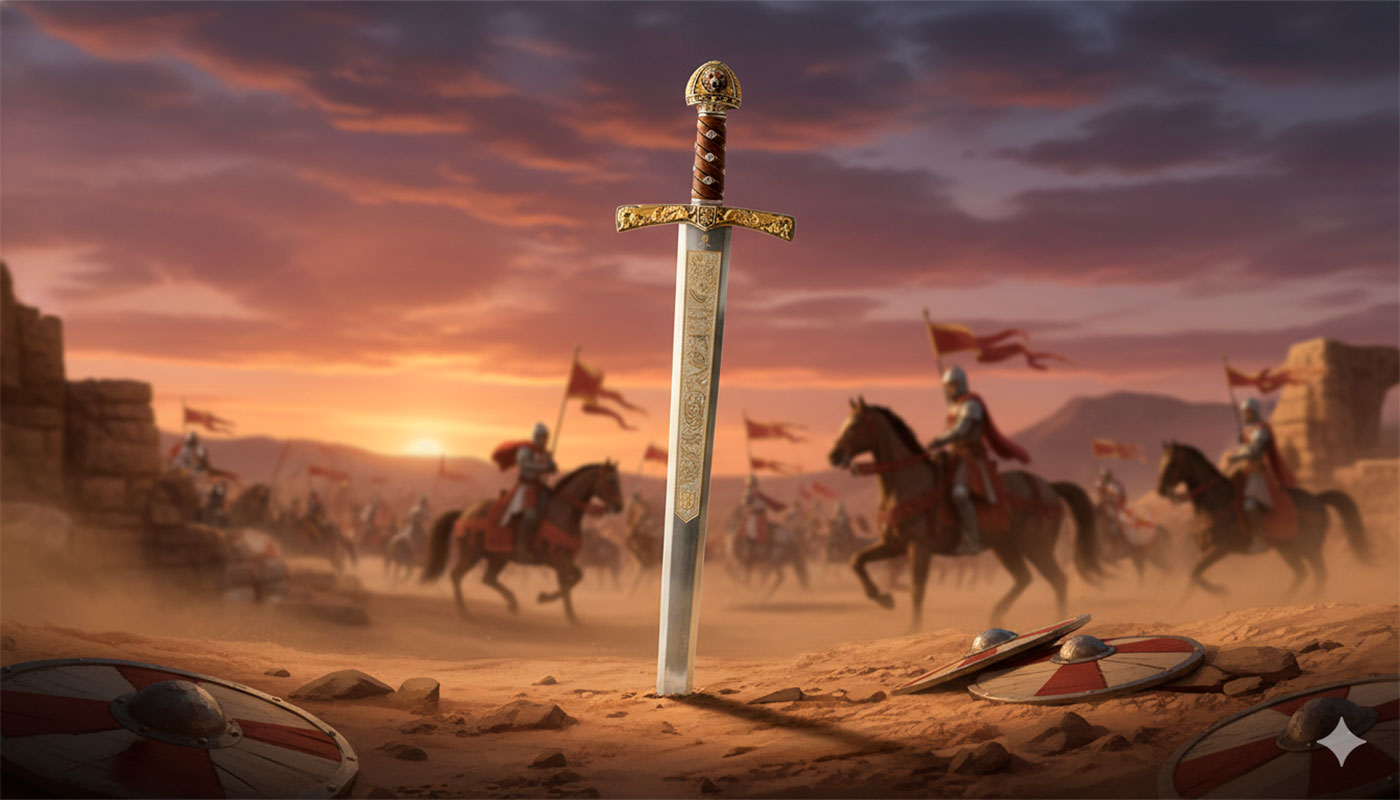
In this series, we promise to reveal the true story of Richard the Lionheart’s sword. We will go through contemporary chronicles detailing its use in key battles such as the Siege of Acre and the defense of Jaffa. We will analyze archaeological and textual evidence on historical swords of the crusades, differentiating fact from fiction.
Owning a faithful replica of Richard the Lionheart’s sword transcends mere possession. It offers the opportunity to hold in your hands a piece of the Third Crusade, to relive the warrior spirit of a monarch who defied Saladin and conquered legends. It connects directly with symbols of power and faith, enriching your collection with precise historical authenticity and avoiding the traps of inflated legends.
Richard’s Rebellious Youth: The Path to Becoming the Lionheart
Born on September 8, 1157, in Oxford, Richard was the third son of Henry II, King of England, and Eleanor of Aquitaine, one of the most powerful women in Europe. His Plantagenet family boiled with tension: parental ambitions clashed with those of their children, sowing the seeds of rebellion. From childhood, Richard showed a passion for chivalry and combat, training in the use of the sword that would later be known as Richard the Lionheart’s sword.
At age 16, in 1173, he joined the Great Revolt of his brothers Henry the Young King and Geoffrey against their father. Henry II invested him as Duke of Aquitaine to appease him, but Richard defended his duchies fiercely. In 1176, he crushed a revolt in Poitiers, capturing castles and demonstrating tactical cunning. His men admired him for his personal bravery in the fray.
The nickname “Lionheart” (Coeur de Lion) appeared in contemporary chronicles, attributed to his leonine courage and unwavering loyalty, possibly inspired by the lion rampant of his heraldry. In 1183, after the death of his brother Henry, Richard rebelled again, allying with Philip II of France. His father died in 1189, and Richard ascended to the English throne.
These youthful experiences forged the relentless warrior who would wield Richard the Lionheart’s sword in the Third Crusade. He dominated tournaments, sieges, and duels, preparing for epic battles against Saladin. His rebellious character, combined with martial prowess, made him the archetype of the crusader knight, ready to carve his legacy with sharpened steel.
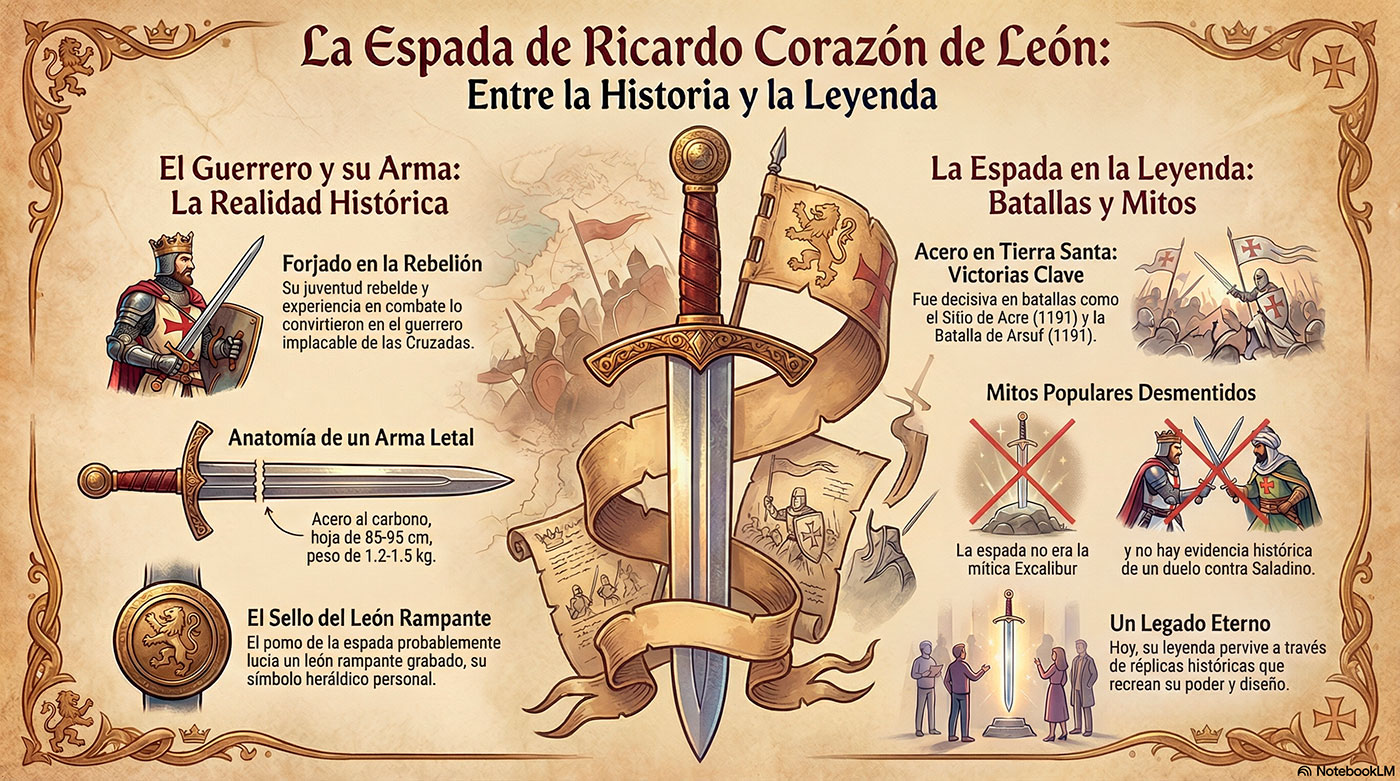
The Third Crusade: The Epic Setting for Richard and His Sword
The Third Crusade broke out in 1189, driven by Saladin’s capture of Jerusalem after the Battle of Hattin in 1187. European kings responded to the papal call: Richard the Lionheart of England, Philip II Augustus of France, and Frederick I Barbarossa of the Holy Roman Empire. Barbarossa drowned in 1190 while crossing Anatolia, while Philip and Richard arrived in the Holy Land in 1191.
Richard landed in Acre on June 8, 1191, revitalizing the two-year siege. With his Richard the Lionheart sword in hand, he led fierce assaults, catapults, and mines that forced the Muslim surrender in July. He ordered the execution of thousands of prisoners, a controversial act that sealed his ruthless reputation.
During the coastal march toward Jerusalem, Richard crushed Saladin’s forces at the Battle of Arsuf on September 7. His chivalric discipline broke the Ayyubid charges, with Richard the Lionheart’s sword cutting down enemies on the front line. This triumph elevated his weapon as a symbol of Christian power, possibly engraved with rampant lions evoking his heraldry.
In December 1191, he advanced as far as Beit Nuba but retreated due to logistics. He defended Jaffa in 1192 against a massive assault by Saladin, fighting while wounded with his legendary sword. He negotiated a truce in September, allowing Christian access to Jerusalem without total reconquest.
Chronicles like the Itinerarium Peregrinorum glorify his bravery, transforming Richard the Lionheart’s sword into an eternal emblem of crusader resistance in the Holy Land.
Authentic Design and Characteristics of Richard the Lionheart’s Sword
Although Richard the Lionheart’s original sword does not survive, evidence from historical crusader swords and contemporary chronicles allows for a precise reconstruction of its design. Classified as Oakeshott type XII or XIII, it featured a straight, double-edged blade, with a total length of 105-115 cm, a blade of 85-95 cm, and a sharp point for thrusting.
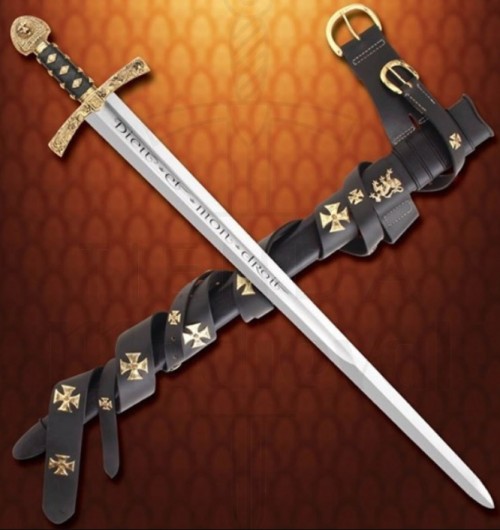 Forged from high-quality carbon steel, possibly using pattern-welded or twist techniques for greater strength. Differential tempering hardened the edge while maintaining flexibility in the spine. A balanced weight of 1.2-1.5 kg facilitated quick maneuvers in battle, from wide slashes against infantry to penetrations against cavalry.
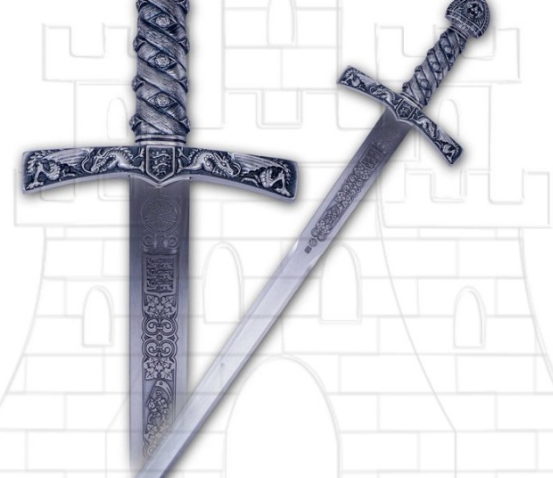
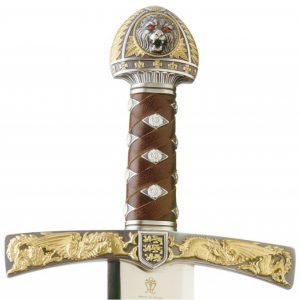
The cruciform guard, 18-22 cm wide, protected the hands with quillons curved outwards. Motifs of intertwined dragons on the guard evoked mythological ferocity, common in Norman weaponry. The straight grip, wrapped in cowhide or braided wire, measured 10-12 cm for a secure grip with a gauntlet.
The discoidal or pyriform pommel, carved in iron or bronze, displayed an engraved lion rampant, the quintessential Richard lion sword symbol. This heraldry personalized the sword of Richard the Lionheart, infusing royal pride and striking terror into the enemy.
These characteristics made Richard the Lionheart’s sword ideal for medieval combat: versatile against Saracen mail, balanced for duels and charges, and symbolically powerful in the Third Crusade.
The Sword in Action: Key Battles of the Crusades
The Siege of Acre in 1191 represented Richard’s triumphant debut in the Holy Land. After a two-year siege by weakened crusaders, his English fleet revitalized the effort. With Richard the Lionheart’s sword unsheathed, he commanded rolling siege towers and trebuchet bombardments. He personally led escalades under arrows and stones, where his weapon split Saracen chainmail in fierce melees, culminating in the capitulation on July 12.
 The Battle of Arsuf on September 7 showed his mastery of discipline. As the crusader column moved across the coastal plain, Saladin’s archers and light cavalry harassed them incessantly. Richard restrained impulsive charges from Templars and Hospitallers, waiting for the optimal moment. Upon giving the order, he led the massive charge with Richard the Lionheart’s sword raised, breaking through Ayyubid formations like a battering ram. His steel cut through spears, shields, and flesh, causing the enemy to rout and leading to a devastating pursuit.
In the defense of Jaffa in August 1192, with only 50 knights against thousands, Richard, wounded in the leg with incipient gangrene, took to horseback. Brandishing his legendary sword from the vanguard, he repelled successive waves, killing key emirs and restoring the spirit of his exhausted troops.
These feats elevated Richard the Lionheart’s sword as an icon among historical swords of the crusades, symbolizing unmatched leadership in Richard’s Third Crusade.
Myths and Legends: Excalibur, Saladin, and the Invincible Sword
Richard the Lionheart’s sword has inspired myths that transcend real history, merging medieval romanticism with later inventions. One “Excalibur Richard the Lionheart” legend claims that during the Third Crusade, Richard discovered or exchanged the mythical Arthurian sword from a rock in the Holy Land, granting him supernatural powers. This fusion arises from Renaissance chroniclers who mixed Arthurian sagas with crusader deeds, ignoring that Excalibur belongs to the 12th-century cycle by Geoffrey of Monmouth, prior to Richard.
Another popular myth, Richard vs Saladin’s sword, describes a singular duel where Richard splits the Ayyubid sultan’s scimitar in two with a single blow, symbolizing Christian superiority. 19th-century novels such as those by Walter Scott popularized this dramatic scene, but contemporary chronicles like those of Ambroise or the Itinerarium Peregrinorum record no personal encounter. Saladin and Richard respected each other from a distance, negotiating truces without one-on-one combat.
The notion of an invincible sword persists in tales where the weapon never dulls nor breaks, blessed by relics. In reality, historical crusader swords required constant sharpening and repairs, as shown by archaeological finds.
Demystifying these stories enriches the appreciation of the authentic Richard the Lionheart sword: a weapon forged for real war, not magic, which shone due to the skill of its wielder in battles like Arsuf and Acre.
Richard’s Death and the Eternal Legacy of His Sword
In March 1199, Richard was besieging the castle of Chalus-Chabrol in Limousin, France, demanding refused feudal tributes. Without full armor because of the heat, he was inspecting works when a crossbow arrow from Pierre Basile wounded him in the left shoulder on April 6. Surgical extraction failed; gangrene spread despite lancing and partial amputation. He died five days later, showing final courage by publicly forgiving his killer and advising mercy to his followers.
 His remains were divided according to tradition: his embalmed heart in Rouen Cathedral, viscera in Chalus, and body buried in Fontevraud Abbey alongside his parents Henry II and Eleanor of Aquitaine.
The precise fate of Richard the Lionheart’s sword is lost to history. Chronicles omit a specific inheritance; it possibly passed to his brother John Lackland for ceremonial use or was deposited in the royal treasury. Without the original artifact, chronicled descriptions guide meticulous Richard the Lionheart sword replicas for museums and collectors.
The legacy remains vibrant. Chroniclers like Roger of Howden and Matthew Paris exalted him as the supreme warrior of his era. Medieval art shows tomb effigies with his sword, and Norman tapestries with the lion rampant. Medieval and Renaissance epic literature, culminating in Walter Scott’s \”Ivanhoe,\” immortalized his deeds.
In modern times, films like \”Robin Hood: Prince of Thieves\” and festivals recreate his figure. Richard the Lionheart’s sword eternally symbolizes bravery in Richard’s Third Crusade, inspiring admiration for historical swords of the crusades.
Modern Replicas of Richard’s Sword: Hold History in Your Hands
Modern replicas faithfully recreate Richard the Lionheart’s sword based on the analysis of historical crusader swords and medieval chronicles. Forged by master blacksmiths using 5160 or 1095 high-carbon steel, they apply differential tempering for a resistant edge that maintains flexibility in the spine, replicating 12th-century techniques.
The blade measures 90 cm long, with a hexagonal section that tapers toward a thrusting point ideal for penetrating mail. A total weight of 1.4 kg ensures perfect balance between point and guard, allowing powerful slashes and precise thrusts as seen at Arsuf.
The 20 cm cruciform guard incorporates curved quillons with engravings of intertwined dragons, merging Norman and Oriental motifs observed in archaeological finds. The 11 cm grip, wrapped in braided brass wire over leather, offers an ergonomic grip even with mail gauntlets.
The forged steel pommel features a lion rampant in high relief, capturing essential Richard lion sword symbols in Richard’s heraldry. Patinated finishes simulate the wear and tear of campaigns in the Holy Land during Richard’s Third Crusade.
Want to learn about other Historical Swords?




These Richard the Lionheart sword replicas serve collectors and historical reenactors. They provide authentic handling for studying medieval fencing techniques, display in collections, and a tangible connection with Richard the Lionheart’s crusades. Functional versions withstand simulated combat; decorative ones highlight fine details for display cases.
Manufacturers like Windlass Steelcrafts or Marto in Spain offer models validated by experts in medieval weaponry, bridging past and present with historical accuracy.