How is it possible that a 9th-century warrior wielded a weapon whose metallurgical technology would not be seen again in Europe until the Industrial Revolution? Ulfberht swords are not just museum pieces; they are true historical anomalies, swords forged in the heat of battle with steel so pure it left modern archaeologists stunned. Imagine a world of brittle iron and rudimentary techniques where, suddenly, a flexible, light, and practically indestructible blade appears. Was it magic or a science that was a thousand years ahead of its time?
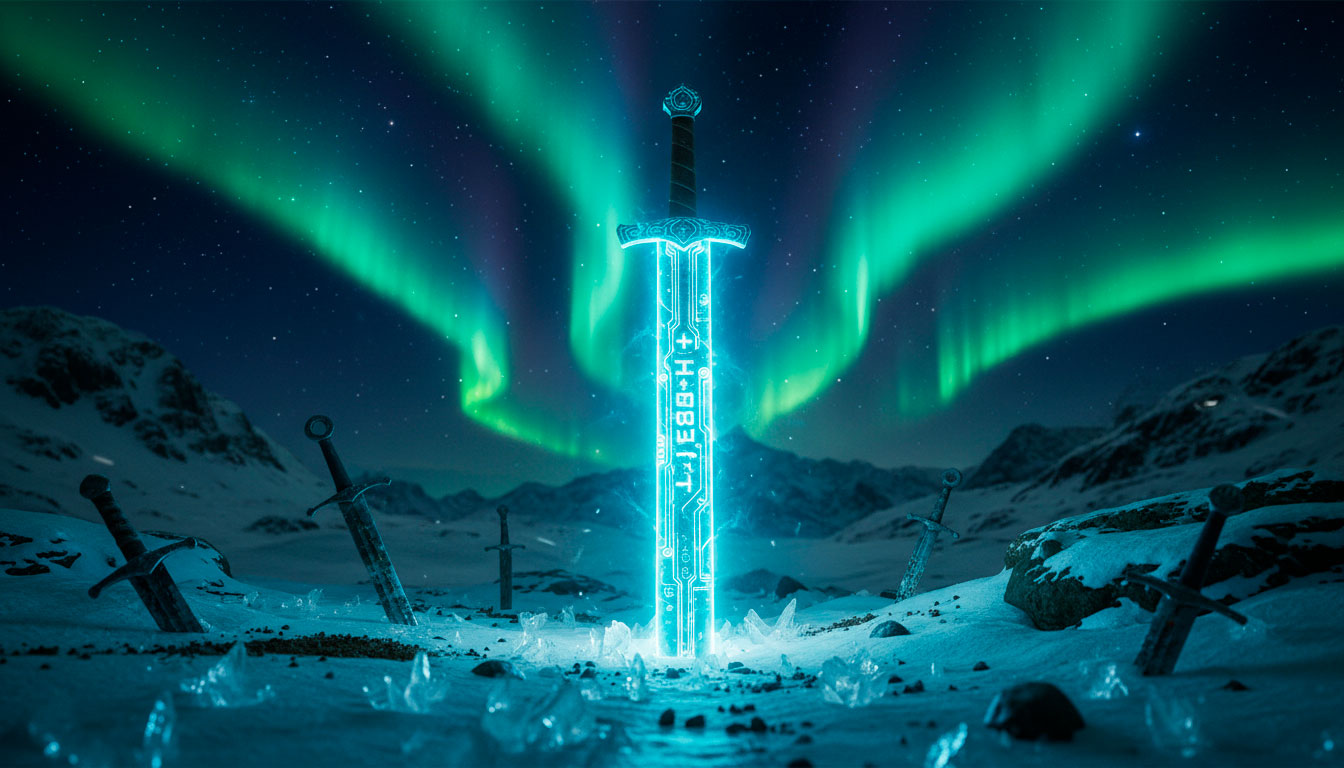
Ulfberht: production stages and diffusion in the High Middle Ages
Swords with the Ulfberht inscription are a benchmark of high-quality Viking metallurgy. Their history spans approximately between the 8th and 11th centuries (mainly 800–1000 AD) and reflects both the typological evolution of weapons and the dependence on trade routes for a supply of crucible steel. Below, we will explore the timeline of these legendary weapons:
| Era | Event |
|---|---|
| Late 8th – 9th century | Beginning of circulation through Europe; early examples date from 850 AD. |
| 9th – 10th centuries | General production range (800-1000 AD). Petersen’s Type H appears. |
| 10th century (c. 900) | Appearance of Type S. Persistence of the ‘brand’ for nearly 300 years. |
| 11th century | Late examples (Type X). Cessation of production in Norway due to religious changes. |
| c. 1000 AD | End of authentic manufacturing due to the closure of the Volga trade route. |
- Ulfberht Chronology Milestones
-
- 850 AD: First records of circulation in Europe of exceptional quality.
- 300 years: Estimated time that the Ulfberht workshop or guild remained active.
- Volga Route: Its closure cut the supply of necessary crucible steel.
The metallurgical enigma: crucible steel in the Viking age
The central mystery of the Ulfberht swords lies in the fact that their manufacturing technology appears to be ahead of its time by nearly a millennium. In the traditional medieval forging process, iron had to be heated to remove impurities, but the technology of the time rarely exceeded 1,100°C. However, to achieve the purity of an Ulfberht, the ore must reach 3,000 degrees Fahrenheit (1,600°C) to fully liquefy.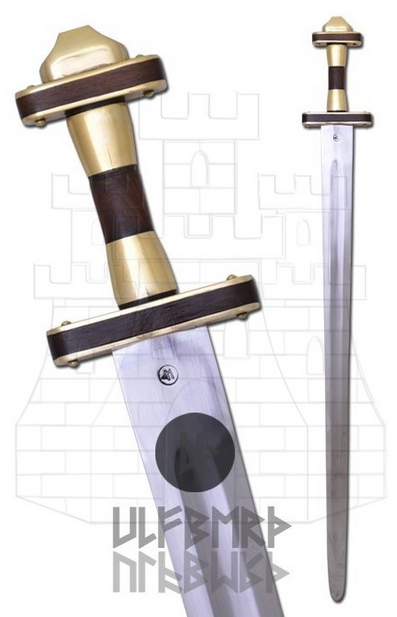
Unlike other medieval swords made of slag-choked iron, authentic Ulfberhts were forged with crucible steel. This metal was so pure and strong that it allowed for the creation of blades with a carbon content three times higher than that of its contemporaries. While a normal sword contained 0.4% carbon, the Ulfberhts reached up to 1.6%, classifying as hypereutectoid steel, comparable to modern spring steel.
Innovations in design and power on the battlefield
Today, our artisans recreate these pieces seeking to capture that unique essence. In ancient times, an Ulfberht was not only more resistant but also faster. The blade design tapered progressively toward the tip, allowing it to penetrate chain mail with astonishing ease. Additionally, the balance shifted toward the hand, allowing for a quick feint and an immediate recovery after the strike.
The signature of the gods: +VLFBERH+T versus copies
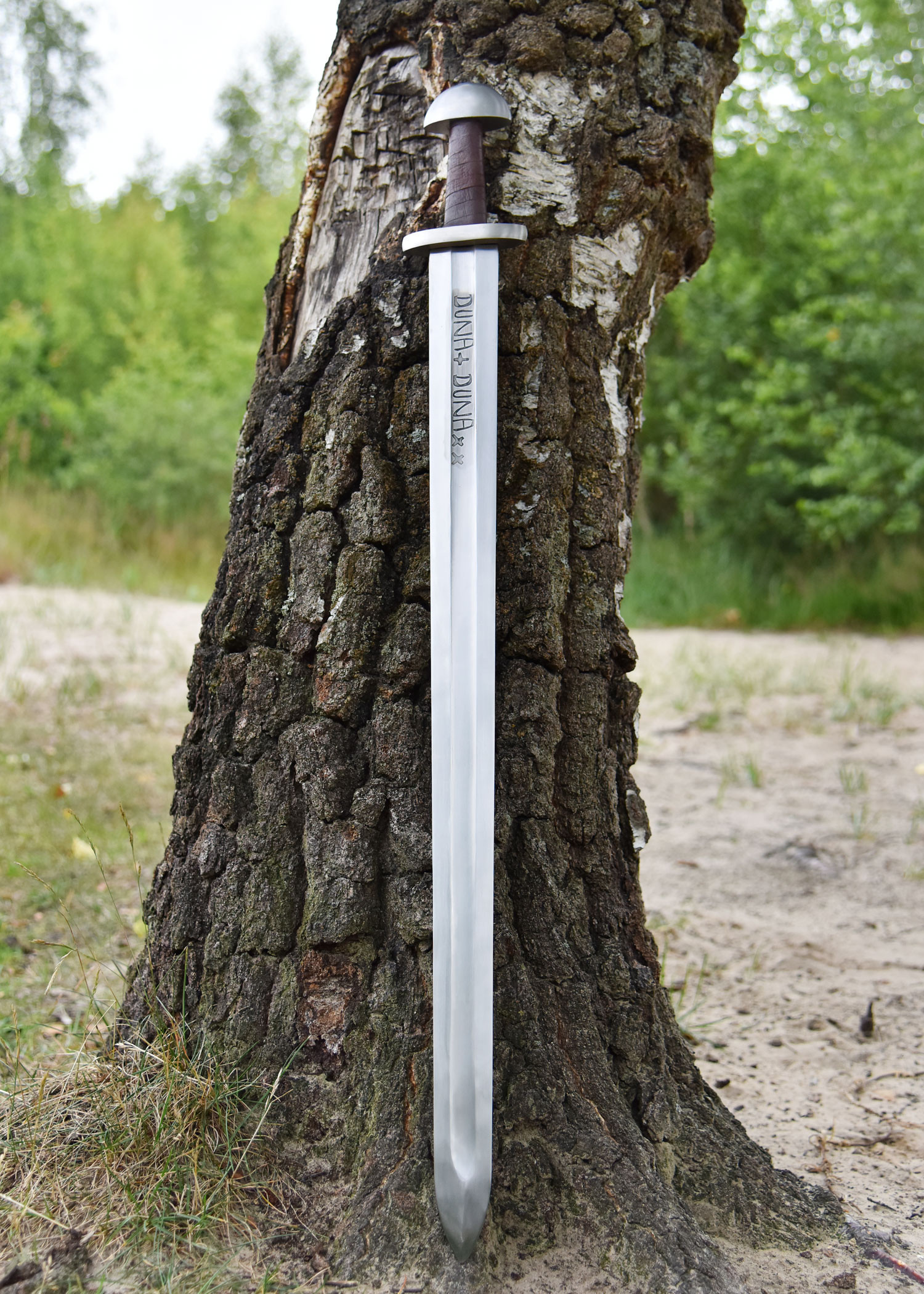
The name “Ulfberht” functioned as an absolute luxury brand. It was the status symbol of the Viking elite, reserved for highly renowned warriors. Due to its prestige, lower-quality forgeries soon appeared. The secret to distinguishing them lies in the inscription: originals usually read +VLFBERH+T (with the cross before the T), while medieval copies often wrote +VLFBERHT+.
The consequences of wielding a forgery were often fatal. While the authentic Ulfberht was elastic and could bend against a shield without breaking, copies made of local iron became brittle when tempered, shattering into a thousand pieces at the most critical moment of the fight.
Oriental origin and the Volga Route
Where did this “magical” steel come from? Research points to the fact that Vikings did not smelt this metal in the north, but instead imported crucible steel ingots from Central Asia via the Volga Route. This trade connection allowed Frankish and Norse blacksmiths access to materials produced in superior furnaces from the Middle East and India. When this trade route closed around the year 1000 AD, the secret of the Ulfberht disappeared from Europe, losing a technology that would take centuries to be rediscovered.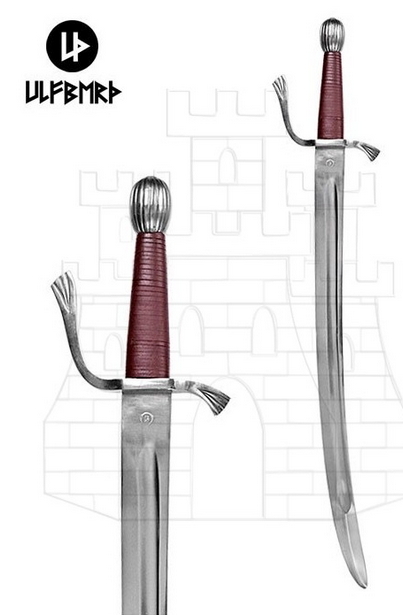
Clearing up unknowns about the legendary Ulfberht swords
How do Ulfberht swords compare to other medieval swords in terms of durability?
Ulfberht swords were significantly more durable and of better quality than other medieval swords of their era.
Ulfberht swords stood out for their exceptional purity steel with a carbon content of approximately 0.75%, while previous swords manufactured using the pattern welding technique only contained between 0.4 and 0.5% carbon. This higher concentration of carbon resulted in blades that were simultaneously harder, more flexible, and less brittle than their predecessors.
Before the Ulfberht, European swords used a different process: soft iron bars were welded together with steel strips, the latter being welded to the edge. In contrast, Ulfberht swords represented a technological leap, being manufactured from complete sheets of high-quality carbon steel, produced through crucible steel ingots that resulted in a material with hardly any impurities or slag.
The result was an elastic, flexible but hard and resistant blade, capable of maintaining its structural integrity better than other contemporary swords. The Rockwell hardness of the Ulfberht reached 48-52 HRC, which guaranteed exceptional longevity even in intense combat scenarios.
The purity of the steel used in the Ulfberht was so advanced that it would not be reached again in Europe until centuries later, positioning them as the quality standard during the Viking era and consolidating them among the most notable weapons of their time.
What specific techniques were used to smelt the steel in Ulfberht swords?
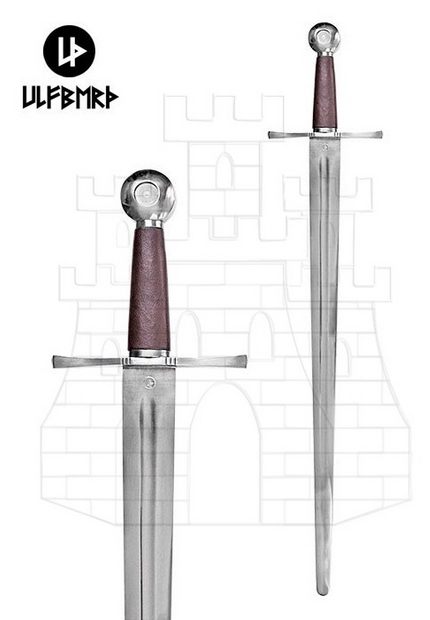 Ulfberht swords were forged using the crucible smelting technique, also called crucible steel, which represented a revolutionary advancement for the time.
The method consisted of improved shaft furnaces that allowed for the extraction of high concentrations of iron from raw ore. Carbon was selectively added to this purified iron, creating a single-piece solid crucible steel, unlike traditional methods that welded multiple layers.
The technique required reaching temperatures above 1600°C, substantially higher than the 1100°C used in traditional forging. This extreme heat was unthinkable in common medieval furnaces and represented highly advanced metallurgical knowledge.
The resulting steel contained approximately 0.65% carbon (1065 carbon steel), achieving a perfect balance between hardness and flexibility. This allowed for the production of practically pure blades, without impurities or slag, eliminating the need to stack multiple layers of low-quality iron as other blacksmiths did.
Once forged, these blades reached a hardness of 50-55 HRC on the Rockwell scale, far superior to the 20-30 HRC of traditional weapons, allowing for swords that did not bend in combat and maintained their edge after multiple uses.
What is the historical importance of Ulfberht swords in Viking culture?
Ulfberht swords represent a superior technological advancement in the Viking era (9th-11th centuries), manufactured with high-purity steel that was extremely hard, light, and flexible, making them ideal for close-quarters combat without getting stuck in shields or armor.
Their historical importance lies in three key aspects:
- Elite Status Symbol: They were very expensive luxury items, accessible only to wealthy and influential warriors, reserved for the Viking nobility, unlike common axes or spears.
- Mark of Quality and Prestige: They bore the inscription \”+VLFBERH+T\”, which indicated artisanal excellence; their fame generated forgeries, and they were used in sagas and skaldic poetry as emblems of honor and power.
- Innovation and Mystery: Possibly coming from Frankish regions like the Rhine, they were ahead of their time in metallurgy (with impurities like arsenic); about 170 have been found in Norse tombs, reflecting the height of Viking raids and the transition to High Medieval swords.
What differences exist between authentic Ulfberht swords and modernly recreated ones?
Authentic Ulfberht swords (9th-11th centuries) are distinguished from modernly recreated ones by their metallic composition, forging quality, performance, and historical authenticity.
- Steel Composition and Purity
- Authentic: Forged with crucible steel (similar to wootz), high purity with 0.65% carbon, almost no impurities or slag, three times more carbon than contemporary iron. Requires temperatures of 1600°C+, impossible in local Viking furnaces (probably imported from the Middle East or Central Asia).
- Modern: Use 1065 steel or industrial equivalents, produced with Industrial Revolution technologies (modern furnaces), but do not replicate the exact purity of Viking crucible steel.
- Forging Technique and Structure
- Authentic: Single monolithic piece blade, not welded strips or twisted bars (common pattern-welded technique of the era). Hardness 50-55 HRC (Rockwell), flexible, unbreakable, and maintains edge after heavy use.
- Modern: Forged with controlled methods (electric furnaces, precise welding), but often imitate the braided or geometric pattern on the surface without achieving authentic monolithic homogeneity.
- Design and Performance
- Authentic: Total length ~91 cm, blade ~77 cm, weight ~1.36 kg, with progressive tapering toward the tip to penetrate chain mail. Light, balanced, fast, and flexible (they bend without breaking when stuck in shields).
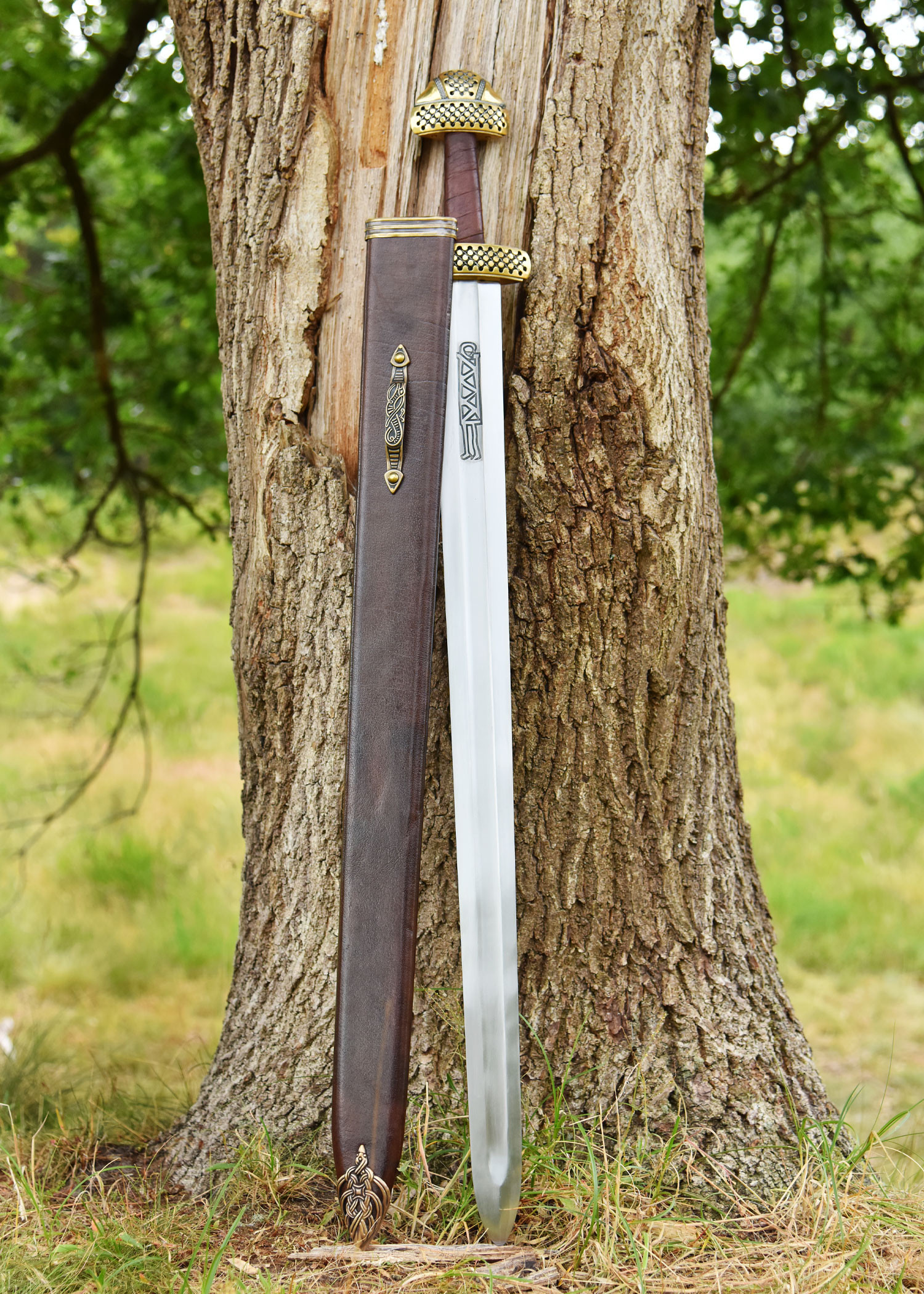
- Modern: Replicas identical in dimensions and engravings (+VLFBERHT+ with Greek crosses), but less flexible and durable in actual combat tests; they lose their edge faster.
- Authenticity and Context
- Authentic: ~170 existing specimens, found in rivers (accidental losses) or noble tombs; a symbol of the Viking elite, with inlaid geometric patterns (braiding).
- Modern: Include medieval imitations (low quality, less carbon, exhumed in tombs) and current replicas; the former were \”fakes\” to capitalize on prestige, while modern ones seek precision but do not match the original technological mystery.



How did Ulfberht sword technology influence the development of later weapons?
The available search results do not contain information on how Ulfberht sword technology influenced the development of later weapons.
The documents focus exclusively on the technical characteristics of the Ulfberht swords themselves — their carbon steel composition, unique blade design, balance, and combat performance — but do not address their technological legacy or their impact on the evolution of subsequent armaments.
To properly answer your question, it would be necessary to access historiographical sources that analyze the transmission of metallurgical knowledge after the Viking period, the adoption of similar forging techniques in other European cultures, or studies on the technological continuity between the Viking era and later periods of the Middle Ages.
The legacy of a lost technology
Ulfberhts represent the ideal convergence between global trade, advanced metallurgical science, and elite craftsmanship. Owning one of these swords was not just a matter of defense, but of carrying in one’s hand the pinnacle of human engineering of its time. Although the secret of its crucible steel vanished with the closure of trade routes, its legend lives on in every replica and in the wonder of those who study its history. They were, and still are, the gold standard of the Viking era.
VIEW ULFBERHT FUNCTIONAL SWORDS | VIEW MORE VIKING SWORDS | VIEW FUNCTIONAL SWORDS