What secrets does the edge of a sword forged in history’s crucible conceal? Within the annals of time, few objects capture the imagination like legendary swords, and among them, Godfrey I’s Sword emerges as a standard of valor, faith, and leadership. But who was this Godfrey, and why does his sword resonate so strongly through the centuries? Join us on this journey through history to discover the true meaning of this iconic weapon, unraveling its military and spiritual legacy for the medieval world.

A Journey Through Time: Chronology of the Godfreys and the Evolution of Swords
History presents us with several leaders named Godfrey, each leaving their mark in different eras and contributing to the evolution of the weapons that accompanied them. It is vital to differentiate between them to understand the true narrative of Godfrey I’s sword, that is, Godfrey of Bouillon.
| Era | Event |
|---|---|
| 8th Century — Godfrey I (King of the Danes) | |
| 8th Century | Godfrey I, King of the Danes, is also credited with ordering the construction of the Danevirke. Sources do not associate a specific sword with this monarch. |
| Viking Age and Transition (late 8th century – 9th century) | |
| Late 8th century – 8th–11th centuries | Viking Age swords include Carolingian styles and the famous Ulfberht swords, which began to circulate towards the end of the 8th century and reached their peak between the 8th and 11th centuries. |
| 9th Century — Godfrey of Frisia | Godfrey of Frisia, a Danish Viking chieftain, was born in the 9th century and active in the late 9th century. |
| Year 880 | Godfrey plunders Flanders. |
| Year 882 | Begins looting in Lotharingia; Emperor Charles III the Fat grants him the Duchy of Frisia. |
| 882–885 | Controls a large part of Frisia. |
| June 885 | Godfrey of Frisia is assassinated. |
| Late 11th Century — First Crusade and Godfrey of Bouillon | |
| 1096–1099 (First Crusade) | The First Crusade transforms military tactics and equipment. A transition occurs in sword design towards forms more adapted to cavalry and High Middle Ages combat. |
| 1099–1100 | Godfrey of Bouillon, one of the leaders of the First Crusade, becomes the first ruler of the Kingdom of Jerusalem (dies in 1100). The famous sword that inspires modern replicas is associated with him. |
| Typology and Design (Context) | Swords contemporary with the First Crusade correspond, according to Oakeshott’s typology, to Types X, Xa, XI, and XII. Type X is a remnant of the Viking Age (wide and crude blade); Type XI emerges around the beginning of the Crusade, designed for mounted combat. |
| Modern Replica | The replica called “Templar Sword 322” is based on the design attributed to Godfrey of Bouillon’s sword and on the sword forms typical of the High Middle Ages. |
| Summary: Evolution of Armament | |
| Chronological Evolution | The Ulfberht and Carolingian swords of the Viking Age (8th–11th centuries) constitute the early models; by the late 11th century, forms evolve towards Oakeshott typologies (XI/XII) more adapted to cavalry and the knight’s combat style, exemplified in the sword associated with Godfrey of Bouillon and replicated today as the Templar Sword 322. |
- Godfrey I (King of the Danes)
-
- 8th Century: King of the Danes, credited with ordering the construction of the Danevirke. No specific sword is associated with this monarch.
- Viking Age and Transition
-
- Late 8th century – 8th–11th centuries: Viking period swords include Carolingian styles and the famous Ulfberht swords.
- 9th Century: Godfrey of Frisia, Danish Viking chieftain. Plunders Flanders (880), Lotharingia (882), and controls much of Frisia (882–885). Assassinated in June 885.
- Late 11th Century — First Crusade and Godfrey of Bouillon
-
- 1096–1099: The First Crusade transforms tactics and military equipment; swords adapt to cavalry.
- 1099–1100: Godfrey of Bouillon, leader of the First Crusade and first ruler of the Kingdom of Jerusalem. His sword inspires modern replicas.
- Typology and Design: Swords from the First Crusade correspond to Oakeshott’s Types X, Xa, XI, and XII.
- Modern Replica: The “Templar Sword 322” is based on the design attributed to Godfrey of Bouillon’s sword and on the forms of High Middle Ages swords.
- Summary: Evolution of Armament
-
- Chronological Evolution: The Ulfberht and Carolingian swords of the Viking Age (8th–11th centuries) evolve into Oakeshott typologies (XI/XII) more adapted to cavalry, such as the sword associated with Godfrey of Bouillon.
The Forging of a Legacy: Godfrey and His Impact
When we evoke the name Godfrey associated with a legendary sword, we dive into the epic deeds of Godfrey of Bouillon, a central figure of the First Crusade. This nobleman was not only the first ruler of the Kingdom of Jerusalem, but his leadership and profound sense of Christian humility made him a legend. His sword, a tangible symbol of his power and devotion, is much more than a weapon; it is a testament to an unbreakable spirit.
Godfrey I’s Sword, almost a millennium old, was not only a combat tool but an emblem that represented the union of military strength and unwavering faith. This leader, who guided an army of approximately 40,000 men in the First Crusade, did not seek an earthly crown, but the title of “Advocate of the Holy Sepulchre,” famously declaring: “I will not wear a crown of gold where Christ wore one of thorns.” This decision marked a milestone of religious humility that has transcended to this day.
The Sword, a Reflection of its Bearer
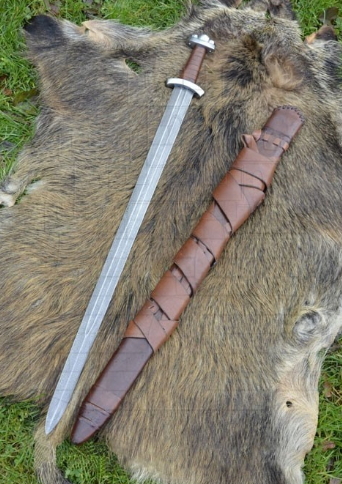
A sword is the soul of the warrior. In Godfrey of Bouillon’s case, the weapon symbolized his leadership and dedication to the cause. Modern replicas, such as the well-known Templar Sword 322, capture the essence of those blades, masterfully forged by experts who followed traditional techniques. Every detail, from the edge to the hilt, was crucial for the perfection of the sword, an art where functionality met aesthetics.
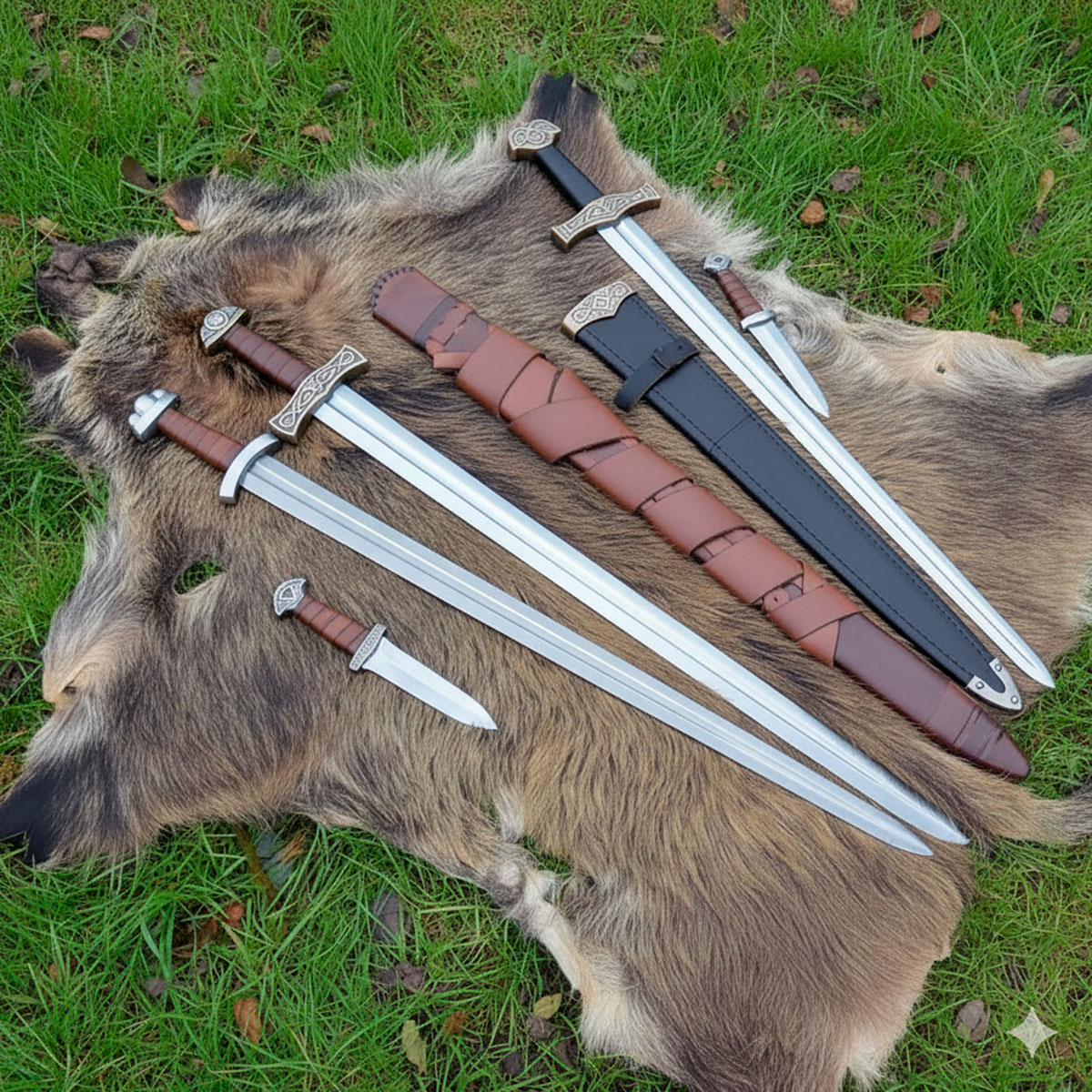
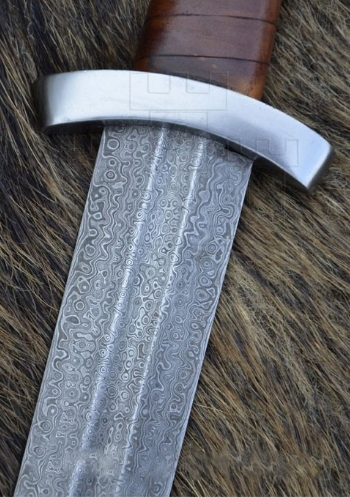
These replicas of swords forged in 100-layer folded Damascus steel, with riveted pommels and leather-covered wooden scabbards, are more than simple objects. They are invitations to connect with history, to feel the weight of millennia of battles, and to understand the significance of those who wielded them.


Clearing Up Mysteries About Godfrey’s Sword and Its Legacy
What symbolism does Godfrey of Bouillon’s sword hold?
Godfrey of Bouillon’s sword possesses a deep, multidimensional symbolism that transcends its function as a weapon.
Symbol of Authority and Crusader Leadership
 The sword represents Godfrey’s military authority as leader of the First Crusade and conqueror of Jerusalem in 1099. It has become an emblem of the Frankish ruler’s power and influence over the Kingdom of Jerusalem, acquiring great historical and cultural importance throughout the centuries.
Emblem of Humility and Christian Faith
The deepest symbolism of this sword is linked to Godfrey’s rejection of a golden crown after the conquest of Jerusalem. He adopted the title “Protector of the Holy Sepulchre” instead of accepting coronation as king, famously stating: “I will not wear a crown of gold where Christ wore one of thorns.” This decision reflects profound religious humility, and the sword is frequently displayed alongside the column of the flagellation, a relic that underscores Christ’s suffering and reinforces the spiritual aspect of the crusading enterprise.
Sacred Significance in Ceremonies
 The sword acquired a fundamental ceremonial role in the Order of the Holy Sepulchre. From the 16th century, it was used in the investiture ceremonies of new knights, where the Franciscan Custos of the Holy Land would perform the anointing with it, tracing the cross in the air three times before touching the candidate’s shoulders. This ritual use transformed the sword into an object for the transmission of faith and ecclesiastical authority, allowing each new knight to symbolically connect with the legacy of the Crusades and with Godfrey himself.
How did Godfrey’s sword influence investiture ceremonies?
Godfrey of Bouillon’s sword had a profound and symbolic influence on the investiture ceremonies of the Order of the Holy Sepulchre of Jerusalem.
The Origin of the Practice
After the conquest of Jerusalem in 1099 by Godfrey of Bouillon, the Knights of the Holy Sepulchre order was established. In the first decades of the 14th century, when this order began to systematically confer investitures, the ceremony focused specifically on the use of a particular sword: the one supposedly belonging to Godfrey himself.
The Investiture Ceremony
The ceremony followed a very specific ritual. The candidate would draw the sword from its scabbard and hand it to the celebrant, who would draw the sign of the cross three times in the air with it and then touch the candidate’s shoulders with the weapon. At the end of the rite, the new knight would return the sword to the Custos of the Holy Land, as the used specimen was considered a historical relic.
Symbolic Meaning
Godfrey’s sword was not merely a weapon, but a symbol of continuity with the founder of the order and with the ideals he represented. Godfrey had rejected the title of King of Jerusalem with the phrase “I will not wear a crown of gold where Christ wore one of thorns,” adopting instead the title of Protector of the Holy Sepulchre. His sword, displayed alongside relics of Christ’s Passion, reinforced this sacralized character of the order.
The presence of this specific sword in the investiture ceremonies transformed the act into more than a simple transmission of power: it became a tangible connection to the founder of the order and to the religious values that sustained it.
What other historical objects are exhibited alongside Godfrey’s sword?
 Alongside Godfrey’s sword, other historical objects are displayed, such as a silver tray offered by the Grand Duke of Tuscany, which is a work of great fineness and historical significance. Also noteworthy is a model of the Holy Sepulchre made by the Franciscan Bartolomé de las Heras in one of the museum rooms where the sword is located. These objects accompany the sword and enrich the historical and spiritual context of the exhibition. Furthermore, they are protected pieces valued for their symbolic charge and connection to the Holy Land.
What is the history behind Godfrey of Frisia’s sword?
Godfrey of Frisia’s sword is associated with Godfrey, a Danish king from the Viking Age who dominated Frisia in the late 9th century. He was a powerful leader who expanded his control over the region, establishing tactical bases and making pacts with the French Crown to consolidate his power. His rule was characterized by violence and territorial ambition but ended with his assassination in 885 by local nobles, which led to the end of his dominion and the retreat of Danish control in the area. The sword symbolizes his figure as a warrior and Viking leader, although there is no concrete evidence that the sword attributed to him is authentic; its history is intertwined with legends and tales about his strength and authority.
What characteristics does a decorative crusader sword have?
A decorative crusader sword is characterized by having a long, straight blade, typically made of stainless steel, with a length of around 75 to 83 cm. Its hilt is cruciform, meaning it has a cross-shaped guard that symbolizes its connection with crusader knights. The pommel is usually cross-shaped and sometimes includes details such as a red cross, decorative engravings, or brass decorations that reinforce its symbolic and medieval appearance. The grip can be leather-wrapped for a comfortable and secure hold. These swords are replicas designed with attention to detail for display, not made for real combat, and usually come with a decorative scabbard, often made of leather.
Its main characteristics are:
- Long, straight, stainless steel blade.
- Cruciform hilt and pommel with cross-shaped decoration.
- Decorative details such as engravings on the blade or brass finishes.
- Ergonomic grip, often with leather covering.
- Decorative replica inspired by medieval weapons from the 11th to 13th centuries.
These characteristics reflect both the historical functionality and the symbolic charge of the swords used by crusader knights.
The Echo of Swords in the Modern Era
Swords, like Godfrey of Bouillon’s, continue to inspire the creation of replicas that allow history and medieval culture enthusiasts to connect with the past. Today, these decorative pieces are designed with meticulous attention to detail, replicating the blade, the cruciform hilt, and the decorative motifs that evoke the crusading era. Each replica is a tribute to the strength, faith, and legend that these swords represented.