Have you ever wondered how medieval knights dominated the battlefield, or how an ancient weapon like the axe transformed into a symbol of their power? Get ready to unveil the secrets of one of history’s most feared and versatile tools of war: the cavalry axe. In the heat of the Middle Ages, before they were instruments of war, these formidable weapons were born as working tools, shaped by necessity and cunning to become effective combat machines, capable of a cutting power that instantly put the enemy out of action.
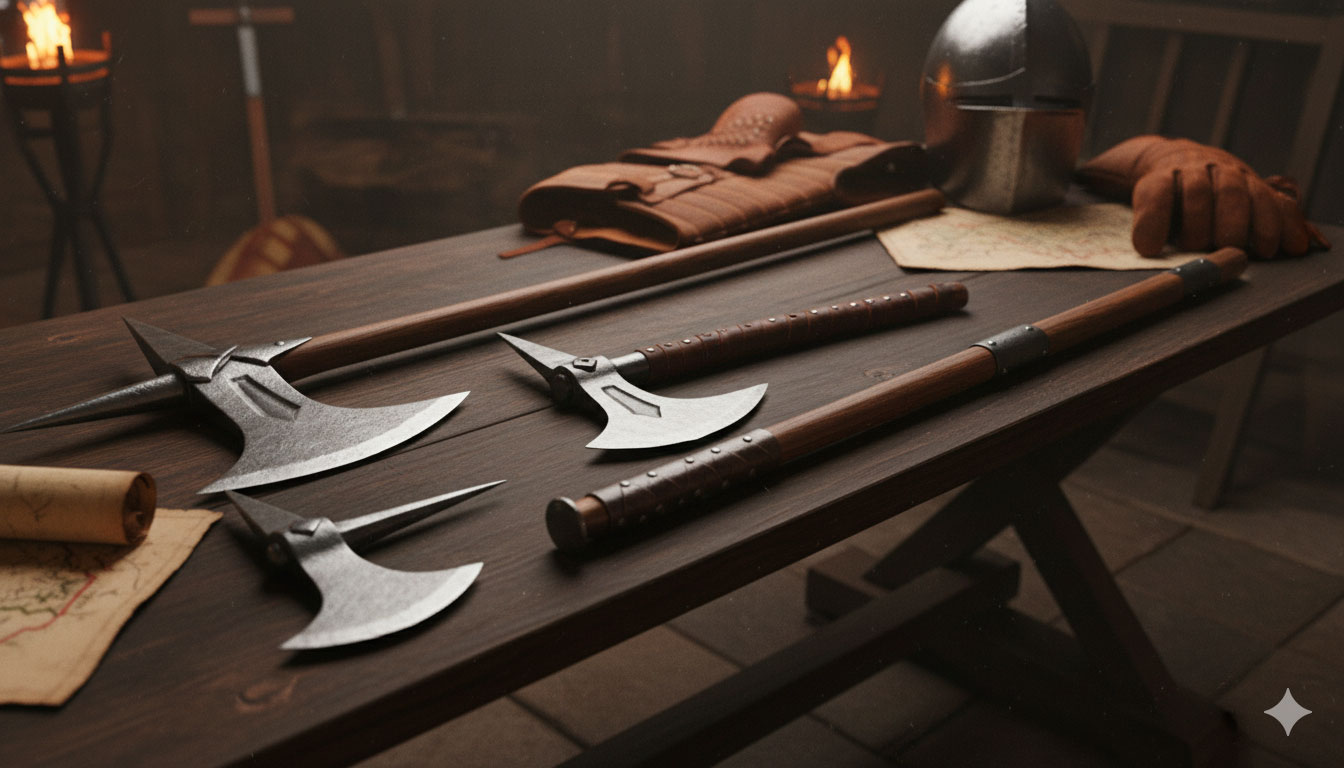
This article will guide you through the fascinating evolution of the cavalry axe, from its humble origins to its crucial role in tournaments and battlefields. You will discover how to select the perfect replica for your historical reenactment, understanding the importance of its design, materials, and the era it represents.
Let the forging of your legend begin!
Axes and Cavalry: Evolution of the Weapon from Late Antiquity to the Modern Age
The following table summarizes, by periods and approximate dates, the morphological and tactical evolution of axes used by troops with cavalry participation, from the Francisca of the Franks to specialization against armor and its decline with gunpowder artillery.
| Era | Event |
|---|---|
| Late Antiquity and Early Middle Ages (c. 500 – 1000) | |
| c. 486 – 507 | Francisca: throwing axe characteristic of the Franks; decisive in battles such as Soissons (486) and Vouillé (507). |
| c. 500 – 750 (and up to 768–814) | Tactical use of the Francisca: thrown in the first charge to break shields and cause casualties prior to hand-to-hand combat; continued use during the reign of Charlemagne (768–814). Procopius (6th century) describes it alongside sword and shield; effective range ≈12 m. |
| High / Full Middle Ages (c. 970 – 13th c.) | |
| Winter 970–971 | Viking Axe (Mammen): late archaeological example from the 10th century illustrating the long shape and broad blade of Danish/Viking axes. |
| c. 970 – 11th c. (1066) | Danish / Viking Axe: long, two-handed weapon, predominant in elite infantry (huscarls). Emblematic use in the Battle of Hastings (Oct 14, 1066). |
| 11th – 13th Centuries | Heavy cavalry standarizes lance and sword; the axe remains as a secondary or reserve weapon (also admitted by rules such as the Code of the Templars). Design for equestrian use: shorter handle, concentrated head, one-handed handling; maintained effectiveness against mail and leather until the 13th century. |
| Late Middle Ages and Specialization (14th – 16th c.) | |
| 14th Century | Decline of the traditional edge: against hardened plates, the edge would be damaged; the cutting axe lost effectiveness and cavalry resorted to maces and war hammers (bec de corbin) that prioritized impact and perforation. |
| 15th Century (max. mid-15th c.) | Poleaxe: specialized weapon against full plate armor; long handle (≈1.5–2 m) with multi-function head (blade, hammer and piercing point). Tactical peak: it became the main weapon against armor, especially in dismounted combat; shorter versions usable on horseback existed. |
| 1506 – 1512 | Castilian inventories (Torremormojón 1506; Pedraza de la Sierra 1512) record “battle axes” large and small, reflecting their standard presence in arsenals and fortresses of the early 16th century. |
| Modern Age and Final Decline (16th – 19th c.) | |
| 16th – 17th Centuries | Czekan: hybrid weapon (axe-hammer) used by shock cavalry in Eastern Europe, notably by the Winged Hussars in the 16th–17th centuries; designed for concentrated impact against heavy protection. |
| 16th – 18th Centuries | Gunpowder and firearms (arquebuses, muskets) subordinate heavy cavalry; plate armor and the pollaxe decline as artillery and modern tactics change the battlefield. |
| 18th – 19th Centuries | Axes move to utilitarian roles (felling, construction) and secondary “in extremis” weapons. Limited persistence in specialized troops and in regions with less military development; references of use until the 19th century in some contexts. |
The Cavalry Axe: A Fearsome Weapon in Expert Hands

The medieval cavalry axe was the scourge of adversaries, a weapon employed by daring knights. It was forged with a curved, heavy, and compact iron blade, fitted to a wooden handle. Its design allowed it to trap enemy weapons, while its one-handed handling, expertly executed from horseback, turned every blow into a sentence. It was capable of splintering shields, tearing through mail protection, and pulverizing plate armor. A formidable tool that spread terror uninterrupted throughout the Middle Ages.
Historical replicas of these cavalry axes often incorporate a spike or hook, a feature used by seasoned riders to unbalance or quickly dismount their adversaries, hooking them by their armor or their own mount. Each piece is handcrafted, recreating the essence of a legendary weapon.
Types of Axes for Reenactment: Forge Your Historical Identity
Choosing your axe for historical reenactment is like embarking on a journey through time, deciding which warrior, which era, and which combat style you want to embody. The evolution of axes was a reflection of the tactics and armor of each period. Here we present the most relevant types for mounted combat, which will help you define your choice:
Early Middle Ages and Throwing Axes (5th-11th Centuries): The Francisca
| Characteristic | Specifications | Context for Reenactment |
|---|---|---|
| Tactical Use | Throwing weapon used in the first charge to break shields and disorganize the enemy before hand-to-hand contact. | Ideal for representing Frankish warriors or the initial shock tactics of this people. |
| Design | Head clearly arc-shaped, widening towards the cutting edge. The design was optimized for rotation in flight and forceful impact. | Its shape is distinctive, with the lower part curved inward forming an elbow with the short handle. |
| Dimensions | Very short handle, about 40 to 45 cm. Typical total length of 50 to 60 cm. | |
| Weight | The average weight is around 600 grams. Archaeological finds vary between 200 and 1300 grams. | A weight of 600-900 grams made it light enough for an effective throw, but heavy enough for a forceful impact. |
| Range | Optimal throwing distance between 10 and 15 meters. |
- Francisca
-
- Tactical Use: Throwing weapon for the first charge, breaking shields.
- Design: Arc-shaped head, optimized for rotation and impact.
- Dimensions: Very short handle (40-45 cm), total length 50-60 cm.
- Weight: Average of 600 grams (ranging from 200 to 1300 g).
- Range: Ideal for throwing between 10 and 15 meters.
Danish Axe (Viking): The Fury of the North
| Characteristic | Specifications | Context for Reenactment |
|---|---|---|
| Tactical Use | Formidable weapon wielded with two hands. Its splitting power was feared for its effectiveness in wounding armor, denting shields, and causing orphans. | Representation of huscarls (elite guards of Scandinavian kings) or the Anglo-Saxon elite who used it at Hastings, where some aristocrats fought with it on foot. |
| Design | Large and wide blade, but thin. Originally a woodcutter’s tool adapted for warfare (lighter head, longer shaft, better materials). | |
| Dimensions | Very long haft, from 120 cm to 180 cm, capable of reaching a man’s height. The blade was usually about 30 cm. | |
| Examples | Can be seen in the Bayeux Tapestry. A famous example is the Mammen Axe. |
- Danish Axe (Viking)
-
- Tactical Use: Two-handed weapon, feared for its splitting power against armor.
- Design: Large and wide, but thin blade; adaptation of a woodcutter’s tool.
- Dimensions: Very long haft (120-180 cm), blade about 30 cm.
- Examples: Bayeux Tapestry, Mammen Axe.
One-Handed Cavalry Axes (Secondary Weapon): Mounted Precision
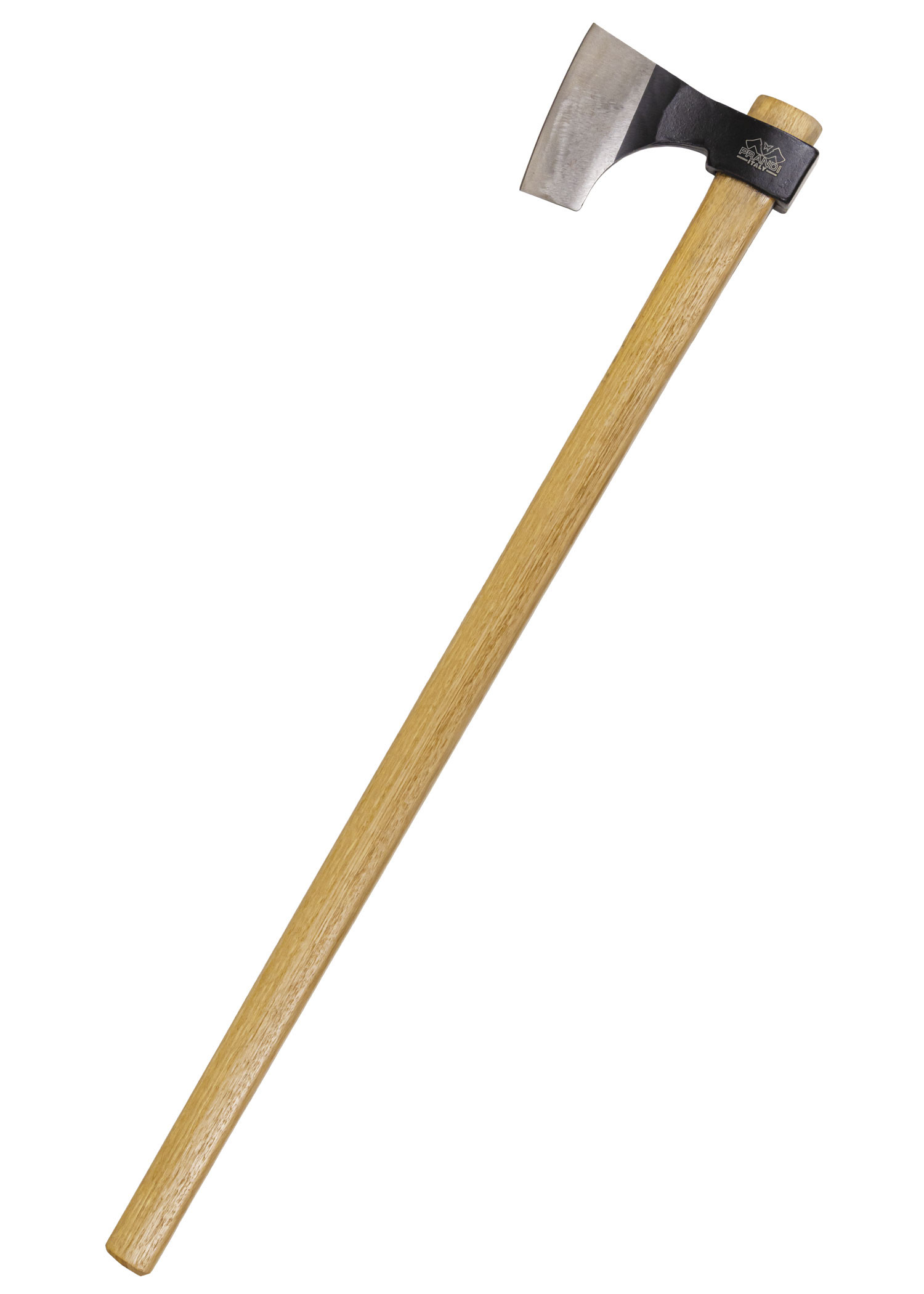
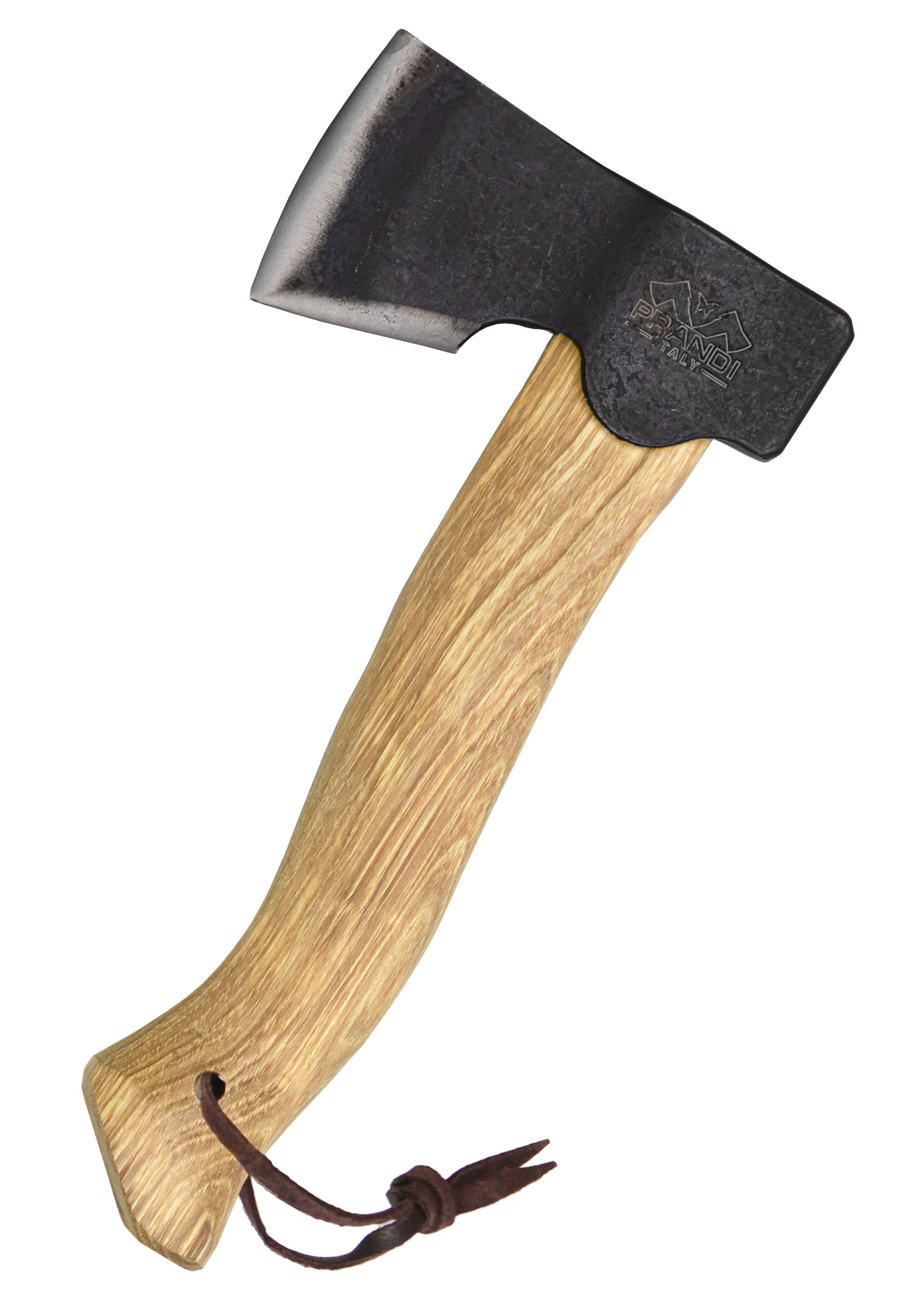
As plate armor became ubiquitous between the 14th and 16th centuries, the traditional edged axe lost its effectiveness in penetrating solid metal. This led to the development of specialized axes, where the cavalry axe consolidated as a secondary or reserve weapon. Its design prioritized a shorter handle for one-handed use, allowing the rider to control their mount. The head, heavy and concentrated, maximized kinetic momentum, being devastating against mail or leather armor, capable of denting protection and causing severe blunt trauma.
Specialized Battle Axes (Late Mounted and Dismounted Use): The Lethal Adaptation
To counteract the invulnerability of plate armor, the axe evolved towards concentrating force and perforation. The generic “Battle Axe” incorporated a spike or blade on the opposite side of the head and a sharp vertical blade on the top. The “horseman’s axes” also emerged, heavier than Viking axes, with rear spikes or picks. The infamous “Raven’s Beak” (Bec de Corbin), and the “Pollaxe” or “Poleaxe,” became surgical tools to “systematically dismantle a man inside a metal breastplate,” being more of an infantry weapon or for knights fighting on foot given their length.






The Path of the True Reenactor: Crucial Considerations
Choosing your axe for historical reenactment is like forging your own epic path. Every detail counts to ensure that your replica is not only authentic but also reflects the mastery and spirit of the time. Here are the keys to a successful choice:
Materials that Forge History: The Soul of the Weapon
Materials are the lifeblood of any authentic replica. The handles of cavalry axes were made from hardwoods such as oak, ash, or walnut, to ensure strength and appropriate weight. The axe head, the heart of its power, was forged from tempered carbon steel (such as type 1065), reaching hardnesses between 48-52 HRC. This balance between edge and durability guarantees astonishing realism and great functionality in reenactment.
Design and Balance: The Deadly Dance
Blade shape is crucial. A curved, wedge-shaped, or arc-cutting design optimizes striking power, allowing it to penetrate chainmail and damage plate armor. Some replicas even integrate a hammer on the reverse side, emulating the brutality of blunt blows against helmets and armor. Balance is key: an ideal cavalry axe, about 50 cm long and weighing close to 900 grams, achieves the perfect harmony between maneuverability and impact force, an essential attribute in mounted combat.
Weight and Handling: Your Strength, Your Destiny
In the field of reenactment, where fatigue is as real an adversary as the enemy, the weight of your axe is fundamental. While lighter axes, like the 600-gram Francisca, offer superior control and are easier to carry, war axes must be light in their head for effective handling. If you’re looking for maximum impact, a heavier axe will be devastating, but it will require greater strength and skill. The choice is yours: balance power with control so that your weapon is an extension of your will.
Knight’s Accessories: The Baldric
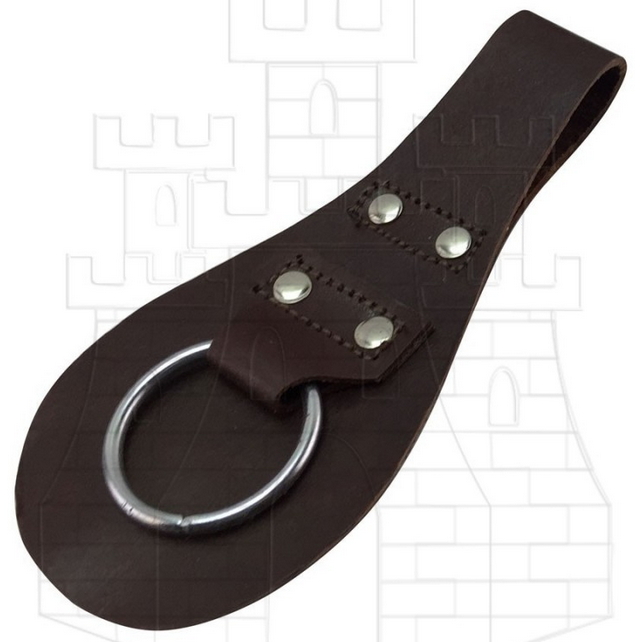
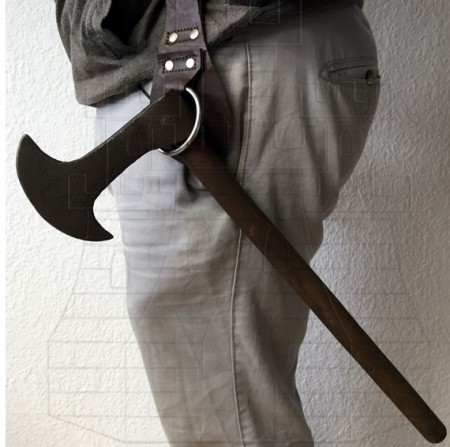
Don’t forget the baldric, your axe’s faithful companion. This accessory, essential for reenactment, allows you to carry your axe threaded to your belt, ensuring comfort and accessibility at all times. A detail that adds authenticity to your equipment and completes the warrior’s image.
Clearing up unknowns about medieval axes and their use
What are the main differences between a battle axe and a medieval cavalry axe?
The main differences between a battle axe and a medieval cavalry axe are:
- A battle axe is a weapon designed for infantry, with different sizes and shapes, but typically lighter and more stylized than a common axe, with a sharp blade and sometimes equipped with additional elements (such as “beaks” or spikes) to penetrate armor or cause blunt damage. It can have long handles for two-handed use and be wielded with force to cut or pierce in close combat.
- A cavalry axe is a weapon designed to be used by riders; it usually has a shorter handle and a blade that allows quick handling on horseback, being lighter and focused on precise and fast blows. It was also used as a secondary weapon. Its design facilitates its use from the saddle and is usually less robust compared to the infantry battle axe, which prioritizes strength and reach.
In summary, the battle axe is a more versatile and powerful weapon for combat on foot, while the cavalry axe is adapted for mobility and speed from the mount, with a design that facilitates its use on horseback.
What materials were commonly used to make medieval axes?
Medieval axes were primarily made with two components: the axe head and the handle.
Axe Head
The head was mainly made of iron, which was the most common material due to its abundance and accessibility in medieval Europe. Iron was relatively easy to obtain and work for blacksmiths of the time. However, for higher quality axes, steel was used, produced by adding carbon to iron, which made them harder and more durable than pure iron ones. Bronze was also used, though less frequently than iron or steel, but it offered greater corrosion resistance.
A particularly refined technique was Damascus steel, which used several layers of different metals to achieve a combination of hardness and flexibility, in addition to creating unique characteristic patterns on each piece. In some cases, carbon steel was used on the edges to improve edge retention.
Axe Handle
The handle was commonly made from hardwoods such as ash, oak, walnut, or beech. These woods were chosen for being strong, flexible, and resistant to breakage, providing good balance to the weapon.
In more sophisticated axes, especially two-handed war axes, wooden handles were reinforced with metal bands called langets to prevent an enemy from cutting them. In some later cases, entirely metal handles were made, forged in one piece with the axe head to increase robustness.
How were knights trained to use a medieval cavalry axe?
 Medieval knights were trained to use the cavalry axe through rigorous physical training that included handling different weapons, including the axe, combined with constant practice on horseback. They began as young pages and squires, using training weapons often heavier than real ones to strengthen their muscles. Training included practices with simulated weapons (such as staffs or training axes made of light and resistant materials), exercises to improve the precision and force of the blow, and techniques to handle the weapon on horseback, guiding the horse only with their legs, leaving their hands free to use the weapon alongside the shield. They also used specific devices such as the quintain to perfect the blow and coordination on horseback.
In addition, training included developing endurance and the ability to fight in heavy armor, which required great strength and agility. Therefore, the use of the axe was not trained in isolation, but as part of a comprehensive program that included lance, sword, and other weapons, progressing from hand-to-hand combat without armor to the sophisticated use of different weapons mounted on horseback. In practice, physical exercises, animal and weapon handling, and tactical training in formation were combined, so that the knight was prepared for real combat.
What types of axes were most popular among medieval knights?
Medieval knights primarily used two types of axes that suited their specific needs on the battlefield:
Norman Axe
The Norman axe was the most representative of early medieval art and the most associated with the knights of the era. It was characterized by a developed and long blade, a one-handed haft, without additional protections (no cheeks). Although the Normans descended from the Vikings, this axe represented a more refined and specialized version for medieval cavalry combat.
Horseman’s Axe
The medieval horseman’s axe was specially designed to be used from horseback by mounted knights. This type of axe featured a heavy head that made it devastating against both footmen and enemy cavalry. Its weight and design made it particularly effective when wielded by a mounted warrior.
General Characteristics
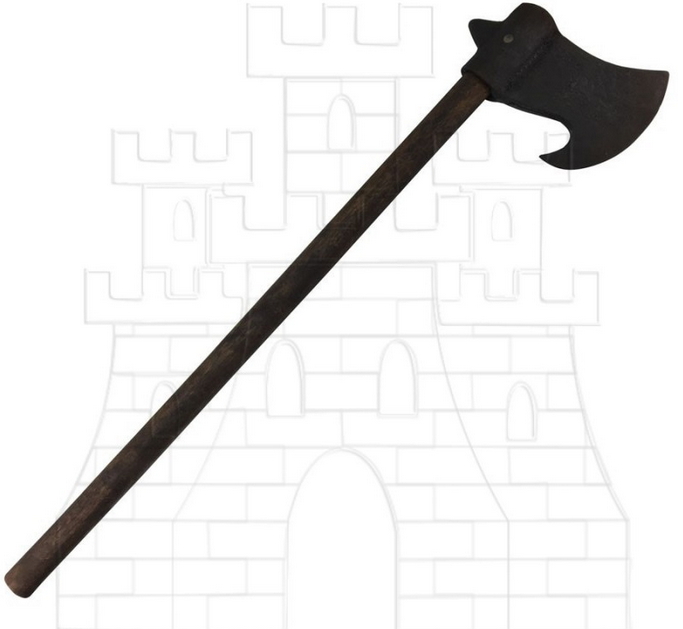
Medieval axes used by knights combined:
- Resistant materials: Forged in steel or iron to ensure durability and cutting power
- Versatile designs: From lighter models for quick maneuvers to heavier variants for maximum impact
- Tactical versatility: They functioned both in hand-to-hand combat and in assaults on fortresses
These designs reflected the evolution of the axe from general-purpose tools to specialized weapons for medieval cavalry warfare.
How did the evolution of weapons influence the popularity of medieval axes?
The evolution of weapons led medieval axes to specialize and adapt to new combat needs, which maintained their popularity. Initially, they were simple weapons, but over time more effective designs were developed, such as battle axes, throwing axes, and those with picks to penetrate armor. The emergence of plate armor drove the creation of axes with specific features, such as the pick or vertical blade, which allowed them to better overcome enemy defenses. This adaptability and versatility in different combat situations ensured their continuous use and their status as a feared and respected weapon in the Middle Ages.
The Journey Is Not Over: Choose Your Axe, Forge Your Destiny
Choosing the perfect medieval cavalry axe for your historical reenactment is much more than a simple purchase; it is a declaration of intent, a journey into the heart of chivalry, and a connection with those warriors who forged history. Remember the survival kit analogy: if you reenact the Early Middle Ages, look for the versatility of the Francisca; if your passion is the Late Middle Ages, opt for the concentrated force of a war hammer or a battle axe. May your choice guide you in countless simulated battles, where every blow counts and every detail comes to life, paying homage to the greatness of a legendary era.