Sale of swords, katanas, sabers, medieval clothing and decoration
Don't hesitate to contact us. We are experts in History of the Bastard Sword: The Versatile Weapon That Changed Cavalry and we will be happy to help you.
☎️ Phone: 020 3603 9234 | ✏️ Chat | ⚔️ WhatsApp: (34) 690268233 | 📩 Email
History of the Bastard Sword: The Versatile Weapon That Changed Cavalry
Could a single blade be light enough to swing on horseback and, at the same time, powerful enough to break a pike formation on solid ground? This was the question that 13th-century armorers answered with one of the most ingenious creations of European metallurgy. The bastard sword, a weapon forged in the heat of social and technological change, was not simply a tool of war, but the symbol of an epic transition between the armored knight and the skilled Renaissance swordsman.\n
\n\n
Chronology of a Legend: The Evolution of the Hand-and-a-Half
\nTo understand the impact of this weapon, we must place ourselves in a world where chainmail was beginning to yield to solid steel plates. The need for greater leverage and precision gave rise to this fascinating hybrid.\n
\n
\n
\n
Era
\n
Event and Technological Evolution
\n
\n
\n
\n
\n
Late 13th Century
\n
Initial appearance in Western Europe as a response to improved armor.
\n
\n
\n
15th–16th Centuries
\n
Period of technical maturity. Blades with diamond cross-sections to pierce steel.
\n
\n
\n
1485
\n
Battle of Bosworth: Notable use in the War of the Roses.
\n
\n
\n
16th–17th Centuries
\n
Military obsolescence in the face of firearms and the rapier.
\n
\n
\n
\n
\n \t
Milestones of the Bastard Sword
\n \t
\n
\n \t
Origin: Late 13th century, the transition from the \”great sword\” to the bastard sword.
\n \t
Peak: 14th to 16th centuries, dominating European battlefields.
\n \t
Legacy: Survival in Historical European Martial Arts (HEMA) manuals.
\n
\n
\n
\n
The Origin of a Name: Why \”Bastard\”?
\nThe term has sparked theories as sharp as the steel itself. In French, the épée bâtarde suggested an irregular weapon, a hybrid that did not fit into the traditional categories of the time. Some historians evoke a rawer connotation: by using both hands to wield the steel, the knight had to relinquish his shield.\n\nWithout the shield, the warrior lost the ability to display his coat of arms, remaining \”like a bastard\” with no visible lineage in the midst of the carnage. Beyond the myth, its technical nature places it at a perfect midpoint: it has the blade of a longsword but maintains an agility that allows for one-handed use if the wielder is mounted.\n
Anatomy of Versatility: Design and Functionality
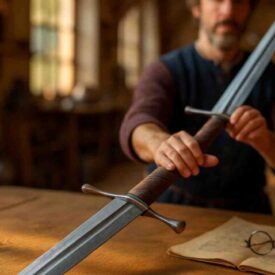
\nA bastard sword is a marvel of balance. Its design was specifically modified to be gripped with two hands, yet without reaching the prohibitive weight of the great two-handed swords. Weighing between 1.2 kg and 1.8 kg, this weapon allows for high-speed handling while being robust enough to unhorse a rider with a sharp blow.\n\nAs the Late Middle Ages progressed, its blades were made thinner and more stylized. This change was not aesthetic; it sought an acute point capable of finding the gaps in plate armor joints. Its hilt, between 15 and 30 cm, is its defining feature, allowing the dominant hand to direct the attack while the other hand on the pommel acts as a lever to apply devastating force.\n
Combat Techniques: More Than Just a Blade
\nUsing the bastard sword required superior mastery. It was not just about striking, but about turning the weapon into a multifunctional extension of the body. Historical manuals by masters like Fiore dei Liberi detail epic positions named after the cat, the lady, the king, and the knight.\n\nIn the heat of combat, its versatility allowed for surprising tactics:\n
\n \t
Half-swording: Gripping the blade with a gloved hand to use it as a short spear with surgical precision.
\n \t
Mordhau (Murder Stroke): Grabbing the sword by the blade and striking with the pommel or guard, transforming the weapon into an improvised mace against armored opponents.
\n \t
Breaking Formations: Its length allowed it to face rows of pikemen with the effectiveness of a greatsword, but with a mobility they lacked.
\n
\n
\n\n
Forging Excellence: From Toledo to the World
\nThe quality of a bastard sword depended entirely on its steel. Centers like Toledo in Spain became the heart of this legendary industry. Toledan artisans, blessed by the supposed magical properties of the Tagus River waters for tempering, created blades that were feared for their impossible balance between hardness and flexibility.\n\nThese pieces were not just weapons; they were jewels of military engineering that accompanied both Landsknecht mercenaries and the highest European nobility, consolidating themselves as the standard of quality in an era where your life literally depended on the strength of your steel.\n
Clearing Up Unknowns About the Bastard Sword and Its Evolution
\nWhat were the main innovations of the bastard sword over the centuries?\n\nThe main innovations of the bastard sword, developed from the late 13th to the 16th century, centered on its hybrid design to adapt to increasingly effective armor and versatile combat techniques.\n
\n \t
Elongated hilt (\”hand-and-a-half\”): Allowed it to be used with one or two hands, increasing strength and precision against plate armor, evolving from short swords to an intermediate format between these and greatswords.
\n \t
Longer, thinner, and more pointed blade: Combined effective slashes with precise thrusts to penetrate armor weak points, varying in flat, narrow, or hexagonal shapes depending on the use (cutting or thrusting).
\n \t
Multifunctional versatility: Acted as a mace, spear, or axe, with guard refinements for better hand protection, laying the foundation for Renaissance fencing.
\n
\nThese adaptations responded directly to the evolution of armor and warfare in the Late Middle Ages, prolonging its use until it was phased out by firearms.\n\nHow did the evolution of armor influence the development of the bastard sword?\n\nThe evolution of armor, especially towards improved chainmail and full plate armor in the Late Middle Ages (13th-16th centuries), directly drove the development of the bastard sword as a versatile weapon to overcome these protections.\n\nArmor became more effective against simple cuts and thrusts, forcing swords to adapt with longer, thinner, and more pointed blades to penetrate weak points like slits, joints, and openings, combining powerful slashes and precise thrusts.\n\nIn addition, the elongated hilts (\”hand-and-a-half\”) allowed the sword to be used with one or two hands, applying greater force and control to break plates or strike with precision, evolving from High Medieval short swords toward hybrid forms that laid the groundwork for later fencing.\n\nWhat fencing techniques were used with the bastard sword?\n\nThe fencing techniques for the bastard sword (or hand-and-a-half) were based on its versatility for use with one or two hands, combining cuts, thrusts, and unconventional strikes.\n\nBasic positions (guards): Included the cat, the lady, the king, and the knight, which served as defensive and offensive stances.\n\nKey grips and maneuvers:\n
\n \t
Change of grip: From one hand (for mobility) to two hands (for greater power and control), or with one hand on the hilt and another on the blade (Halbschwert or half-sword) for precision and pressure in thrusts against armor.
\n \t
Wide cuts and thrusts: Powerful strikes to break spear or pike formations, and precise thrusts into weak points.
\n \t
Percussive techniques:Mordhau (striking with the hilt or \”murder stroke,\” using the back part of the blade as a mace), attacks with the pommel and the guard.
\n \t
Hybrid uses: Employed as a mace, spear, or axe, adapting to foot combat, horseback, duels, or battles.
\n
\nThese techniques evolved in schools such as HEMA (Historical European Martial Arts), standing out in the 14th-16th centuries in Germanic and Italian regions.\n\nIn which historical battles did the use of the bastard sword stand out?\n\nThe bastard sword stood out in the Battle of Bosworth (1485), during the War of the Roses, where it was used by the Houses of York and Lancaster for its versatility in individual and formation combat.\n\nIt was a crucial weapon in 15th and 16th-century European conflicts, adapting to evolutions in armor and tactics of the Late Middle Ages, although other specific battles are not mentioned with the same level of historical detail.\n\nHow did the bastard sword differ from other medieval swords?\n\nThe bastard sword, also called a hand-and-a-half sword, differed from other medieval swords by its longer hilt, which allowed it to be used with one or two hands (unlike one-handed short swords or exclusively two-handed greatswords), and by its long, straight double-edged blade (90-110 cm), more stylized than High Medieval swords.\n
Key Differences:
\n
\n \t
Versatility: A hybrid between a short sword and a greatsword; balanced for speed, power, and maneuverability (weight 1.2-1.8 kg), ideal for thrusts, cuts, breaking pike formations, or using it as a mace/spear with the pommel and guard.
\n \t
Design: Extended handle (approx. 17 cm, with a separator ring), pronounced guard, fullness in the blade to reduce weight without losing strength, and romboidal/hexagonal cross-section; made of high carbon steel for durability.
\n \t
Historical Use: Popular in the Late Middle Ages (13th-16th centuries) against light armor or riders, evolving from elongated normal swords until being displaced by firearms and rapiers.
\n
\n
Eternal Legacy in Combat and Culture
\nAlthough the battlefields eventually surrendered to the thunder of gunpowder, the bastard sword never disappeared from the collective imagination. Its silhouette is what we recognize today in great fantasy sagas, from Jon Snow’s Longclaw to Aragorn’s Andúril, reminding us of an era where victory was decided by the balance of a blade and the skill of the one who wielded it.\n\nOwning a hand-and-a-half replica is today a direct link to that past of chivalry and refined technique. It is the testimony of a weapon that was born to change the rules of the game, adapting to every challenge and surviving as the ultimate tool of the versatile warrior.\n

 \n
\n
 The evolution of armor, especially towards improved chainmail and full plate armor in the Late Middle Ages (13th-16th centuries), directly drove the development of the bastard sword as a versatile weapon to overcome these protections.\n\nArmor became more effective against simple cuts and thrusts, forcing swords to adapt with longer, thinner, and more pointed blades to penetrate weak points like slits, joints, and openings, combining powerful slashes and precise thrusts.\n\nIn addition, the elongated hilts (\”hand-and-a-half\”) allowed the sword to be used with one or two hands, applying greater force and control to break plates or strike with precision, evolving from High Medieval short swords toward hybrid forms that laid the groundwork for later fencing.\n\nWhat fencing techniques were used with the bastard sword?\n\nThe fencing techniques for the bastard sword (or hand-and-a-half) were based on its versatility for use with one or two hands, combining cuts, thrusts, and unconventional strikes.\n\nBasic positions (guards): Included the cat, the lady, the king, and the knight, which served as defensive and offensive stances.\n\nKey grips and maneuvers:\n
 The bastard sword, also called a hand-and-a-half sword, differed from other medieval swords by its longer hilt, which allowed it to be used with one or two hands (unlike one-handed short swords or exclusively two-handed greatswords), and by its long, straight double-edged blade (90-110 cm), more stylized than High Medieval swords.\n