Have you ever wondered how to distinguish an authentic replica of the Great Captain’s sword from a mere imitation? The figure of Gonzalo Fernández de Córdoba, the military genius who revolutionized the art of war, evokes bravery, honor, and loyalty. His swords, symbols of an era of transition and Spanish power, are coveted pieces by collectors and enthusiasts. In this essential guide, we will delve into the fascinating world of the Great Captain’s swords so that you can learn to identify a quality replica, understanding its history, its characteristics, and the secrets of its manufacture. Get ready to unravel the mysteries of these legendary weapons and choose wisely the piece that honors their legacy.
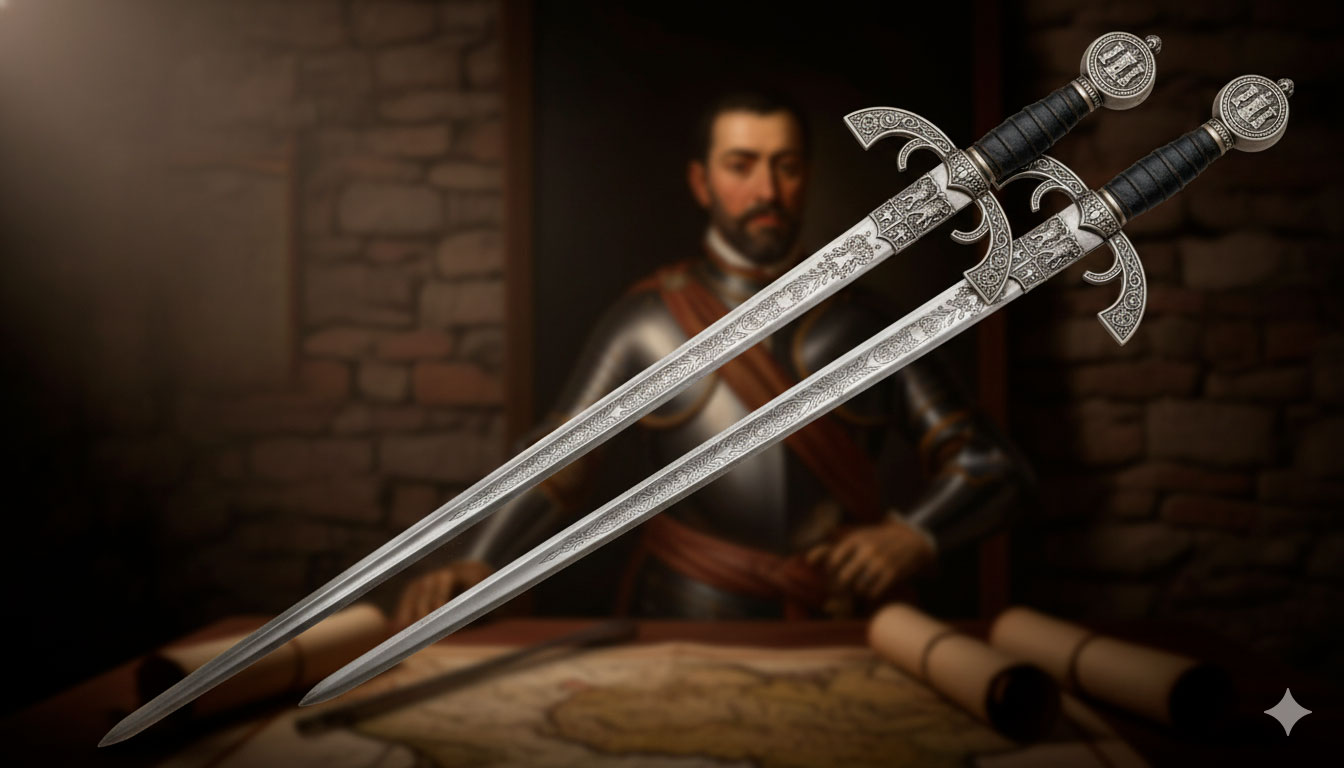
Gonzalo Fernández de Córdoba was the great Spanish military genius who forever changed the “art of war,” by implementing modern infantry and devising new military strategies. Despite his unparalleled military feats, he remained an officer close to his men, with a sense of honor towards the adversary, stoic, and, above all, a loyal subject to the Catholic Monarchs who, through him, began the adventure of a powerful and extensive reign. His name is associated with bravery, honor, and loyalty.
Forged History: Swords of the Great Captain and their Typologies
The legacy of Gonzalo Fernández de Córdoba materializes in two main typologies of swords attributed to him, each with a unique purpose and symbolism. Knowing these differences is the first step to appreciating a quality replica.
The Combat Sword: A Blade Ready for Battle
This sword, also known as “hand-and-a-half” or bastard sword, was the Great Captain’s tireless companion in the heat of battle. Intended for pure functionality, its design responded to the demands of combat, being an agile and effective weapon. It was carried both on foot, hanging from the belt, and on horseback, in the saddle bow. Currently, it is considered an invaluable jewel, privately held by the Fernández de Córdoba lineage.
The Ceremonial Sword or Papal Estoc: Distinction and Luxury
In contrast to the robustness of the combat sword, the Papal Estoc was a ceremonial piece, a symbol of status and recognition. It is believed to have been a gift from the Pope, probably Alexander VI, around 1500 or 1503, as a token of gratitude for the defense of Christianity. Its luxury and detail made it a parade sword, later used for knighting ceremonies. The most recognized example is exhibited in the Royal Armory of Madrid.
Essential Characteristics to Recognize an Authentic Replica
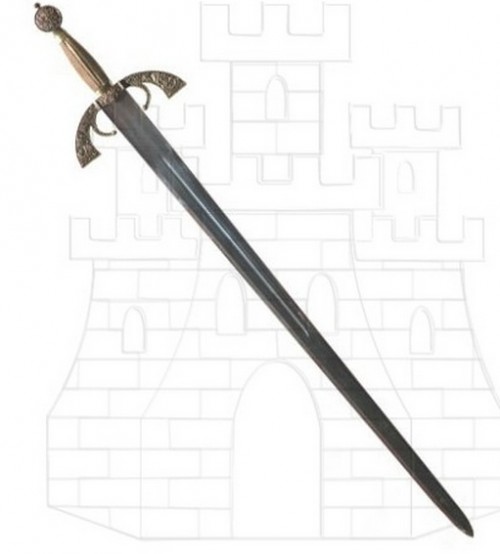 To identify a quality sword of the Great Captain, whether for combat or ceremonial, it is crucial to pay attention to the materials, craftsmanship, and historical details. The artisans of Toledo, faithful to a millenary tradition, know these secrets well and guarantee the most faithful replica.
Materials that Withstand the Test of Time and Battle
The heart of any quality sword is its blade. Superior replicas are forged from high-carbon steel (0.5-0.8%), which guarantees exceptional hardness, elasticity, and flexibility. For decorative models, high-quality stainless steel is the preferred option, resistant to oxidation and the passage of time.
Forging and Tempering: The Soul of the Sword
The forging process is vital. A quality blade must be hand-forged and subjected to rigorous tempering, where it is heated to about 900 degrees and drastically cooled, giving it the necessary hardness for durability. This is the moment where the steel truly comes to life.
Design and Details: The Faithful Reproduction of the Original
A quality Great Captain’s sword respects the original design. Replicas usually feature a straight, narrow blade, with a flat round pommel. The hilt, often wire-wrapped or leather-covered, must offer a firm and aesthetic grip. Finishes can be rustic, offering a more sober polish; mirror-polished, with a gleaming shine; or aged, achieving an antique and realistic patina.
Dimensions and Certification: The Guarantee of Authenticity
The faithful natural-sized replicas measure approximately 100 cm in total length, with an 83 cm blade and a balanced weight of 1.2 kg, allowing for agile handling. There are also cadet or compact models of 75 cm for different needs. Additionally, high-quality swords manufactured in Toledo often include a Certificate of Quality and Origin, which endorses their provenance and the excellence of their craftsmanship.
Gonzalo Fernández de Córdoba and the destiny of his swords: main milestones
1523–1534
During the pontificate of Clement VII, a sword linked to the Great Captain appears in the Monastery of San Jerónimo with an inscription by Clement VII; due to the anachronism, it is suggested that it could have been a gift to the Count of Cabra (his son-in-law) between 1523 and 1525.
October 5, 1552
Transfer of the mortal remains of the Great Captain to the Monastery of San Jerónimo in Granada.
December 2, 1552
The estoc (with gold and silver fittings) carried by Juan Peláez de Berrio in the funeral procession is returned to the Duke of Sessa by the prior, considering it unrelated to the Great Captain.
1621
A sword attributed to the Great Captain, with inscriptions and ornaments about his battles in Italy, is recorded in the inventory of the Royal Armory of Madrid, where it has been preserved ever since.
c. 1663 – 1671
The ceremonial estoc guarded in the main altar of the Monastery of San Jerónimo was stolen and replaced by a crude wooden replica. The stolen sword was described with a gilded silver hilt, montante style, and green enamels.
March 24, 1671
A secret summary is initiated for the theft of the Great Captain’s sword in the Monastery of San Jerónimo.
August 16, 1716
A sword attributed to the Great Captain (with a very thin blade and ivory hilt) was added to an entail by the III Marquis of Algarinejo; that piece had previously been given by the Duke of Sessa to the Marquis of Valenzuela.
1723
Juan de Medina paints a mural in the Monastery of San Jerónimo representing Pope Alexander VI handing the estoc to Gonzalo Fernández de Córdoba.
Spring 1810
During the French occupation, General Horace Sébastiani desecrates the tomb and takes a sword that is believed to be a replica, as the original had been stolen earlier.
This table chronologically details the key events related to the Great Captain’s two attributed swords: the combat sword with an ivory hilt and the ceremonial estoc (associated with a papal donation), from his birth to their current status.
| Era | Event |
|---|---|
| Birth and military career (1453–1515) | |
| September 1, 1453 | Birth of Gonzalo Fernández de Córdoba in Montilla, Córdoba. |
| Late 15th century | A combat sword with an ivory hilt is attributed to him. This piece is preserved in the private possession of the Fernández de Córdoba lineage. |
| 1497 | After liberating the port of Ostia and his triumphant entry into Rome, it is believed that Pope Alexander VI granted him a blessed estoc (ceremonial sword), the cardinal’s hat, and the Golden Rose in recognition of his role as defender of Christianity. |
| c. 1500 / 1503 | Possible delivery of a luxurious Renaissance-model girdle or gala sword, considered a papal gift for his defense of Christianity. The inscription on one of the swords in the Royal Armory of Madrid alludes to victories in Italy and seems to date the piece after the 1504 campaign. |
| December 2, 1515 | Death of Gonzalo Fernández de Córdoba in Granada. |
| After death: attributions, transfers, and robberies (1515–1810) | |
| 1523–1534 | During the pontificate of Clement VII, a sword linked to the Great Captain appears in the Monastery of San Jerónimo with an inscription by Clement VII; due to the anachronism, it is suggested that it could have been a gift to the Count of Cabra (his son-in-law) between 1523 and 1525. |
| October 5, 1552 | Transfer of the mortal remains of the Great Captain to the Monastery of San Jerónimo in Granada. |
| December 2, 1552 | The estoc (with gold and silver fittings) carried by Juan Peláez de Berrio in the funeral procession is returned to the Duke of Sessa by the prior, considering it unrelated to the Great Captain. |
| 1621 | A sword attributed to the Great Captain, with inscriptions and ornaments about his battles in Italy, is recorded in the inventory of the Royal Armory of Madrid, where it has been preserved ever since. |
| c. 1663 – 1671 | The ceremonial estoc guarded in the main altar of the Monastery of San Jerónimo was stolen and replaced by a crude wooden replica. The stolen sword was described with a gilded silver hilt, montante style, and green enamels. |
| March 24, 1671 | A secret summary is initiated for the theft of the Great Captain’s sword in the Monastery of San Jerónimo. |
| August 16, 1716 | A sword attributed to the Great Captain (with a very thin blade and ivory hilt) was added to an entail by the III Marquis of Algarinejo; that piece had previously been given by the Duke of Sessa to the Marquis of Valenzuela. |
| 1723 | Juan de Medina paints a mural in the Monastery of San Jerónimo representing Pope Alexander VI handing the estoc to Gonzalo Fernández de Córdoba. |
| Spring 1810 | During the French occupation, General Horace Sébastiani desecrates the tomb and takes a sword that is believed to be a replica, as the original had been stolen earlier. |
| 20th Century–Present | |
| Present | The ceremonial sword (estoc) is preserved in the Royal Armory of Madrid; it is a Renaissance parade estoc with gilded and chiseled iron fittings, known since 1621 and whose model is faithfully reproduced by Toledo artisans. The combat sword from the late 15th century, distinguished by its ivory hilt, remains in the private possession of the Fernández de Córdoba lineage as undivided property. |
Resolve your doubts about the Great Captain’s swords
What are the differences between the Great Captain’s swords from different manufacturers?
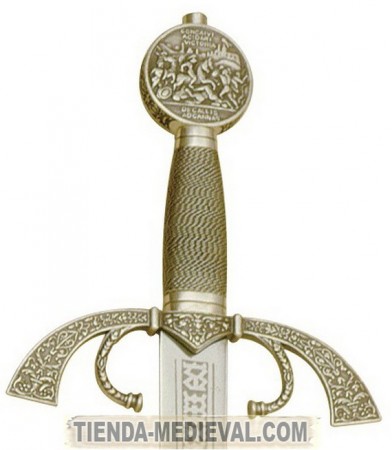 The differences between the Great Captain’s swords from different manufacturers are mainly based on:
- Material and steel quality: Most use high-quality stainless steel, although some manufacturers use aged steel or Damascus steel for greater authenticity and durability.
- Blade finishes: They vary in rustic, silver, gold, aged, or mirror finish, allowing a choice according to personal taste or desired historical style.
- Length and size: They are found in various lengths, typically between 56 cm and 103 cm, including standard replicas of approximately 98-100 cm.
- Hilt details: Some versions have engraved or artisanally worked hilts to reflect the original historical style.
- Authenticity and provenance: Some replicas are based on museum models such as the Toledo Army Museum or the Royal Armory of Madrid, with differences in fidelity to the original sword and era, while others are modern reproductions for collectors.
- Weight and ergonomics: They usually weigh around 1.2 kg, although this varies slightly depending on the manufacturer and type of finish.
The differences between commercially available Great Captain swords lie in the material, finish, length, historical hilt details, and the fidelity to the original historical model employed by each manufacturer.
What characteristics make a Great Captain’s sword high quality?
Materials
Steel is the most critical component. The best replicas use high-quality stainless steel or forged carbon steel, the latter being especially valued for its authenticity and strength. The blade must be hand-forged, which guarantees both strength and authenticity in construction.
Blade Construction
The blade must have specific characteristics such as acid etchings in low relief that faithfully reproduce the original details. Proper tempering of the steel is essential to ensure durability and functionality. Superior quality blades are semi-polished and precisely engraved, reflecting the artisanal care in their elaboration.
Finish and Details
A quality sword must have a detailed finish on both the hilt and the blade. Engraved silver or gold finishes, when well executed, are indicators of superior quality. Care in every aspect of the design, from the guard to the tip, must be evident.
Technical Specifications
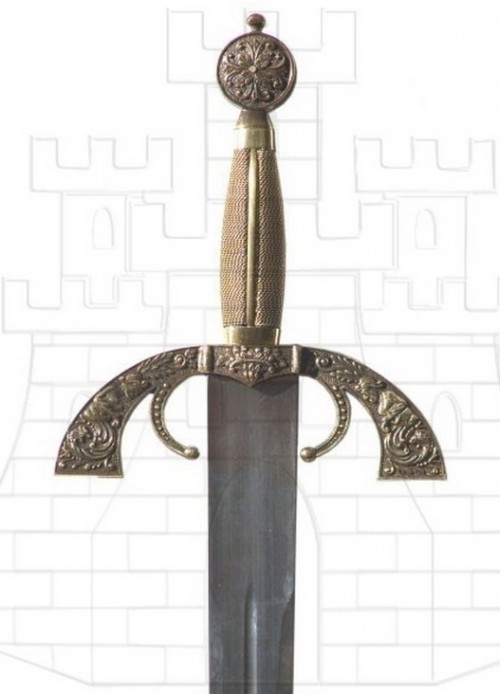 Correct proportions are important: a functional sword typically measures around 100 cm in total length, with a blade of approximately 83 cm and a balanced weight of approximately 1.2 kg. These measurements ensure that the replica is a faithful representation of the historical weapon.
Aesthetic Finish
Visual quality is determining. A good finish must be resistant to oxidation and maintain its appearance over time. The product must come well preserved and free of defects that compromise its presentation as a collector’s item.
How does the Great Captain’s sword compare to other historical swords?
The Great Captain’s sword is distinguished as a high-quality historical replica, manufactured with stainless steel or carbon steel, with precise details that reflect its use in Renaissance Spain. It is characterized by having a narrow blade and can be found in gala and combat versions, the latter being more robust and functional for battle, suitable for a warrior who innovated military tactics. Compared to other historical swords, it stands out more for its historical and symbolic value linked to Gonzalo Fernández de Córdoba and his impact on the evolution of warfare, than for extraordinary technical characteristics typical of legendary or mythical swords. Its design is relatively simple but authentic, and current manufacturing combines forging traditions with modern materials, which makes it appreciated by collectors and reenactors, although not necessarily excelling in technical quality or functionality over other classic historical swords that were exclusively weapons for battle.
What materials are used in the manufacture of the Great Captain’s swords?
The Great Captain’s swords are primarily made with carbon steel or stainless steel blades. The blade is usually forged and tempered for greater strength and durability. The guard can be made of premium casting, and the hilt is usually wire-wrapped or made with materials that ensure good grip and aesthetics. In some models, the finish can be silver-plated or with acid engravings for greater artisanal detail. These swords are primarily manufactured in Toledo, Spain.
Are there modern versions of the Great Captain’s sword?
Yes, there are modern versions of the Great Captain’s sword. Detailed replicas have been manufactured using high-quality stainless steel and are available in different finishes (gilded, silver-plated, rustic) and sizes (e.g., 56, 76, or 103 cm in length). These reproductions are intended for both collectors and history enthusiasts and are produced in specialized workshops, some in Toledo, Spain, renowned for their craftsmanship in historical swords. These modern versions seek to accurately recreate the characteristics of the Great Captain’s original weapon.


The Fate of a Legend: The Battle for its Memory
The history of the Great Captain’s swords is not without intrigue and loss. In 1671, the ceremonial sword of the Monastery of San Jerónimo in Granada was stolen, and a crude wooden replica took its place. Although the theft of the Great Captain’s sword and skull in 1810-1812 is popularly attributed to the French General Horace Sébastiani, it is likely that he took the replica. Today, the original ceremonial sword is preserved in the Royal Armory of Madrid, while the combat sword with an ivory hilt remains in the private possession of his lineage.
The search for a quality Great Captain’s sword is a fascinating journey that connects us with one of Spain’s greatest military strategists. By understanding the typology of his swords, the characteristics of their manufacture, and the historical details of their creation, each piece is not only an object but a fragment of a living legend. May this essential guide help you choose wisely, honoring the memory of a warrior who forged history with the edge of his sword.