Have you ever felt the shiver running down your spine when the sound of a bugle breaks the dawn’s silence? It is not just music; it is the echo of millennia of strategy, courage, and sacrifice. From the steppes where warriors sounded animal horns to the battlefields of the Napoleonic era, bugles and trumpets have been the “radio” of generals, the soldier’s watch, and the voice of command in the heat of combat.
Bugles, as their name suggests (derived from horn), were made from animal antlers, maintaining their curved shape, but over time wood or metal began to be used. As a musical instrument, it belongs to the “wind” category and was originally most famous among military armies or warrior peoples. The horn, at first, and the bugle later, was highly valued as a weapon of war, in games, in hunting exercises, and in some religious rituals or for communicating over long distances.
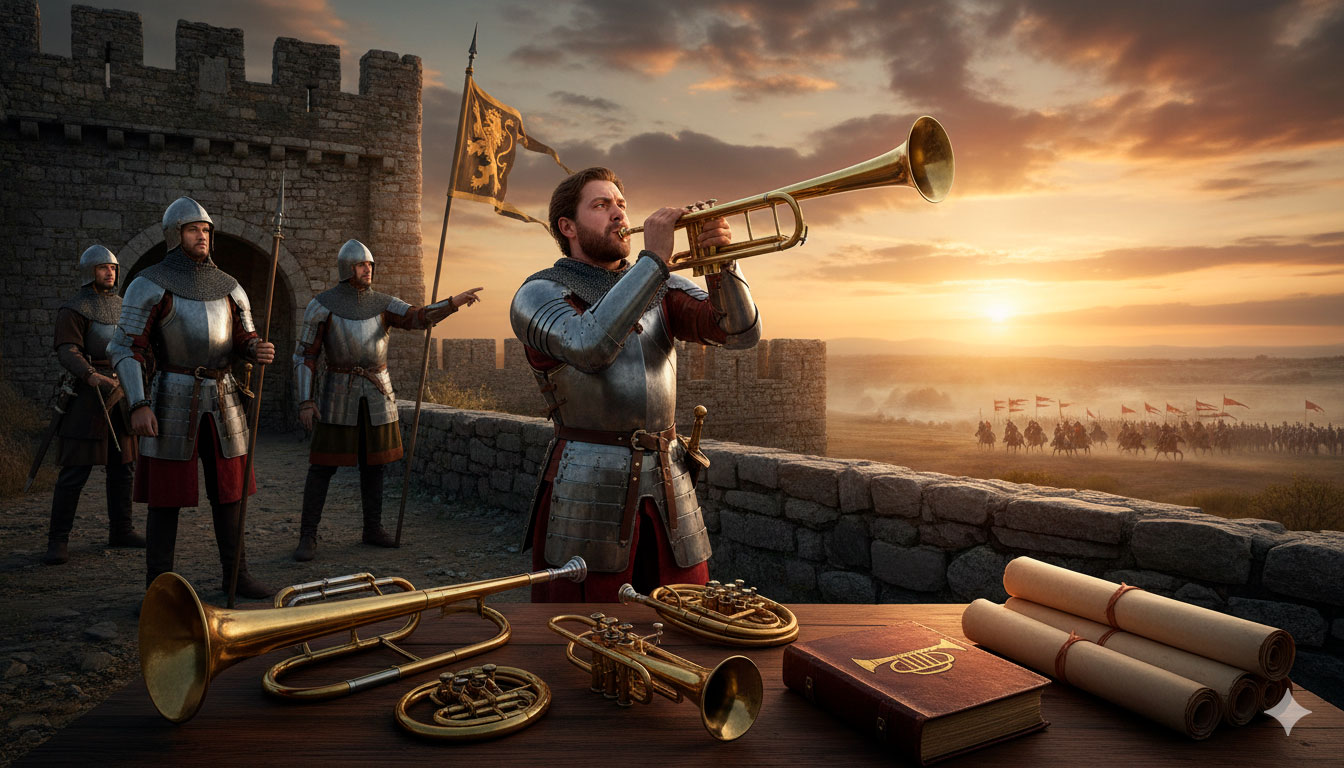
From Signals to Fanfares: Historical Evolution of Military Bugles and Trumpets
The history of communication on the battlefield is a constant struggle against chaos. In antiquity, before metal was mastered by artisans, man turned to nature to make himself heard. The Egyptians were already using the sheneb, a straight bronze trumpet found even in Tutankhamun’s tomb, while the Bible tells how the shofar (ram’s horn) made walls tremble.
| Era | Key Event |
|---|---|
| Prehistory | Use of animal horns and conch shells for basic signals. |
| Egypt / Israel | Metal trumpets (sheneb) and shofars to summon troops. |
| Ancient Rome | Advanced signaling system with the Tuba, the Cornu, and the Buccina. |
| Middle Ages | Use of the ivory Olifant and reintroduction of the anafil after the Crusades. |
| 19th Century | Appearance of piston bugles and standardization of official bugle calls. |
Rome took this logistics to the next level. Their aenatores were musicians in charge of handling specific instruments such as the Tuba (straight, for infantry) or the Cornu (curved, for directing standards). A failure in interpreting these signals could mean total defeat, so these musicians held the rank of non-commissioned officers.
The Middle Ages: The Olifant and the Clash of Cultures
After the fall of the Roman Empire, the metal trumpet almost became extinct in Europe, returning to the simplicity of animal horns. Here the legendary Olifant emerges, a horn carved from elephant ivory that only nobles and high-ranking knights could carry. Who doesn’t remember the Song of Roland, where the hero sounds his olifant until his temples burst to call for help?
It was during the Crusades when metal returned in force. Contact with Saracen armies, who used the anafil to terrify their enemies with metallic roars, transformed psychological warfare in the West. Christian kingdoms quickly adopted these long, straight trumpets as symbols of divine power and military authority.
Tactical Differentiation: Trumpet vs. Bugle
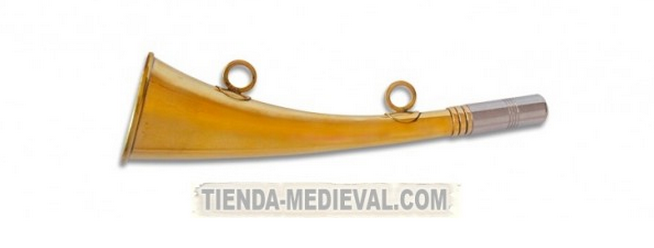 With the advancement of metallurgy in the 18th and 19th centuries, the distinction between instruments became fundamental for the organization of modern armies. It was not just a matter of aesthetic preference, but of functionality on the ground.
- The Trumpet: Cylindrical bore and bright sound. It was the soul of the cavalry. Its power allowed orders to be heard above the thundering gallop of hundreds of horses.
- The Bugle: Conical bore and darker sound. It became the preferred tool of the light infantry. Being more compact and manageable, hunters and skirmishers could easily carry it through the undergrowth.
In Spain, figures such as the Great Captain or monarch Charles III were essential to standardize these sounds. The “Toque de Oración” (Prayer Call), for example, was born after the Battle of Ceriñola (1503) as a gesture of respect for the fallen, while the 1761 “Marcha Granadera” would eventually become our National Anthem.
The Legacy in Civil and Religious Culture
Although radio and digital systems replaced bugles in the trenches of World War I, its spirit did not die. In Spain, ancient war bands found a new home in Holy Week (Semana Santa). Legendary bands, such as that of the Royal Firefighters Corps of Malaga founded in 1911, kept alive the use of the 1882 regulation bugle.
Today, when we hear the calls of “Taps” or “Reveille,” we are not just before a melody; we are listening to a centuries-old code that has moved armies and forged nations. These replicas that we can admire today are windows into an era where honor and victory depended on a firm breath and well-forged metal.


Solve your doubts about the history and use of military signals and instruments
How did military signals evolve throughout history?
Military signals evolved from primitive and visual methods in antiquity to modern electronic and satellite systems, driven by the need for greater speed, range, and security.
Antiquity and Middle Ages: They began with messengers on foot or horseback, smoke signals, drums, arrows, mirrors, and flags to transmit simple orders on the battlefield, limited by distance, weather, and enemy visibility.
18th-19th Centuries (transition to optics): Optical telegraphies emerged, such as the lines between Madrid-Aranjuez (1794) and Cadiz during the War of Independence (1808-1814); inventions like Ambrosio de la Cuadra’s portable vane telegraph (1825) and Hurtado’s mast telegraph (1833) in the First Civil War, using masts or carriages for coded signals over long distances.
19th Century (electric revolution): The electric telegraph, a pioneer in the American Civil War (1861-1865), replaced slow methods with fast wired transmissions, along with flags, bugles, and standards for tactical coordination.
20th Century (radio and specialization): Mobile radios appeared (such as the 1934 Soviet automobile), forming “signal corps” specialized in coded communications; they evolved into technical telecommunications integrating civilian methods.
Modern Era: They moved to satellite, headset, and digital systems, allowing for secure and instantaneous global communications, overcoming previous limitations of speed and precision.
What differences exist between bugles and trumpets in terms of military use?
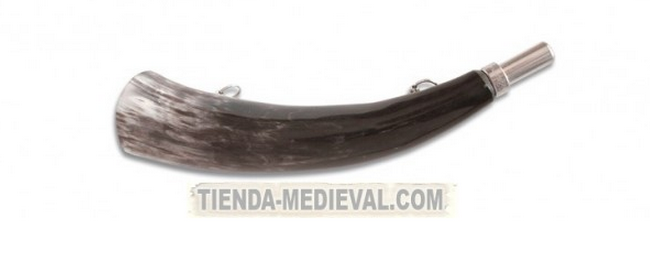 In military use, bugles are mainly used to transmit coded orders on the battlefield (such as marching, stopping, or accelerating the pace), thanks to their penetrating sonority, portability, and more compact, conical shape, which produces a dark and sharp sound.
Trumpets, on the other hand, are intended for ceremonial functions and fanfares, such as parades, national anthems, or solemn events, with a brighter and more projected timbre, historically associated with noble power and authority.
Other key differences:
- Technique and design: Bugles are natural (without valves in their basic Spanish military form) or with an optional transposer for bands; military trumpets are straight and natural, emitting harmonics without pistons.
- Sound and role in formations: Bugles for practical signals and melodic reinforcement in bugle and drum bands; trumpets for fanfare passages and lead voice in formal contexts.
- Military history: Bugles derive from horns and olifants for hunting/war; medieval trumpets for royal and religious ceremonies.
What was the impact of the Napoleonic invasion on the use of bugles in the Spanish army?
 The Napoleonic invasion prompted the adoption of the bugle in the Spanish army as the primary instrument for transmitting military signals. During the War of Independence (1808-1814), in Cadiz, the Spanish army incorporated the bugle to coordinate movements and orders, replacing or complementing other traditional signaling systems due to the need for greater efficiency against the French enemy. This practice spread, even influencing later bugle bands, such as the firefighters in Malaga, who preserved the 1882 Spanish Army regulation model originated in that era.
How were bugle and drum bands integrated into Holy Week processions?
Bugle and drum bands were integrated into Holy Week processions through a natural evolution from the military sphere, where these instruments fulfilled communication and coordination functions in the army.
The process began at the end of the 19th century when “cofrade” music emerged. Initially, these formations were incorporated as sections within traditional Music Bands, later acquiring their own identity and performing their marches independently. The bugles and drums came directly from the army, which is why they maintained military characteristics such as uniformity in the musicians’ attire.
A major milestone in this integration was the appearance of Alberto Escámez López, a military musician from Linares who in the 1920s created the processional march. Until then, bugle and drum bands accompanied sacred images by performing simple military marches, but Escámez was the first to compose marches exclusively dedicated to processions, thus transforming church music.
The adoption of these formations responded to a common practice among confraternities, which frequently recruited components from military bands to train the brothers in musical doctrine. Over time, bugle and drum bands became indispensable elements of Holy Week, leading processions and accompanying the “pasos” of the brotherhoods throughout Spain.
What role did trumpets play in Roman battles?
Roman trumpets, mainly the tuba, played an essential role in battles as military signaling instruments to transmit orders to the troops.
They were used to indicate the charge, retreat, and joint advance with the cornu, allowing thousands of legionnaires to be coordinated through coded sounds audible for miles. Their powerful “hoarse and terrifying” timbre inspired the Romans, instilled fear in the enemy, and guaranteed tactical control of the army in combat. The tubicines played them in the infantry, synchronizing movements and raising morale during the heat of battle.