In the heart of feudal Japanese history, the katana emerges not only as a weapon, but as a living symbol of honor and skill. Its edge, capable of cutting with astonishing precision, is also a delicate work of art forged from high-carbon steel; a metal that, if not cared for, succumbs to the relentless embrace of rust. Would you dare to let the silent enemy corrode the essence of your samurai spirit? Don’t worry, for today we will unveil the secrets to protect your blade from the passage of time.
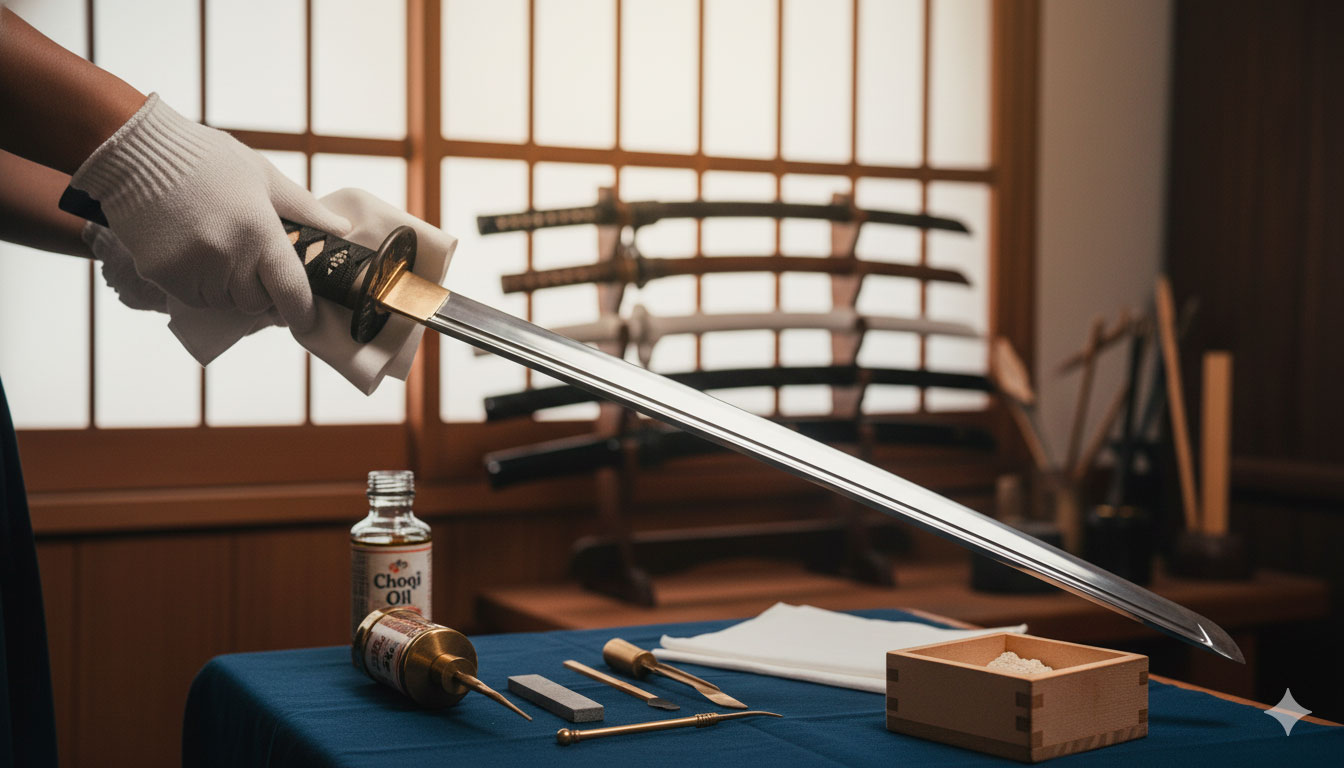
The legendary Choji Oil: Tradition meets effectiveness
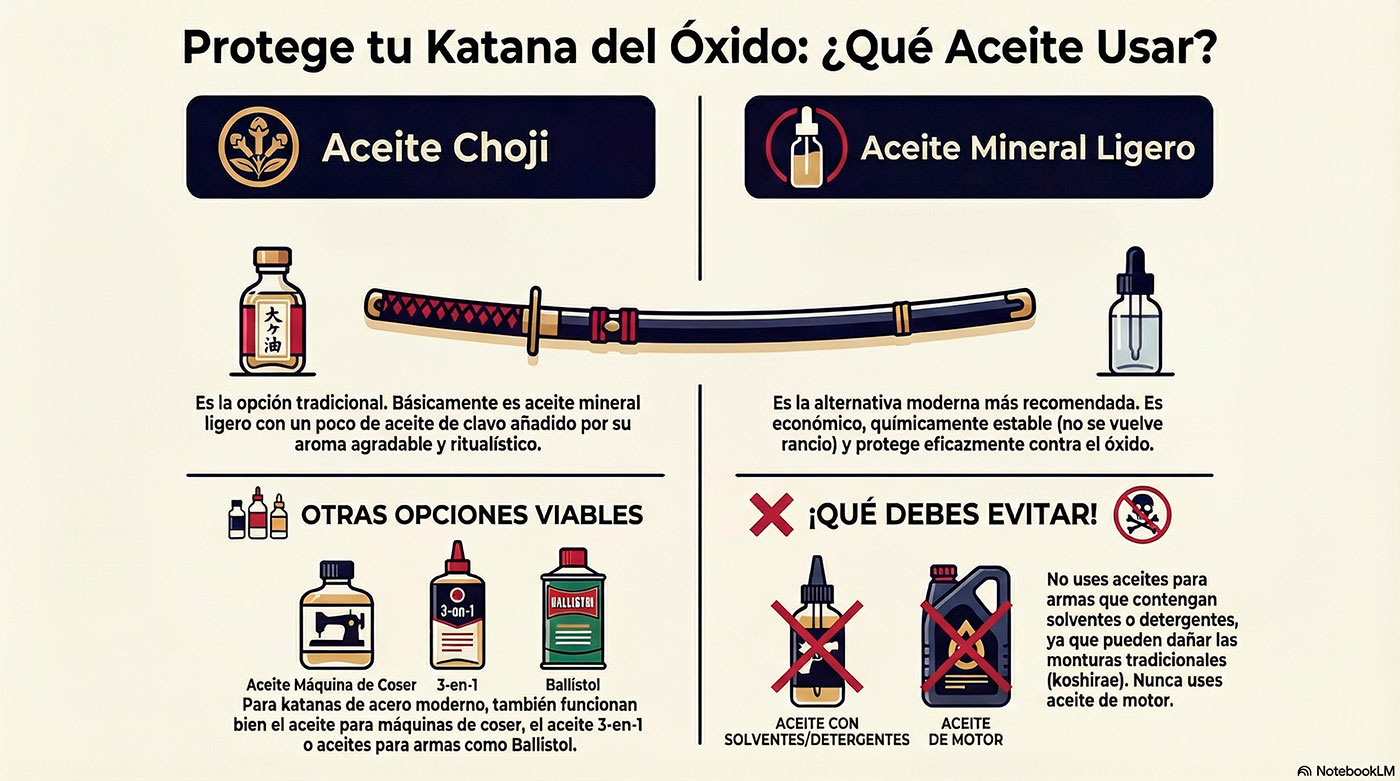
Choji Oil, also known as Choji Abura, is the ancestral ointment par excellence for blade care. Essentially, it is composed of light mineral oil infused with a touch of clove oil extract. Purists value it not only for its effectiveness, but for the aroma it infuses into the metal, inducing a meditative state during oiling, a ritualistic dimension that connects the warrior with his weapon.
However, its tradition comes at a price. It can be more expensive and, if not stored properly, runs the risk of going rancid, making it less ideal for very long-term preservation.
Light Mineral Oil: Stability at its best
For those seeking an equally effective but more stable alternative, light mineral oil is the preferred choice. Being the base of Choji Oil itself, this petroleum-derived hydrocarbon is odorless, economical, and, most importantly, immutable: it does not spoil or go rancid. Its chemical stability makes it the superior option for prolonged preservation of your blade.
Modern alternatives: Innovation at the service of the blade
Today’s world offers practical solutions for rust prevention. Various oils are formulated for swords and weapons, providing the appropriate viscosity and corrosion resistance needed for your katanas:
- Specific oils for weapons:
-
- Gun Oil: Formulated to offer robust protection on any modern sword.
- Synthetic Oil (Ballistol): This type of oil creates a protective film that adheres to the steel, hardening and providing durable defense with minimal maintenance, with an application every six months recommended.
- Commercial rust inhibitors: Products such as WD-40 and Boeshield T-9 generate protective barriers against moisture. However, their use must be researched and strictly follow the manufacturer’s instructions.
- Lithium grease: Some katana care masters have found success with lithium grease, especially in high humidity climates, applying it every two months for robust protection.
The maintenance ritual: How to apply the protective elixir
The art of maintaining a katana goes beyond choosing the oil; it is a ritual that demands precision and constancy.
Preparation: Cleaning and purification of the blade
Before fortifying your blade with oil, it is imperative to clean it. With a microfiber cloth, remove any trace of old oil or impurities. Then, a soft, slightly dampened cloth, with gentle movements and without excessive friction, will purify the blade without damaging its integrity.
Application: A protective veil
Once the blade is immaculate and dry, apply a thin layer of oil with a soft, clean cloth. Moderation is key: a thin, uniform layer is the most effective shield. Be sure to cover every millimeter of the blade, from its base to its sharp tip.
Application frequency: A constant pact
The frequency of oiling will depend on your environment. In dry climates, a weekly application is sufficient. However, in more humid environments, some experts suggest applications every two months, obtaining exceptional results that testify to the power of consistency.
Unbreakable guardians: Precautions in the choice and use of oil
The choice of oil is a pledge of protection, but certain substances can corrupt the essence of your katana.
Risks and warnings: Hidden enemies
| Type of Oil or Substance | Risk / Warning |
|---|---|
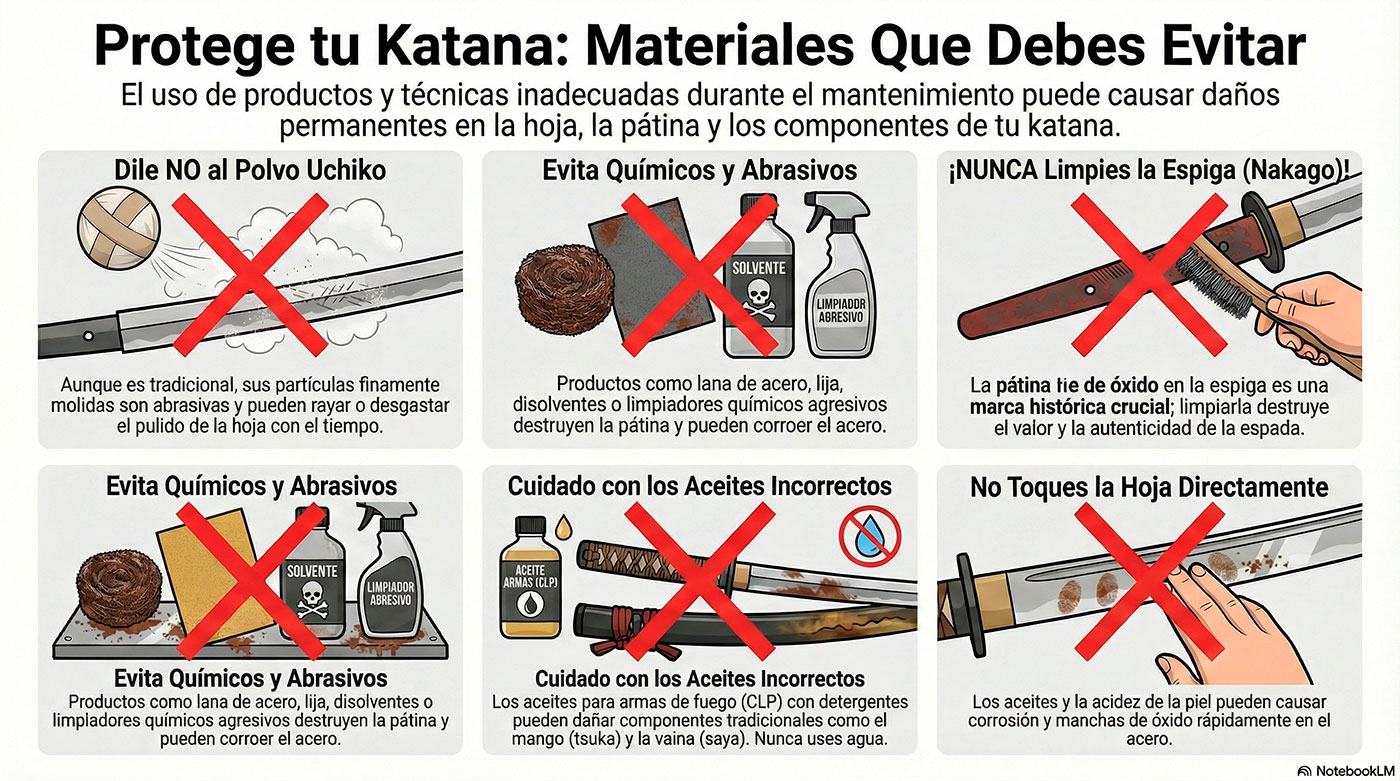
| CLP Oils / Modern Weapon Oils | May contain solvents and detergents that damage or react negatively with traditional accessories (koshirae), the wood of the scabbard (saya) or the patina, especially in Nihontō or high-end swords. |
| Excess Oil | A thick layer can damage the scabbard (saya) and lacquer, as oil accumulates and saturates the wood, attracting dirt and increasing the risk of corrosion. |
| Engine Oil | Too viscous and harmful for a Japanese sword. |
| Mineral Water | Contains salts and minerals that are harmful to carbon steel and promote corrosion. |
- CLP Oils / Modern Weapon Oils:
-
- Risk: Many modern oils contain solvents and detergents. These can damage traditional accessories (koshirae), the wood of the scabbard (saya), or the patina of katanas, especially in high-end pieces.
- Excess Oil:
-
- Risk: A thick layer of oil can deteriorate the scabbard (saya) and lacquer. The oil will accumulate, saturate the wood, attract dirt, and ironically increase the risk of corrosion.
- Engine Oil:
-
- Risk: Too viscous and harmful for the delicate steel of a Japanese sword.
- Mineral Water:
-
- Risk: Should not be used to clean the blade due to the salts and minerals it contains, which are corrosive to carbon steel.
Critical factors to prevent oxidation: A constant commitment
Humidity is the nemesis of the katana. Keeping the blade dry at all costs is the first commandment. Storing your katana in an environment with a relative humidity of 40-50% is ideal. Humidity exceeding 60% is an open invitation to rust and corrosion.
Also, avoid touching the blade with bare hands, as natural skin oils can leave corrosive fingerprints. Use gloves or a soft cloth. And finally, your katana should rest in a dry, well-ventilated place, away from direct sunlight, which can damage both the metal and the handle.
For comprehensive maintenance, rice paper is your ally to remove dirt and moisture after each use, while fine chalk powder (Uchiko) will restore its shine and cutting ability.
The art of protection: Choosing the perfect oil for your katana
The selection of “Abura” or protective oil, is crucial. The primary function of this ritual is the application of a uniform and thin protective film that acts as a shield against oxidation, the arch-enemy of every warrior and his valuable blade.


Answer your concerns about katana care and maintenance
What is the best oil for katanas in terms of durability?
Choji oil is considered the most recommended oil for katanas in terms of durability. This oil is specifically designed to protect the blade against oxidation and is of superior quality.
However, practice shows that there are effective alternatives. The special vegetable oil included in katana cleaning kits also works well to maintain blade durability. Likewise, some users have reported excellent results with lithium grease, which provides a durable protective film capable of keeping high-carbon steel in optimal condition for more than a year, even in very humid environments.
The most important thing is that you do not use just any oil. You should avoid olive oils and products containing chemical additives, as they can compromise the durability of the katana. The key is to use only quality oils specifically formulated for weapons or swords.
For maximum durability, apply the oil in moderation (avoiding excess), evenly along the blade, and maintain a consistent re-oiling routine: after each use if you actively use it, or at least once a month if you store it unused.
What are the differences between mineral oil and camellia oil for katanas?
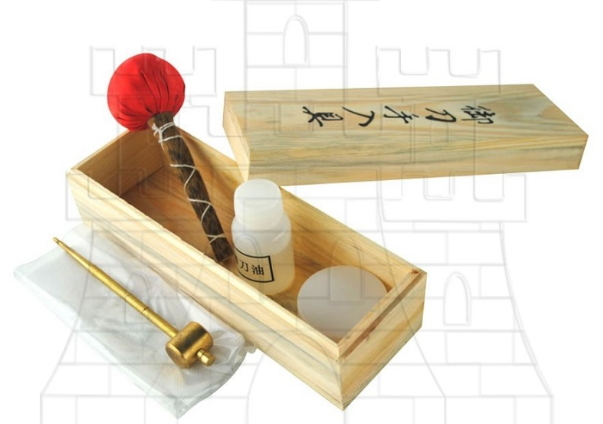 Mineral oil and camellia oil are two valid options for katana maintenance, but they have distinct characteristics and advantages.
Mineral oil is a refined byproduct derived from petroleum, specifically highly refined paraffins. In contrast, camellia oil is a natural oil obtained by cold pressing the seeds of the Japanese camellia (Tsubaki), being a completely organic product.
Mineral oil offers high penetration and does not degrade or attract dirt, making it ideal for regular protection and maintenance. Camellia oil stands out for its natural antioxidant properties, being acid-free and non-volatile, which makes it especially effective in protecting against oxidation without drying out the blade.
An important advantage of camellia oil is that it does not leave a greasy film on the blade after application, which prevents stains on the saya (scabbard) and the handle. Mineral oil, although effective, tends to leave more visible residues. In addition, camellia oil is odorless, allowing food to be cut without transferring unpleasant flavors to it.
Both oils are acid-free when they are of quality. However, camellia oil is especially recommended when superior antioxidant protection and a cleaner application are required, while mineral oil is more economical and accessible for regular maintenance.
Is it necessary to use rust inhibitors in addition to oil?
It is not necessary to use rust inhibitors separately from the oil if the oil already contains these additives, as modern engine oils include rust and corrosion inhibitors that protect against rust and corrosion of the engine’s metal parts. These inhibitors are an integral part of the oil’s formulation to prolong its useful life and protect the engine during its normal operation.
However, in certain cases of extreme use, prolonged storage, or very aggressive conditions, the additional use of specialized anti-rust additives or lubricants that create an extra protective barrier on metal surfaces may be considered. These products are usually used for preventive maintenance or on machinery in prolonged disuse.
- Conventional engine oil already contains rust and corrosion inhibitors that fulfill this function.
- Using additional rust inhibitors is not mandatory but an extra measure for specific conditions or specialized maintenance.
- Specific additives can improve protection and cleaning, but they are not essential for normal use if the oil is adequate.
Therefore, for most engines and usual situations, quality oil containing integrated rust inhibitors is sufficient.
How does humidity affect katana maintenance?
Humidity negatively affects katana maintenance because it promotes oxidation and corrosion of the blade’s steel. Keeping the katana in an environment with controlled relative humidity, ideally between 40% and 50%, helps prevent rust from forming. Exposing the katana to excessive humidity, especially above 60%, increases the risk of rust damage and blade deterioration. Therefore, it is essential to clean and dry the katana after use, apply protective oil to prevent oxidation, and store the sword in a dry place with controlled humidity to preserve it in good condition long-term.
In areas with high environmental humidity, it is recommended to check and re-oil the blade more frequently to avoid rust stains. Furthermore, avoiding exposure to sudden temperature changes along with humidity contributes to preserving both the steel and the wooden parts of the katana.
What type of wax is most effective for protecting a katana blade?
Wax is not the most recommended product for protecting a katana blade; instead, Choji type oil, a traditional Japanese oil made with a mineral oil and clove base, is the most effective for protecting the blade from rust and maintaining the integrity of the katana’s high-carbon steel. This oil creates a protective layer that prevents oxidation and also protects other parts such as the handle.
Additionally, it is recommended to keep the blade clean with Uchiko powder and apply oil regularly to ensure its preservation. While modern metal wax products exist, in the traditional context and for katanas, Choji oil or an acid-free mineral oil are the most effective and safest options for protecting the blade.
With each stroke of oil, each meticulous cleaning, you not only protect a piece of steel, but you honor a millennia-old tradition. Your katana, with its immaculate edge and bright reflection, is a testament to your commitment and reverence for the art of the samurai, ready for any challenge that time may present.