In the heart of samurai tradition, the katana is not just a weapon, but a reflection of its wielder’s soul. But what happens when the passage of time or neglect threatens to tarnish its splendor? Rust, a silent and corrosive enemy, can devour the beauty and functionality of this ancestral blade. Restore its glory, protect its edge, and uncover the secrets of care that will keep it pristine throughout the centuries.
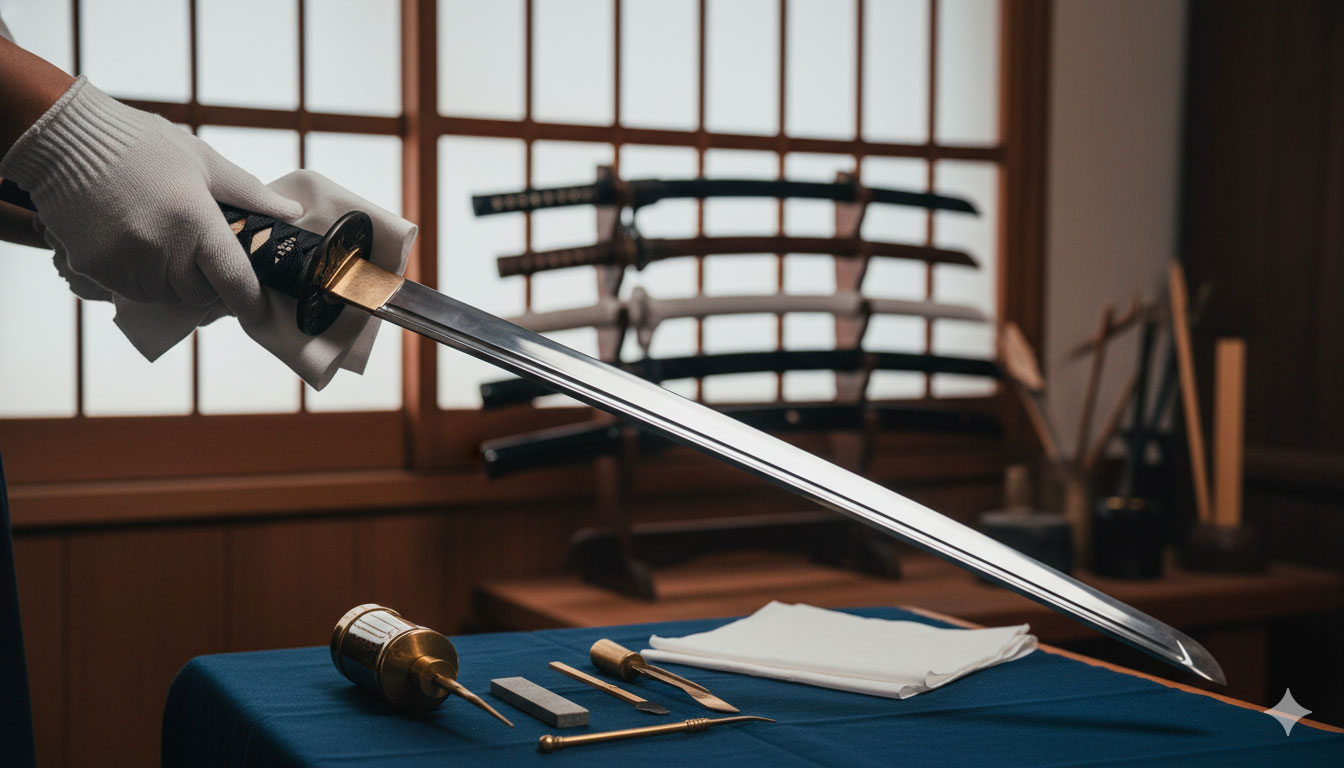
Maintaining a katana is an art in itself, a ritual that honors its history and its future. Whether a functional or decorative piece, every katana demands meticulous care to preserve the carbon steel of its blades, which is extremely vulnerable to the ravages of corrosion. A cleaning kit is not just an accessory; it is an imperative necessity to ensure the longevity of these oriental swords.
The Protective Elixir: Oils and Solutions for Your Katana
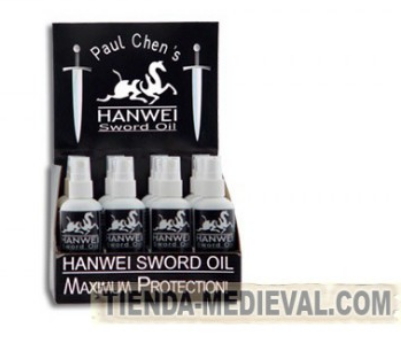
The steel of a katana, though masterfully forged, is susceptible to the passage of time and humidity. Therefore, protective oil is its most faithful shield. There are elixirs like spray oil, designed to protect carbon steel blades of fighting swords and other bladed weapons against the harshness of corrosion. A small container, like those from CASS HANWEI (PAUL CHEN), which contains petroleum distillates, can be a formidable ally.


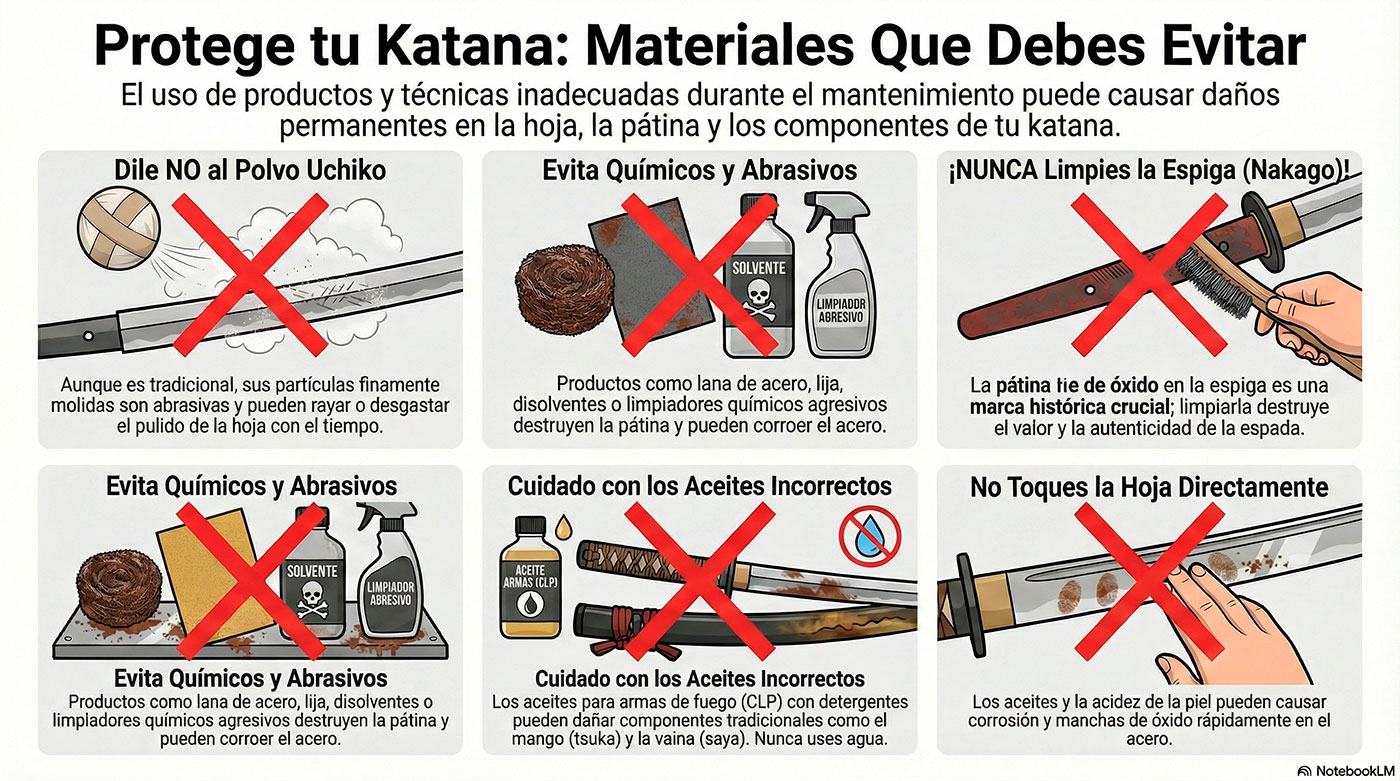
The choice of oil is crucial. Choji oil, traditional and appreciated for its aroma, or a good light mineral oil, more economical and with superior durability for long-term preservation, are your best options. Avoid modern CLP oils that can damage the koshirae (fittings) and wood. For deeper cleaning, ethanol or isopropyl alcohol are excellent for removing old oil and contaminants.
The Cleaning Arsenal: Essential Tools for Your Sword Maintenance
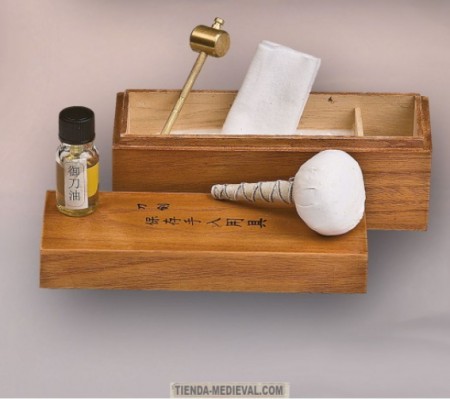
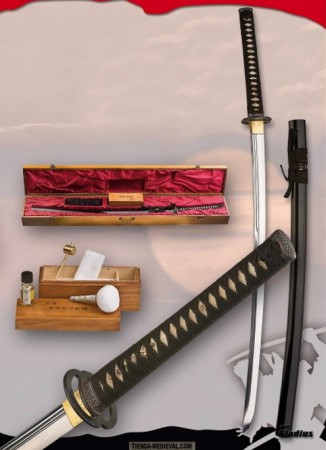
A katana cleaning kit is a treasure in itself. Generally, it includes:
- Metal hammer (mekugi-nuki): for disassembling the katana.
- Vegetable oil (koji or choji oil): the blade protector.
- Rice paper (harai gami or nuguigami): for delicate cleaning and polishing.
- Non-abrasive powder ball (uchiko): for absorbing old oil and polishing.
- Soft cloth (erufu): for general maintenance.
Some katanas come with their own cleaning kit, a gesture that underscores the importance of this ritual. Cloths should always be soft, clean, and lint-free, such as microfiber cloths, to avoid scratching the glorious surface of the blade.
Frequency and Signals: When to Act and Detect Rust
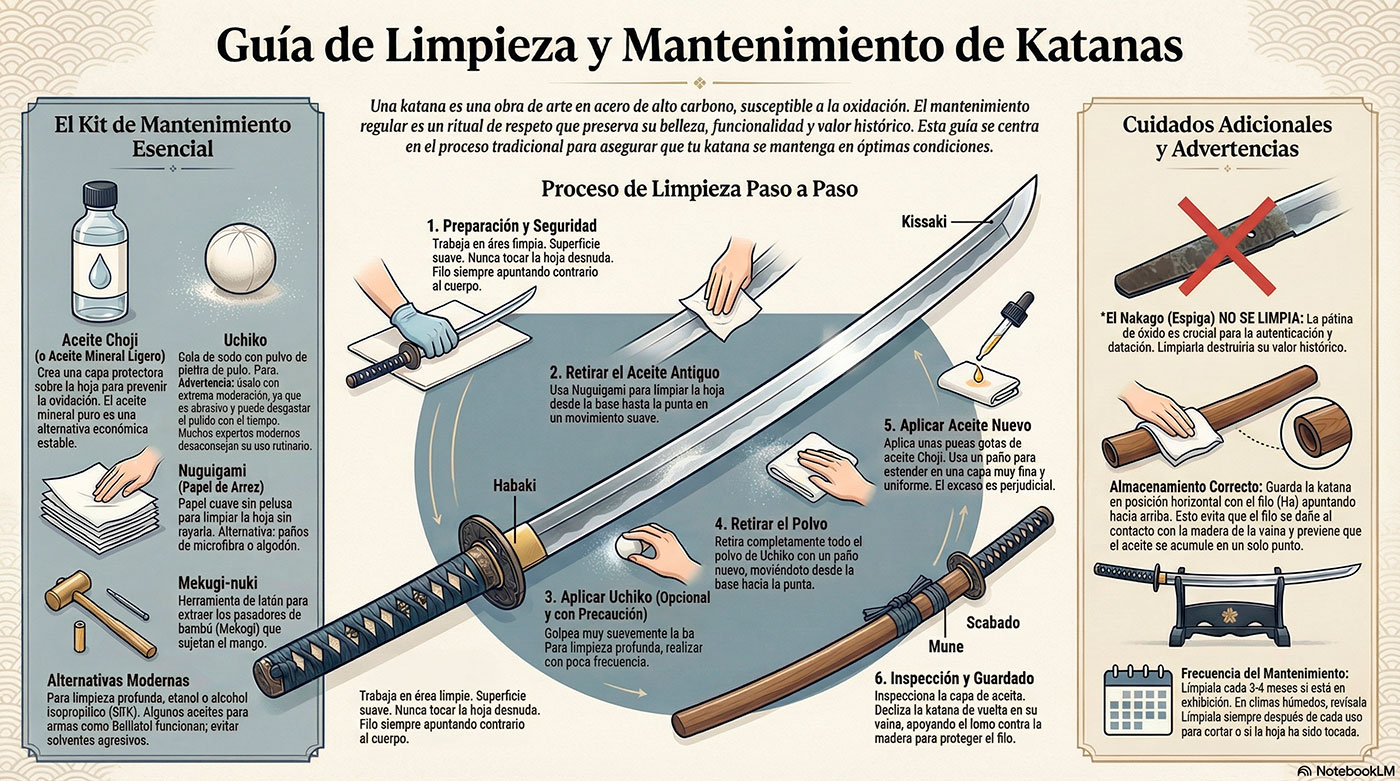
Diligence is key. The frequency of your katana’s maintenance is not arbitrary, but a response to its use and the environment around it:
- Frequent Use: After each encounter or use, especially after cutting wet targets, or whenever the bare blade touches the skin (sweat oils and salts are corrosive).
- Storage/Display: A thorough cleaning every three or four months is generally sufficient.
- Humid Environments: If you live near the coast or in areas of high humidity, a monthly inspection is vital.
- Oil Renewal: Protective oil evaporates; renew the layer every two or three months.
Pay attention to the signs: discoloration, surface scratches, incipient rust spots, dust, or a blade that has lost its shine are calls to action that demand your attention.
The Cleaning Ritual: From Pre-cleaning to Final Oiling
Each step is an act of reverence towards your katana.
Preparation and Drawing
- Safety above all: Work in a clean, well-ventilated space without distractions. Handle the blade with the edge always away from your body.
- Draw the katana: Carefully slide it from the scabbard (saya), with the edge upwards and the tip (kissaki) slightly raised.
- Clean the saya: Gently tap the mouth of the scabbard (koiguchi) against a surface to clear any debris. Never sheathe a dirty or wet katana!
Deep Cleaning (According to Tradition)
- Disassembly (optional and sporadic): For a thorough cleaning, use the mekugi-nuki to remove the pins (mekugi). Then, gently tap the left wrist (while holding the handle) with the right fist until the tang (nakago) loosens and comes out. This step should not be frequent to avoid loosening the assembly.
- Remove old oil: With a clean, dry cloth (rice paper, flannel, or disposable tissue), slide in a single motion from the habaki (collar) to the tip (kissaki) to remove the old layer of oil. If the oil is stubborn, you can use cotton or gauze soaked in benzene or pure alcohol.
Applying Powder and Polishing
- Uchiko: Lightly tap the uchiko ball along the blade to sprinkle the fine powder. Remember, application should be minimal.
- Polish carefully: Use a second clean cloth or rice paper to gently rub the uchiko powder over the entire blade, making sure to remove it completely. This step absorbs residual oil and polishes lightly. Warning! Excessive or aggressive use of uchiko can damage the polish, especially on sensitive blades.
Oiling and Protective Storage
 Apply new oil: Pour a few drops of oil (choji or mineral) along the spine of the blade.
- Spread evenly: With a third clean cloth or rice paper, spread the oil to create a protective, uniform, and extremely thin layer over the entire nagasa. Avoid excess! A thick layer attracts dirt and can damage the saya.
- Reassemble (if disassembled): Replace the habaki, seppa, and tsuba. Insert the tang (nakago) into the handle (tsuka) and secure it with the mekugi.
- Sheathe with respect: Without touching the blade after oiling, store it by sliding it over the spine (mune).
When Rust Lurks: Specific Treatment for Rusted Katanas
Rust is an adversary, but not invincible. Know your enemy:
- Active Rust (Sabi): Bright reddish or reddish-brown. It is the most dangerous, progresses rapidly, and can cause irreparable damage if not treated in time.
- Fixed Rust/Old Patina: Black spots or dark brown to purplish black tones. It is stable, protective, and, if not on the cutting edge, should be left intact.
Removal of Severe Contamination (Post-Cut)
If your katana has touched liquids or organic materials (blood, sweat, wet targets), immediate action is required:
- Initial mechanical cleaning: Use disposable paper towels to remove larger debris and moisture.
- Degrease with solvent: Apply 90% isopropyl alcohol or Windex to strip the surface of sticky residues.
- Urgent re-application of oil: Solvents remove protection. After complete drying, it is imperative to apply a new layer of oil to prevent flash oxidation.
Treatment of Rust on the Blade (Nagasa)
 Mild rust: Can be removed with oil and uchiko powder.
- Abrasive polishing (with caution): For very stubborn stains on mirror-polished blades, some resort to metal polishing compounds (Mothers Mag or Flitz). These are abrasive; use them with extreme caution and always follow with a deep chemical cleaning (isopropyl alcohol) to remove any residue.
Treatment of Rust on the Iron Guard (Tsuba)
The tsuba requires delicate handling to avoid damaging its patina:
- Gentle cleaning: Wash the tsuba with warm water and mild hand soap (never detergent). You can use a soft toothbrush. Dry it thoroughly.
- Boiling (only if applicable): Boiling the tsuba in distilled water for about 20 minutes can soften dirt and red rust, opening the metal’s pores. Warning! Do not do this if the tsuba has gold inlays or nunome zogan, as heat can damage them.
- Mechanical removal of red rust: Use a tool softer than the black patina, such as ivory, dense bone, or antler, and gently scrape off the rust. Periodically clean the red powder with a damp cloth. Patience is key. Bamboo wooden chopsticks can also be used for thin areas.
- Finishing: After removing the rust, rub the tsuba with a cotton cloth to darken the color and give it a soft luster. Some apply choji oil at the end.
| Component | Function and Acceptable Alternatives |
|---|---|
| Protective Oil (Abura) | Choji Oil: Traditional, with mineral oil and clove. Can go rancid. Light Mineral Oil: More economical, odorless, superior for long-term preservation. Household Alternatives: 3-in-One oil, sewing machine oil. |
| Cleaning Agent/Solvent | Ethanol (98%-99%) or isopropyl alcohol (90%) to remove old oil. Benzene or pure alcohol for difficult oil. Windex or metal cleaning compounds (Mothers Mag, Flitz) for post-cut cleaning. |
| Cleaning Cloths (Nuguigami) | Rice paper (Nuguigami or Harai gami): Soft Japanese paper. Alternatives: thin tissues, chamois, or microfiber cloths. Must be clean, soft, and lint-free. |
| Polishing Powder (Uchiko) | Silk ball with finely ground stone powder. Absorbs old oil, moisture, and polishes. Use with minimal application. |
| Disassembly Tools | Mekugi-nuki: Brass hammer or punch to extract the mekugi (bamboo pegs). |
- Protective Oil (Abura)
-
- Choji Oil: Traditionally recommended, it is light mineral oil with a bit of clove oil for scent. Can go rancid.
- Light Mineral Oil: Works equally well as Choji to prevent rust, is cheaper, has no odor, and cannot spoil, being superior for long-term preservation.
- Household Alternatives: 3-in-One oil, sewing machine oil, or gun oils.
- Cleaning Agent/Solvent
-
- Ethanol (purity 98%-99%, not alcohol diluted with water) or isopropyl alcohol (90%) to remove old oil and contaminants.
- Benzene or pure alcohol can be used to remove stubborn oil.
- Windex or metal cleaning compounds (like Mothers Mag or Flitz) followed by alcohol cleaning, can be used for deep post-cut cleaning.
- Cleaning Cloths (Nuguigami)
-
- Rice paper (Nuguigami or Harai gami): Thick Japanese paper, crumpled to soften, used to remove oil and powder.
- Alternatives: thin disposable tissues or chamois or microfiber cloths.
- Must be clean, soft, lint-free, and non-starched cloths.
- Polishing Powder (Uchiko)
-
- A silk ball filled with finely ground stone powder (used in final polishing).
- Used to absorb old oil, moisture, and polish the surface.
- Disassembly Tools
-
- Mekugi-nuki: Brass hammer or punch to extract the mekugi (bamboo pegs).
Clearing Doubts About Katana Care and Maintenance
What is the best oil for cleaning a katana?
The best oil for cleaning a katana is choji oil, which is a blend of mineral oil (99%) with 1% clove oil. This oil protects the blade against rust and corrosion, in addition to providing a characteristic aroma. If choji oil is not available, pure mineral oil can be used as an alternative.
Additionally, to properly clean the katana before oiling, it is advisable to use an uchiko ball (special powder to remove residues) and soft cloths such as microfiber or rice paper, ensuring the blade is clean and dry before applying the oil. It is important to avoid aggressive chemicals that can damage the blade.
How is chalk powder (Uchiko) used in katana maintenance?
Chalk powder (Uchiko) is used in katana maintenance to finely clean the blade and remove surface moisture and impurities. The powder bag is gently tapped on the blade to spread the powder, and then carefully rubbed with a soft cloth to absorb residues and prepare the surface before applying the protective oil that prevents oxidation.
That is, the process is:
- Lightly tap the Uchiko ball (cloth ball with finely ground chalk powder) onto the blade to spread the powder.
- Gently rub the blade with a clean cloth, removing powder, dirt, and moisture.
- Then apply a thin layer of oil to protect the blade from rust.
This method keeps the blade clean, shiny, and protected from corrosion without damaging the steel or the edge.
What are the differences between using vinegar and baking soda to clean katanas?
Vinegar and baking soda are two effective methods with distinct characteristics for cleaning katanas and removing rust.
White vinegar
Vinegar acts as a mild acid that directly dissolves rust. You can submerge the piece in white vinegar for several hours or pour it directly onto the rusted surface. Rust chemically reacts with vinegar and dissolves, then allowing you to scrub with steel wool or aluminum foil soaked in vinegar to remove residues. This method is ideal for moderate rust and offers controlled action thanks to the slow-acting acetic acid present in vinegar.
Baking soda
Baking soda works in a more abrasive and mechanical way. It is mixed with water to create a thick paste that is spread over the metal and left to act for one or two hours. Afterwards, it is scrubbed with steel wool or a wire brush to remove both the paste and the rust. This method requires more manual work but is less aggressive than other chemical products.
Combined method
The combination of both is particularly effective: mixing equal parts of vinegar and baking soda forms a paste that combines the chemical action of vinegar with the abrasion of baking soda. This mixture is rubbed onto the rusted parts with a brush or steel wool, then rinsed and dried thoroughly.
The main advantage of vinegar is its rapid dissolving action, while baking soda offers softer control and is ideal for cases of mild rust combined with general blade cleaning.
Is it necessary to disassemble the katana for maintenance?
For proper katana maintenance, yes, it is recommended to disassemble it to thoroughly clean and oil the blade, removing dust, dirt, and residues that could damage it or cause oxidation. Disassembly involves removing the scabbard, taking out the pegs (mekugi) that secure the blade to the handle, and carefully extracting the blade. This allows for deeper cleaning and inspection of all parts, including the hilt and guard (tsuba). However, it is not mandatory to disassemble it every time it is cleaned; a superficial cleaning of the blade can be performed without disassembling for frequent maintenance, applying special oil to protect it.
Summary:
- Disassembly recommended for deep cleaning and preventive maintenance.
- Not necessary to disassemble for every maintenance if superficial cleaning is done and oil is applied.
- Always handle the katana with care to avoid damage and corrosion.
What type of cloth is most effective for cleaning a katana blade?
The most effective cloth for cleaning a katana blade is a soft, lint-free one that leaves no residue, such as nuguigami (traditional Japanese cleaning cloth) or a microfiber cloth. Rice paper or a super soft, unscented tissue can also be used if the former are not available. The important thing is that the material is soft enough not to scratch the blade and leaves no particles.
The Care of Each Component: Beyond the Blade
 The honor of a katana resides in each of its parts.
The Tang (Nakago): An Untouchable Historical Treasure
The tang, the section of the blade hidden within the handle, is a living record of its history. Its dark rust patina is crucial for the authentication, dating, and value of the sword. Therefore, the golden rule is clear: the nakago should never be cleaned, scrubbed, polished, or oiled. Altering its patina could halve the value of an original katana.
The Scabbard (Saya): The Protective Case
The saya, often covered in lacquer (urushi), deserves your attention. Clean its exterior with a very soft cloth and, occasionally, apply a thin layer of wax to maintain its finish. Remember! Never sheathe a dirty katana, as debris can damage the inside of the saya.
Storage: The Warrior’s Rest
The resting place of your katana is as important as its cleaning:
- Position: Always store it horizontally with the edge facing up. This reduces stress on the blade, prevents the edge from compressing the internal wood of the saya, and ensures that the protective oil is evenly distributed.
- Environment: Choose a dry and cool place. Avoid using camphor or naphthalene balls in the chest, as they can cause rust.
Deep rust, significant scratches, or chips on the blade are problems that require consultation with a professional polisher. Attempting repairs without the proper experience can irreversibly worsen the damage.
The Wisdom of Care: Crucial Precautions
Cleaning a katana is an act of high concentration and respect:
- Do not touch the blade: The oils and salts from your hands cause corrosion. If you must hold it, do so only by the spine (mune) or the nakago.
- Cleaning direction: Always clean from the habaki towards the tip (kissaki) and keep the blade’s edge away from your body.
- Take your time: Incorrect cleaning can lead to damage, oxidation, and even injuries.
- Be careful with uchiko: Do not inhale its powder.
Preventive and regular maintenance is the only way to ensure the longevity of your Nihontō, a Japanese sword that is much more than metal and art; it is a legacy forged in time.