If you have ever imagined clandestine duels, flowing capes, and flashes of steel under the light of a streetlamp, the image you are looking for is likely that of the rapier sword. In this article, you will discover why this sword of the Golden Age was much more than a weapon: it was a symbol of status, a tool for dueling, and the driving force behind the birth of fencing as both a theoretical and practical art.
Origin and Rise: Why was the Rapier born?
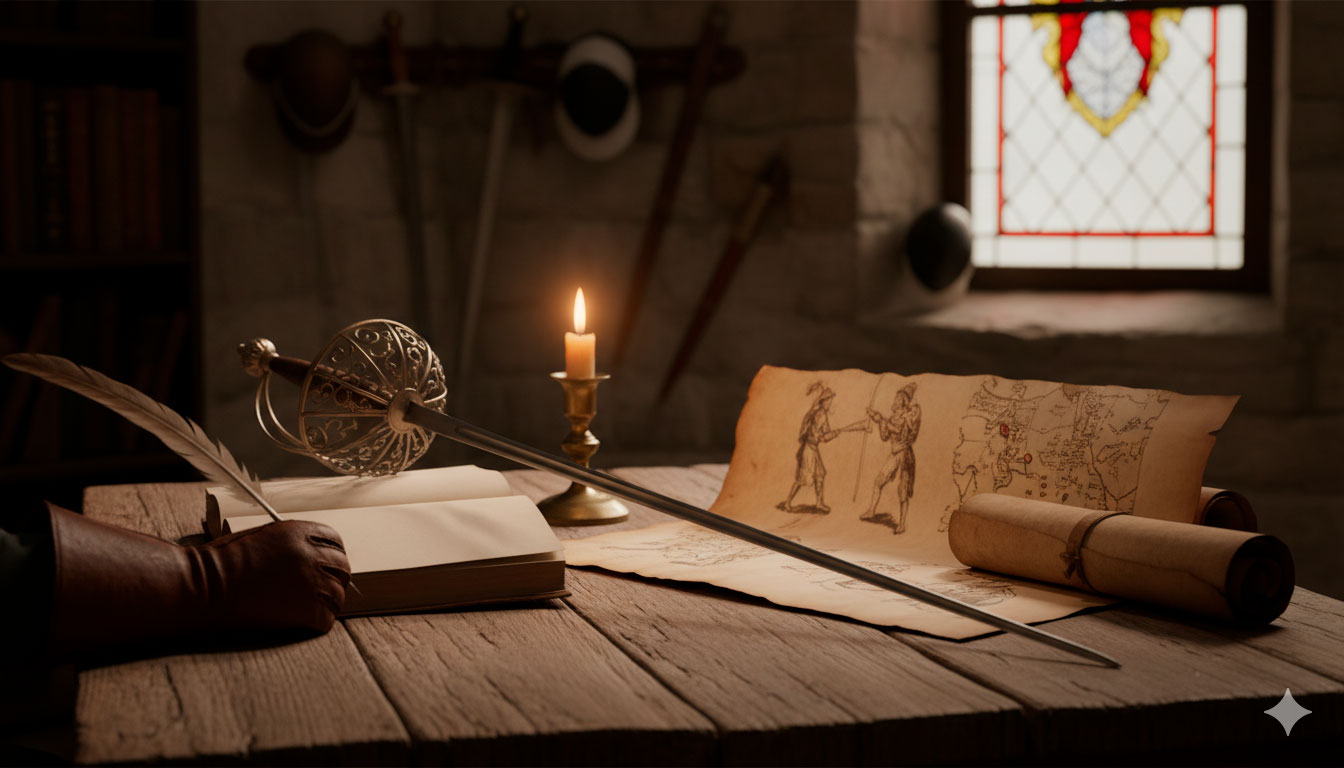
The rapier sword emerged in early modern Europe and consolidated between the 16th and 17th centuries. The term, of Spanish origin (espada ropera), refers to its social function: it was a sword to be worn with clothes, suitable for civilians seeking protection and distinction. It was not born on the battlefield, but in the streets, salons, and fencing halls, where mobility and elegance began to replace the blunt force of medieval weapons.
Chronology of the Rapier Sword
The rapier sword was not just a defense tool, but the ultimate symbol of the Golden Age gentleman. Arising from the need to carry an elegant weapon that complemented civilian attire—the “ropa”—its technical evolution transformed combat into a geometric and social science. From the crude swept-hilt designs of the 15th century to the defensive perfection of the cup-hilt, the history of the rapier reflects an era where honor was defended with the tip of the steel and the logic of fencing treatises.
Below, we present the key milestones in the development of this legendary weapon and the school of Verdadera Destreza.
| Era | Historical Milestone / Event | Technical Development / Work | Context / Evolution |
|---|---|---|---|
| 15th Century | Appearance of the term “espada ropera” (Coplas de la panadera). | First swept hilts. | Civilian dress weapon, similar to the “spada da lato”. |
| 16th Century | Publication of “De la Filosofía de las Armas” (Carranza, 1582). | Birth of “Verdadera Destreza” and shell hilts. | Specialization in the thrust; predominant dueling weapon in Europe. |
| 17th Century | Duel between Quevedo and Pacheco de Narváez (1608). | Rise of the cup-hilt around 1650. | Maximum geometric sophistication and total hand protection. |
| 18th Century | Global transition towards the French school. | Progressive substitution by the smallsword. | Decline in favor of lighter weapons and triangular blades. |
| 19th Century | Publication of hybrid treatises (Manuel Antonio de Brea, 1805). | End of the living tradition of Destreza. | Disappearance of civilian use and transition to competitive fencing. |
- 15th Century: Origins
-
- Term: First documented mention in Spain (1445) and France (1474).
- Design: Swept hilts and use of both cut and thrust.
- Use: Linked to the gentleman’s daily attire.
- 16th Century: Consolidation
-
- Theory: Carranza establishes the foundations of Verdadera Destreza (1569).
- Morphology: The blade becomes longer and narrower to favor the thrust.
- Status: Becomes the symbol of prestige for the European nobility.
- 17th Century: The Splendor
-
- Technical Peak: Popularization of the cup-hilt (cazoleta), the quintessential Spanish design.
- Treatises: Works by Pacheco de Narváez and Girard Thibault dominate the scene.
- Culture: Era of literary duels and fencing as a geometric science.
- 18th – 19th Century: Evolution and Legacy
-
- Transition: The French smallsword displaces the rapier for being lighter and more functional for fashion.
- Hybridization: The last masters mix Destreza with Italian and French systems.
- Oblivion: Total disappearance of the practical tradition in the early 20th century.
Anatomy of the Rapier: Blade, Hilt, and Handling
Understanding the rapier requires breaking down its anatomy: each element has a purpose that explains why the weapon adapted so well to civilian dueling.
The Blade
The rapier blade is long and thin, primarily designed for the thrust. Nonetheless, many rapiers retained cutting capability. Toledo blades were famous for their combination of flexibility and hardness, the result of forging techniques that allowed for swords that were both resistant and elastic. Variants existed: slightly more robust blades with double edges (for military orientation) and very narrow blades for civilian use.
The Hilt
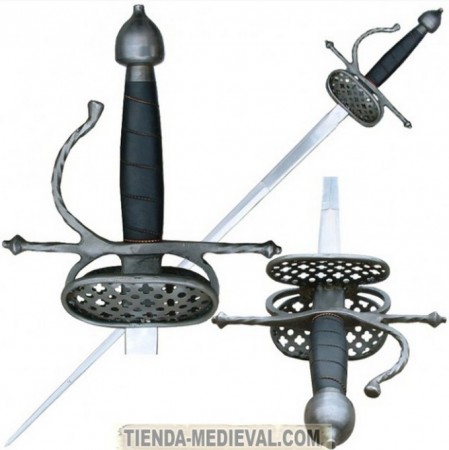
The evolution of hand protection is one of the hallmarks of the rapier. It moved from simple crossguards to complex systems that protected the fingers and wrist without sacrificing agility. The main types are:
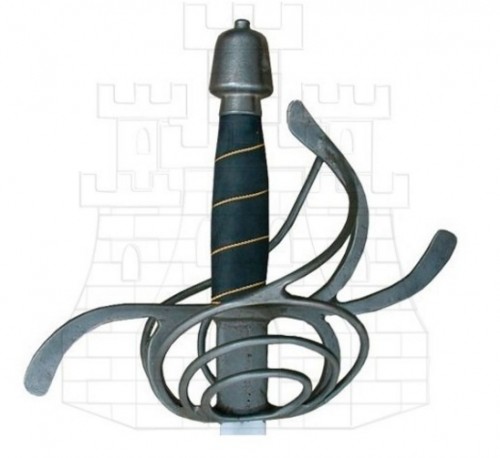
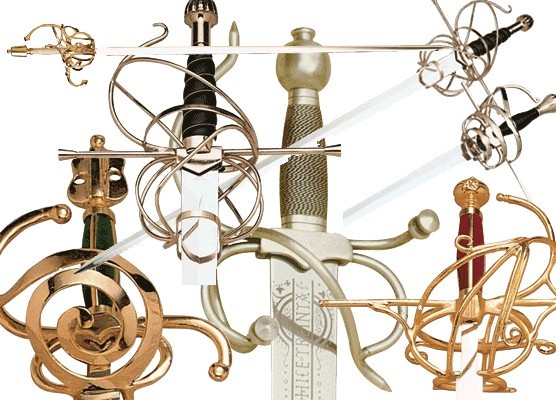
- Swept Hilt (Lazo): early protections with rings and hooks for the index finger.
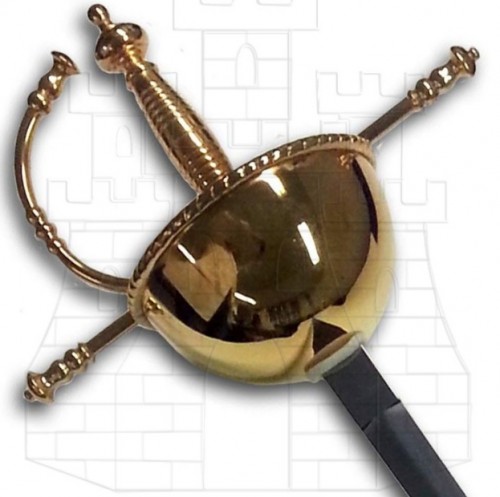
- Shell Hilt (Concha): late 16th century; added aesthetics and better protection.
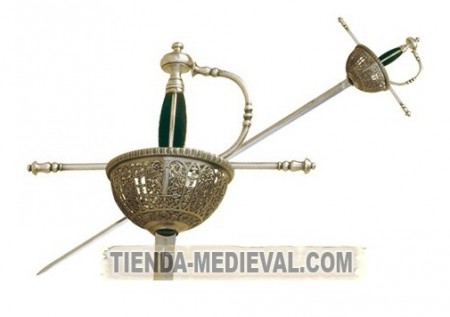
- Cup-Hilt (Taza): 17th century; offered almost complete coverage of the hand without adding too much weight.
The Rapier in Combat: Technique, Speed, and Control
The rapier did not seek heavy frontal impact. Its effectiveness lay in agility, precision in the thrust, and control of the opponent through movement and geometric lines. In a duel, posture, timing of entry, and tip placement were decisive.
The Free Hand and Its Use
The use of the non-sword hand was a tactical matter: blocking with the free hand was risky without protection, which is why intelligent combinations arose:
- Main-gauche or parrying dagger: the classic pair; allows for blocking, counter-attacking, and disarming.
- Cloak: wrapped around the arm, it serves to cover, distract, or trap the rival’s blade.
- Buckler or target: small shields that persisted in military contexts and some civilian traditions.
Schools, Treatises, and Masters: How the Rapier Created Modern Fencing
The popularity of the rapier promoted the professionalization of fencing. Masters, fencing halls, and treatises appeared that systematized techniques and strategies. Among the most influential schools were the Italian, German, and Spanish.
Italy and the Rational Method
Italian masters, such as Camillo Agrippa, pushed a mathematical and rational vision of the duel. Their proposals reorganized the use of the dagger and sword, reducing unnecessary movements and prioritizing optimal lines and angles for the thrust.
Verdadera Destreza: The Spanish School
 In Spain, fencing transitioned from a sometimes violent and popular practice to a liberal art. Jerónimo Sánchez de Carranza laid the theoretical foundations in 1582, incorporating geometric and rational principles; later Luis Pacheco de Narváez developed and disseminated Verdadera Destreza. Pacheco taught the court, was Master-at-Arms to Philip IV, and ensured his method dominated fencing instruction in the Spanish Monarchy for decades.
Verdadera Destreza is characterized by:
- Use of imaginary lines and circles to control distance.
- Lateral movements and control of the opponent’s blade.
- Emphasis on maintaining one’s own defense while preparing the thrust.
How to Identify an Authentic Rapier and Its Variants
If you find yourself facing an antique sword or a replica, looking at certain details will help you identify it as a rapier:
- Blade length: relatively long for a one-handed sword.
- Blade section: narrow, often with profiles designed for thrusting.
- Elaborate hilt: swept, shell, or cup are clues for civilian/dueling use.
- Balance: designed to combine speed and control, not heavy blows.
Hilts and Styles: Comparative Table
| Hilt | Period | Main Advantage | Typical Use |
|---|---|---|---|
| Swept (Lazo) | Late 15th – 16th Century | Lightness and better grip | Urban dueling and civilian carry |
| Shell (Concha) | Late 16th Century | Aesthetic and functional protection | Gentlemen and nobles |
| Cup (Taza / Cazoleta) | 17th Century | Post-complete hand protection | Salon fencing and formal duels |
Manufacturing, Forging, and the Seal of Toledo
The quality of the blade marked the fame of many rapiers. The workshops of Toledo were synonymous with excellence: selected steels and tempering processes that allowed for elastic, resistant blades with reliable tips. Artisans combined tradition and experimentation to obtain the balance between flexibility and edge retention.
Practical Technique: Basic Exercises to Understand the Rapier
If you have access to a replica (or practice in a historical hall), some fundamental exercises will help you incorporate rapier principles:
- Footwork: lateral steps and line recovery.
- Entries and exits with thrusts: mastering timing and distance.
- Coordinated use of the free hand: practice with a cloak or dagger to learn how to combine attack and defense.
Practicing with a master trained in historical fencing accelerates progress and minimizes bad habits.
The Rapier in Literature, Theater, and Culture
The rapier occupies a privileged place in the Hispanic culture of the Golden Age. Authors like Lope de Vega and Cervantes mentioned it in works and texts, and its presence in theater contributed to consolidating the image of the gentleman who defends his honor with elegance. The rapier sword is, therefore, at the intersection between social reality and literary imagination.
Collecting, Buying, and Valuing Replicas


If you are interested in acquiring a historical rapier or a replica, value these points: design authenticity, blade quality, balance, and hilt fidelity. For purchases, we recommend doing so in our online store, where you will find verified replicas, functional options, and decorative models.
| Model / Replica | Hilt Type | Recommended Use | Level |
|---|---|---|---|
| Functional cup-hilt rapier | Cup-hilt (Cazoleta) | Historical training | Intermediate – Advanced |
| Decorative swept-hilt rapier | Swept-hilt (Lazo) | Collection and display | All |
| Shell-hilt rapier replica | Shell-hilt (Concha) | Historical reenactment | Beginner – Intermediate |
Care and Maintenance of a Rapier
A well-cared-for rapier lasts centuries. Basic recommendations:
- Clean the blade after use and apply a thin layer of oil to prevent corrosion.
- Regularly inspect the hilt and handle for any looseness.
- Avoid heavy strikes against hard surfaces that could bend the blade.
SEE MORE CUP-HILT RAPIER SWORDS | SEE MORE SWEPT-HILT RAPIER SWORDS | SEE ALL TYPES OF SWORDS
Today, the rapier sword continues to teach principles of movement, distance control, and technical elegance. Whether as a collector’s item or as a tool in teaching historical fencing, it represents a bridge between theory and practice, between aesthetics and effectiveness.
Reflect: knowing the rapier is knowing an essential part of how conflicts of honor were resolved and how reason and geometry were applied to a martial art. Learning its techniques is, ultimately, learning to think about movement with precision and elegance.