
In the fascinating world of historical weapons, every element of a sword serves a vital function, and the choice of types of sword pommels for hilts is far more than just an aesthetic matter. From ergonomics to balance, and combat safety, the pommel is the essential counterweight that defines the soul of the blade. At Tienda-Medieval.com, we understand that every detail counts, which is why we unravel the secrets of these fundamental pieces that have evolved over the centuries, marking the difference between a good sword and a masterpiece of martial engineering.
The Anatomy of the Pommel: Beyond a Simple End Piece
Though often underestimated, the pommel is the culmination of a sword’s hilt—a piece that not only prevents the hand from slipping but also plays a critical role in the weapon’s handling and effectiveness. Its design, material, and weight are decisive factors in how a swordsman can wield, cut, and thrust. Historically, pommels have served several fundamental purposes:
- Weapon balance: Acting as a counterweight, it shifts the balance point towards the hilt, making the sword more manageable and less heavy at the tip.
- Grip security: It stops the user’s hand, preventing it from sliding off the hilt during intense use.
- Blunt striking: In close combat situations, the pommel could be used as a secondary weapon to strike the opponent.
- Aesthetics and status: Often richly decorated, pommels could indicate the rank, wealth, or affiliation of the wielder.
- Hilt fixation: In many designs, the pommel is riveted to the end of the tang (the part of the blade that extends through the hilt), securing all the pieces together.

The variety in types of sword pommels for hilts is immense, reflecting the ergonomic needs, aesthetic trends, and metallurgical advances of each period. From the rudimentary pommels of early Bronze Age swords to the intricate forms of Renaissance rapiers and the robust pommels of claymore swords, each tells a story.
Classification by Shape and Period: An Evolution in Types of Sword Pommels for Hilts
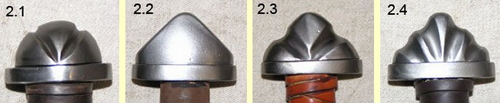
The diversity in types of sword pommels for hilts is as vast as the history of the sword itself. Though we often find hybrids and regional variations, we can identify some classic forms that remained popular over long periods:
Disc or Wheel Pommels
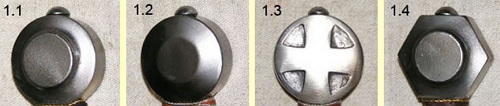
Extremely common during the Early and High Middle Ages, wheel pommels consisted of a flat or slightly convex disc. They were ideal for one-handed and hand-and-a-half swords, providing good counterbalance without being overly bulky. Their simplicity in manufacturing and effective function made them ubiquitous.
- Common materials: Iron, steel, bronze.
- Historical examples: Viking swords, Norman swords, 13th-century cavalry swords.
- Advantages: Good balance, relatively easy to manufacture, aesthetically versatile.
- Disadvantages: Less utility as a striking weapon compared to other types.
Brazil Nut Pommels
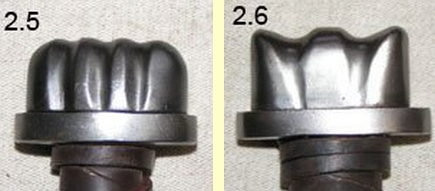
Characteristic of Viking swords and early European medieval swords (approximately 8th to 11th centuries), these pommels have a lobed shape resembling a Brazil nut. They offered a secure grip and were often cast in bronze or iron, sometimes with decorative inlays.
- Common materials: Bronze, iron.
- Historical examples: Viking-era swords (Oakeshott types X, XI).
- Advantages: Excellent grip, distinctive shape, often well-balanced.
- Disadvantages: Design specific to a limited period.
Pear or Conical Pommels
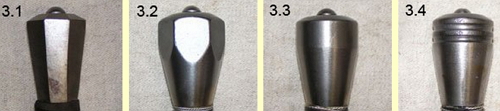
With a shape that tapers towards the top, pear pommels were popular from the late High Middle Ages through the Renaissance. They offered excellent counterbalance and a firm grip point, being particularly common in hand-and-a-half swords and longswords.
- Common materials: Steel, iron.
- Historical examples: Gothic longswords, war swords, Oakeshott types XII-XV.
- Advantages: Superior balance for longer swords, allows for a more natural grip.
- Disadvantages: Can be more complex to forge than a flat pommel.
Spherical or Octagonal Pommels
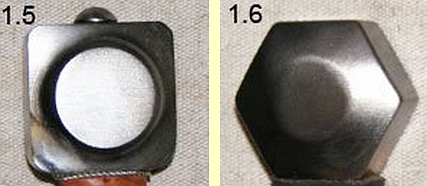
These pommels, which could be a perfect sphere or have octagonal facets for better grip, were common in the Renaissance and beyond. They were often found on rapiers and other dueling swords, where precision and balance were paramount. Octagonal pommels offered the additional advantage of improved grip and reduced slippage.
- Common materials: Steel, iron, sometimes decorated with silver or brass.
- Historical examples: Rapiers, dueling swords, basket-hilted swords.
- Advantages: Excellent balance, aesthetically elegant, octagonal facets enhance grip.
- Disadvantages: Spherical ones can slip more if not well-designed.
Fish-tail Pommels
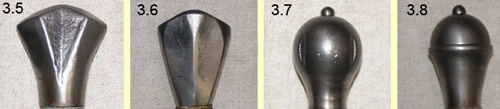
A distinctive shape that forks at its lower end, resembling a fish’s tail. These pommels are often found on Celtic swords and some early European swords. Their design provided a firm grip and effective counterbalance.
- Common materials: Bronze.
- Historical examples: Late Bronze Age swords, some Celtic swords.
- Advantages: Unique aesthetic design, good grip for the period.
- Disadvantages: Less common in later periods.
Materials and Manufacturing Techniques in Different Types of Pommels
The choice of material for the various types of sword pommels for hilts was as crucial as their shape, directly influencing weight, durability, and cost. Throughout history, we’ve seen an evolution from softer metals to hardened steel.
- Bronze: One of the first metals used, especially in Bronze Age and early Iron Age swords. It’s malleable and easy to cast, allowing for elaborate shapes.
- Iron: More durable than bronze, it became widespread with the advent of the Iron Age. Though harder to work with, it offered greater durability.
- Steel: With advances in metallurgy, steel became the predominant material. Its strength and ability to be forged allowed for thinner, more elegant pommels without sacrificing counterbalance.
- Precious metals: In ceremonial or high-status swords, gold, silver, or decorative alloys were sometimes used.
- Other materials: Exceptionally, pommels made of bone, ivory, or wood could be found on lower-rank swords or for specific purposes, though they were less common due to their lack of weight and durability.
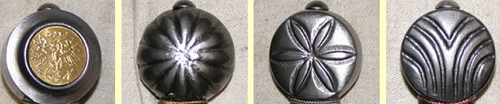
Manufacturing Techniques:
- Casting: Especially common for bronze and iron, it allowed for creating complex shapes by pouring molten metal into moulds.
- Forging: The primary method for iron and steel. It involved heating and hammering the metal into shape—a technique requiring great skill.
- Turning: For spherical or conical pommels, turning on a lathe was an effective technique, especially from the Renaissance onward.
- Riveting and threading: How the pommel attaches to the tang is also important. Riveting (hammering the end of the tang through the pommel) was very common. Later, threading (screwing the pommel onto a threaded tang) gained popularity for allowing better disassembly and adjustment.
The Importance of Balance: How Does the Pommel Affect Fencing?
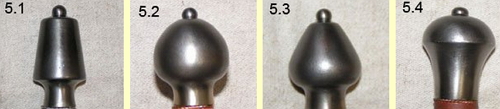
The counterweight function of the pommel is undoubtedly the most critical from the perspective of weapon handling. A well-designed pommel with the right weight can transform a sword from a heavy piece of metal into an agile, balanced extension of the swordsman’s arm. The point of balance (PoB) of a sword is where the weight feels “centred”.
A heavy pommel shifts the PoB closer to the guard, towards the hilt. This has several consequences:
- Greater agility: The sword feels lighter at the tip, allowing for faster movements and changes in direction with less effort.
- Improved control: It facilitates fine manoeuvres and recovery after a strike or parry.
- Reduced fatigue: With the weight closer to the hand, the swordsman’s arm fatigues less over time.
- Effective striking: Though it may seem contradictory, a balance point closer to the guard allows the swordsman to “feel” the sword’s tip better, improving accuracy and power applied to the target.
On the other hand, a sword with a pommel that’s too light or a very heavy blade will have the PoB further from the guard, making it feel “heavy at the tip” (blade-heavy). This results in:
- Slower, clumsier movements.
- Greater user fatigue.
- Difficulty recovering position after an attack or parry.
The relationship between blade weight, guard, and pommel is both a science and an art. Medieval blacksmiths and armourers were masters of this discipline, adjusting the weight of types of sword pommels for hilts to optimise each weapon’s performance.
Comparison of pommel types and their key characteristics Pommel Type Prevalent Period Common Materials Key Features Main Advantages Disc (Wheel) Early/High Middle Ages (9th-13th c.) Iron, Steel, Bronze Flat or slightly convex Good balance, simple to make Brazil Nut Viking – Early Middle Ages (8th-11th c.) Bronze, Iron Distinctive lobed shape Secure grip, historical value Pear / Conical High Middle Ages – Renaissance (14th-16th c.) Steel, Iron Tapers upwards Ideal for longswords, excellent counterbalance Spherical / Octagonal Renaissance – Early Modern (16th-18th c.) Steel, Iron, decorations Perfect sphere or faceted Precise balance (rapiers), improved grip (octagonal) Fish-tail Bronze Age – Early Iron Age Bronze Forked at lower end Firm grip for the era, unique aesthetic
What is the primary function of a sword pommel?
The primary function of a pommel is to act as a counterweight to balance the sword, shifting the balance point towards the guard and making the weapon more manageable. It also prevents the hand from slipping off the hilt and, in some cases, can serve as a secondary striking weapon.
How does pommel weight affect sword handling?
A properly weighted pommel brings the sword’s point of balance (PoB) closer to the hilt. This makes the sword feel lighter at the tip, allowing for faster movements, better control, reduced arm fatigue, and improved accuracy in cuts and thrusts.
Can pommels be used as weapons?
Yes, in close combat or specific fencing techniques, the pommel could be used as a blunt weapon to strike the opponent, especially after a block or when the sword’s blade was unusable. Some pommels, like spherical or pyramidal ones, were more suited for this function.
What materials were most commonly used to make pommels?
Historically, the most common materials were bronze (in the Bronze Age), iron, and later steel. For high-status or ceremonial swords, precious metals like gold or silver could also be used, or even materials like bone and ivory, though these were less frequent.
What is a disc pommel, and in what type of swords is it found?
A disc pommel (or wheel pommel) is a flat or slightly convex pommel shape, very common in Early and High Middle Ages swords, such as Viking, Norman, and 9th-13th century cavalry swords. It provided good counterbalance and was relatively easy to manufacture.
The True Essence in Types of Sword Pommels for Hilts
As we’ve explored, types of sword pommels for hilts are far more than just a simple finishing ornament. They are crucial components that directly influence a sword’s effectiveness, balance, ergonomics, and safety. Each shape and material tells a story of innovation and adaptation to the warrior’s needs across the centuries. From the rugged Viking pommels to the elegant spheres of rapiers, the evolution of the pommel is a testament to the relentless pursuit of perfection in weapon design.
At Tienda-Medieval.com, we are passionate about authenticity and quality. We understand the importance of every detail, which is why our swords are crafted with deep respect for history and functionality. Whether you’re looking for a faithful replica for display or a majestic functional sword for historical reenactment, the choice of pommel will reflect your weapon’s character and purpose. We invite you to explore our extensive collection and discover the perfect sword that will captivate you not only with its beauty but also impress you with its balance and authenticity.