Was Excalibur the invention of a medieval poet or a real steel weapon that forged the destiny of a nation? Few objects have captivated the human imagination as much as King Arthur’s sword. From cinema to literature, the image of a shining blade emerging from the stone or from the depths of a lake evokes a time of honor, magic, and chivalry.
In this article, we will unravel the truth behind the myth. We will explore the historical evidence, the archaeological findings that bear a striking resemblance to the legend, and how a simple object of war became the universal symbol of justice.
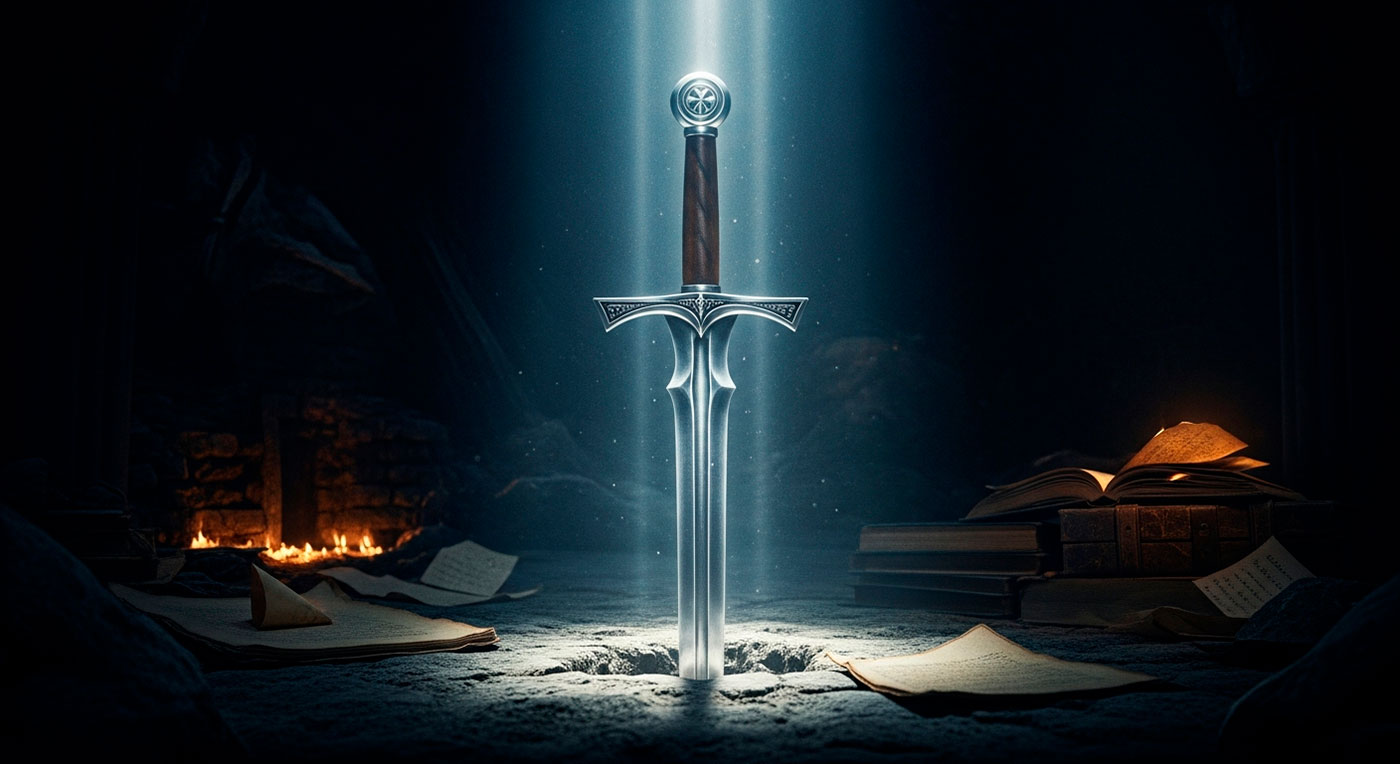
Excalibur and Arthur: Literary Development and Historical Vestiges
The legend was not born overnight. It is the result of centuries of Celtic oral traditions and medieval chronicles that shaped the sword’s identity. To understand if Excalibur existed, we must first look at how it evolved over time.
| Era | Event |
|---|---|
| 11th–12th Centuries | Caledfwlch appears in the Welsh tale “Culhwch and Olwen”. Its name means “hard cleft”. |
| c. 1136 | Geoffrey of Monmouth latinizes the name to Caliburnus in his “Historia Regum Britanniae”. |
| c. 1200 | Robert de Boron introduces the iconic “Sword in the Stone” motif as a test of legitimacy. |
| 1485 | Sir Thomas Malory publishes “Le Morte d’Arthur”, consolidating the modern name: Excalibur. |
- Key Milestones of the Myth
-
- Caledfwlch: The original Celtic root linked to Irish mythology.
- Caliburnus: The version that placed the sword’s forging on the mystical island of Avalon.
- Excalibur: The definitive name we all recognize today.
The Historical Basis: Was There a Real Sword in a Stone?
Although the magical Excalibur of the movies is a literary creation, there are historical parallels that are breathtaking. The most surprising case is the Sword of Saint Galgano. Located in the Montesiepi Chapel, Italy, this real 12th-century sword remains plunged into a rock to this day.
It belonged to Galgano Guidotti, a knight who renounced violence by thrusting his weapon into the ground. Metallurgical analyses carried out in 2001 confirmed that the steel is authentic to the period. Since this event occurred shortly before the accounts of Robert de Boron, it is very likely that the story of Saint Galgano was the direct inspiration for Arthur drawing his own sword from the stone.


The Mystery of the Lake: Celtic Rituals and Steel Offerings
The second version of the legend tells us that the Lady of the Lake gave Arthur a sword forged in Avalon. At the end of his days, the king ordered it returned to the water. Is this pure fiction? Archaeology suggests otherwise.
During the Iron Age, Celtic peoples practiced votive deposits in rivers and lakes. Numerous swords have been recovered from the River Thames that were ritually bent or “killed” before being thrown into the water as an offering to deities. This connection suggests that the end of Excalibur reflects a real warrior custom of ancient Britain.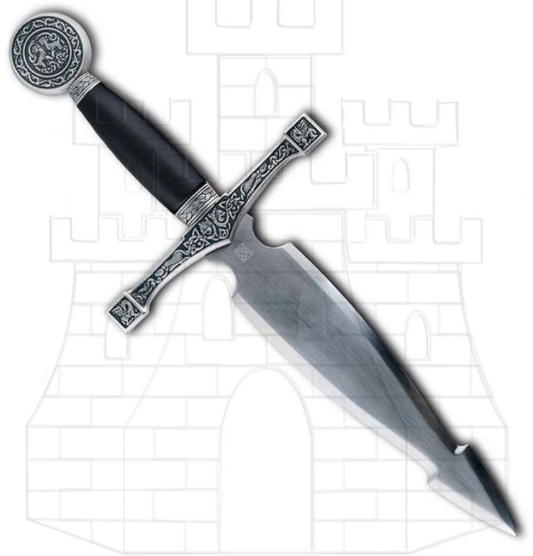
One or Two Swords? The Confusion of the Chronicles
In the original sources such as the Vulgate Cycle, a clear distinction is made that we often forget: Arthur had two main swords. The first, the one from the stone, broke in a duel against King Pellinore. It was then that Merlin guided Arthur to the lake to receive the true Excalibur.
This “second” sword possessed a magical scabbard which, according to legend, prevented its bearer from losing blood in battle. The loss of this scabbard, stolen by Morgan le Fay, was what sealed King Arthur’s fate at Camlann. Today, high-quality replicas capture this dualism, offering designs that evoke both the sobriety of real steel and the mysticism of Avalon.
Resolve Your Doubts About the Legendary Excalibur
What archaeological evidence has been found regarding Excalibur?
There is no archaeological evidence of the legendary Excalibur of King Arthur, as it is a mythical element without confirmed historical backing.
The findings nicknamed “Excalibur” are real artifacts but are not related to the Arthurian legend:
- “Valencian Excalibur” sword: A 46 cm iron short sword, with a bronze hilt and curved blade, found in 1994 in Ciutat Vella (Valencia, Spain). Dated to the 10th Islamic century by sedimentary layer analysis; it is the first Islamic sword in the city and similar to one from Medina Azahara.
- “Excalibur” Hand-axe: A unique lithic tool (lanceolate hand-axe) found in 1998 in the Sima de los Huesos (Atapuerca, Spain), dating back 430,000 years, associated with Homo heidelbergensis.
- Others: Medieval swords in Poland (14th century) and Wales, popularly compared due to their condition or location, but without a link to the legend.
How does Excalibur relate to Celtic legends?
Excalibur is deeply related to Celtic legends as a symbol of power and legitimacy for King Arthur, who represents the lost power of the Celtic peoples. The sword emerges in the context of the British Early Middle Ages, when the vacuum left by the fall of the Roman Empire was occupied by Celtic tribes, Saxons, and Roman vestiges, each contributing their own myths and traditions.
The Celtic connection is manifested in several aspects:
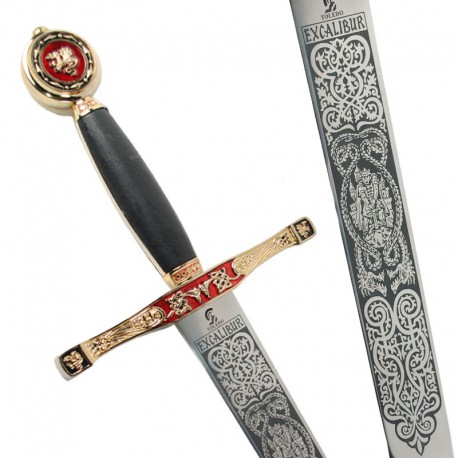 Origin and magical traditions: The magical weapons in Excalibur have roots in the Celtic tradition of the Early Middle Ages, similar to other legendary swords like Dyrnwyn, the sword of the British ruler Rhydderch Hael. Excalibur’s scabbard, with its healing properties, reflects this heritage of Celtic magical objects.
The return to the lake: The account of Excalibur’s return via a hand emerging from the water is based on Celtic customs of throwing the belongings of great warriors into lakes as offerings to their gods. This suggests a continuity between previous Celtic mythology and the Arthurian legend.
Celtic names: In Welsh legend, Excalibur is named “Caledfwlch,” directly linking it to the Welsh Celtic tradition.
Symbolism of the return: According to Celtic tradition, Arthur remains on the island of Avalon (the Celtic paradise) and will one day return with his sword to restore the unity of the Celtic world and rebuild a horizontal society, contrary to the Roman spirit.
What theories exist about the origin of Excalibur?
The theories about the origin of Excalibur focus on its etymology, legendary forging, and acquisition by Arthur, with varied versions in medieval Arthurian traditions.
- Derived from Latin “Ex Calce Liberatus” (“Released from the stone”), the most accepted theory.
- Possible Celtic origin: from Welsh “Caledfwlch” (from “hard-battle” and “breach”) or Breton “kaledvoulc’h”, linked to Welsh legends like Culhwch and Olwen.
- Older roots in Roman myths, such as Hercules’ bar driven into the ground.
- Forged by Merlin in Avalon: Geoffrey of Monmouth (Historia Regum Britanniae) indicates that Merlin created it on the island of Avalon and drove it into a stone or anvil next to a chapel in London.
- Drawn from the rock/stone/anvil: Robert de Boron’s version (Merlin), where Arthur extracts it as proof of his right to the throne; only the “true king” could do so.
- Given by the Lady of the Lake: In the Vulgate Cycle and Thomas Malory’s (Le Morte d’Arthur), it is a second sword given by the nymph Nimue after the first one broke; it represents mystical power and justice.
- Other variants: Forged from a meteorite in the Grampian Mountains by a blacksmith (novel The Last Legion); given by nymphs after playing with a dragon; or as a metaphor for royal authority without physical existence.
Confusions exist between two swords (rock vs. lake), but all emphasize magical properties such as invincibility and solar brightness.
What symbolism does Excalibur have in medieval tradition?
Excalibur symbolizes royal legitimacy, divine justice, virtuous leadership, and destiny in the medieval Arthurian tradition.
In medieval tales, such as those of the Vulgate Cycle and Malory’s Le Morte d’Arthur, it represents legitimate sovereignty: only the king chosen by divine right, like Arthur, can wield it, whether by drawing it from the stone or receiving it from the Lady of the Lake, which validates his authority over the throne and the kingdom.
 It embodies justice and protective power, with magical properties such as a blinding brightness that dazzles enemies, a scabbard that prevents bleeding, and the ability to cut through any material, linking it to the Celtic Otherworld and Christian ideals of redemption.
Its possession ensures the prosperity of Camelot and the balance of the kingdom, reflecting the medieval idea that the people’s well-being depends on the ruler’s virtue; its loss (as by Morgana’s theft) initiates decadence and tragedy.
Finally, its return to the lake upon Arthur’s death closes the mythical cycle, symbolizing the end of an era, the renunciation of earthly power, and the promise of rebirth, reinforcing themes of fertility, nobility, and transcendence.
How is Excalibur described in different versions of the Arthurian legend?
Excalibur is described in Arthurian legends as a magical sword symbol of royal power, divine legitimacy, and invincibility, with variations according to the versions: sometimes it is the sword drawn from the stone (forged by Merlin in Avalon), other times it is a later gift from the Lady of the Lake after breaking the first one.
- Sword in the stone (Merlinian origin): Driven by Merlin into a rock next to a chapel in London or in Avalon; only the legitimate king (Arthur) can extract it, symbolizing predestined fate and the union of the kingdom.
- Gift from the Lady of the Lake: Different from the previous one (which breaks in combat); it emerges from enchanted waters (lake or Avalon), delivered by a mystical figure like Nimue; it marks a supernatural cycle.
- Common features: Shining steel blade that glows blindingly like the sun, indestructible, cuts through any material (even the most resistant); hilt ornamented with Celtic or arcane symbols; red or protective magical scabbard that prevents the bearer from bleeding, grants invulnerability and healing properties (its loss foretells ruin).
- Recurring end: Arthur, mortally wounded, orders it returned to the lake; a female hand (Lady of the Lake) claims it, symbolizing cyclical closure and the wait for a new worthy king.
Although Excalibur as such has not been recovered from a sedimentary layer with a tag saying “Property of Arthur,” the essence of the sword lives in every piece that respects the Toledan tradition. It is a reminder of a time when steel was not just a tool, but a sacred commitment to truth and justice.