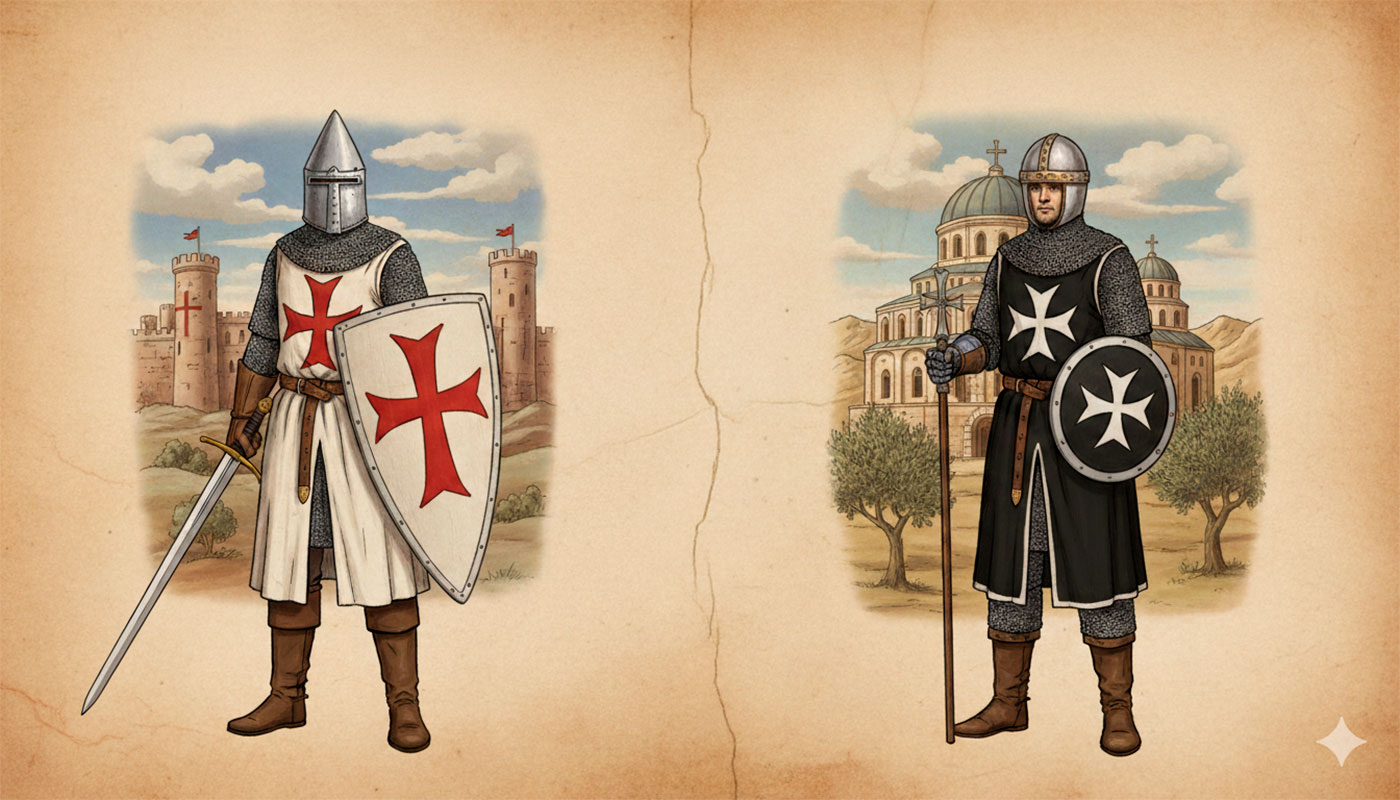
For any Middle Ages enthusiast, it is common for concepts to blend together when talking about military orders. Popular culture, driven by cinema and literature, has generated a mist of mystery that often prevents a clear view of the differences between Templars and Hospitallers. Although both groups shared the Christian faith and the defense of the Holy Places, their trajectories, operational missions, and final destinies were notably different, marking the future of Christendom in the Near East.
Templars or Hospitallers? Debunking common myths and confusions
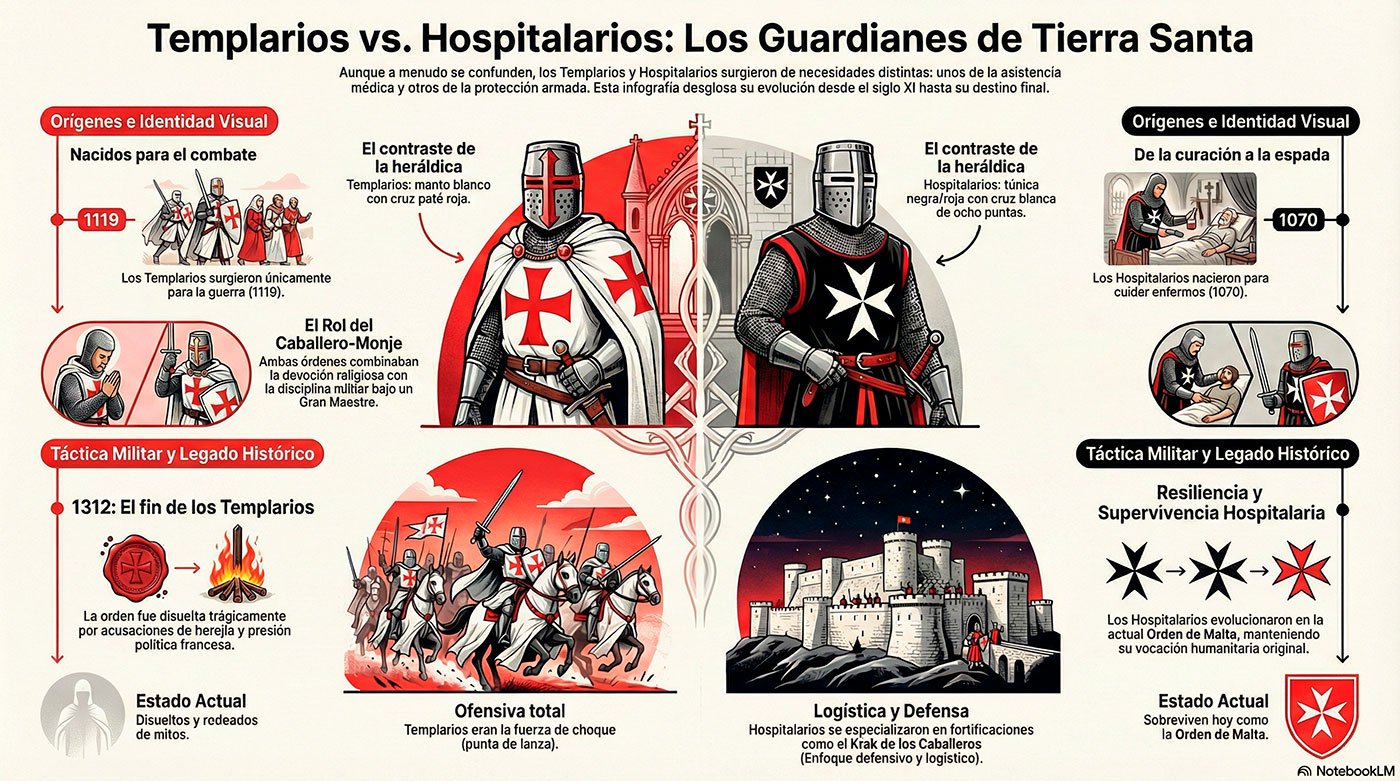
Understanding the differences between Templars and Hospitallers requires analyzing their genesis. While the Templars were born with a purely military vocation to protect pilgrims’ paths, the Hospitallers emerged from a caregiving movement prior to the Crusades, focused on the medical care of the sick in Jerusalem. This duality between the sword and healing defined their identities for centuries. It is not just about different colors on their tunics, but about organizational structures that evolved in opposite ways under Europe’s political pressures.
Many fans usually group them under the same banner of armed holiness, but their internal rivalries were legendary. By studying the differences between Templars and Hospitallers, we discover that they competed for land, resources, and the favor of European monarchs. This competition not only strengthened their defenses but also accelerated commercial and banking processes that laid the foundations of the modern economy.
The historical impact of these crusading military orders is incalculable. While some vanished tragically under accusations of heresy, others reinvented themselves to survive to the present day. Exploring their myths allows us to demystify the figure of the medieval knight, separating tactical reality from the romantic legend that still captivates our collective imagination today. Knowing their legacy is to understand the roots of Western culture.
Origins and Foundations: From the hospital to the militia
To understand the evolution of military forces in the Holy Land, it is essential to analyze their foundational roots. One of the major differences between Templars and Hospitallers lies in the original purpose that brought each institution to life. Sovereigns and the Church did not create them from the same mold; in fact, their reasons for being responded to totally different social and operational needs in the context of the 11th and 12th-century Mediterranean Levant.
 The Order of Saint John, known as the Hospitallers, has a history predating the First Crusade. Around the year 1070, a group of merchants from Amalfi founded a hospital in Jerusalem dedicated to Saint John the Baptist to care for poor and sick pilgrims. Its initial identity was purely charitable and welfare-oriented. It was not until decades after the conquest of the Holy City that, out of defensive necessity against border attacks, they began to adopt military functions, transforming into one of the most influential crusading military orders.
By contrast, the Templar origin emerged in 1119 with an exclusively combative mentality. Hugues de Payens and eight other knights founded the brotherhood with the specific objective of protecting, by force of arms, the dangerous roads that led pilgrims from the coast to the interior of Palestine. Unlike their counterparts, they never managed hospitals as a primary goal but were born as soldier-monks based at the site of the ancient Temple of Solomon.
This Templar historical comparison reveals that while some incorporated the sword into their hospital work, others were born from the sword to serve the faith. Analyzing these differences between Templars and Hospitallers shows how the need for security and Christian charity converged into a model of religious life that would mark the medieval military future of Christendom.
Symbols, structure, and military roles: Crosses and combat styles
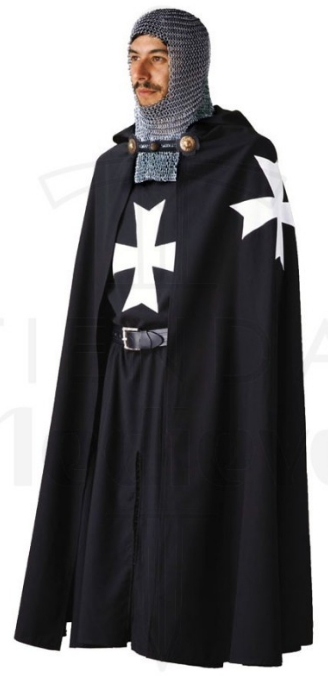
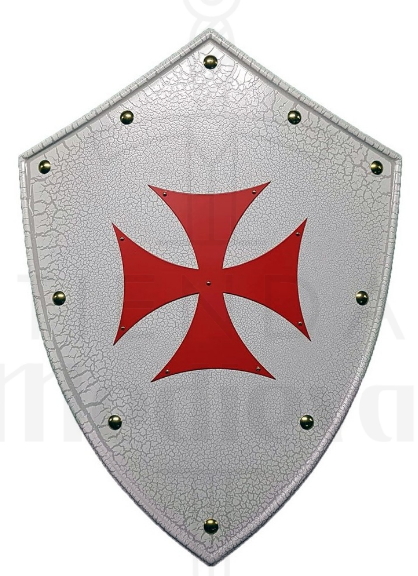 Visual distinction on the battlefield was fundamental for troop coordination. Within the differences between Templars and Hospitallers, heraldry held a central place. Templar knights were easily identifiable by their characteristic white mantle with a bright red cross pattée on the chest, a symbol of their readiness for martyrdom. In contrast, Hospitaller knights wore a black tunic (later red in combat) with a white eight-pointed cross, known today as the Maltese cross, representing the eight biblical beatitudes.
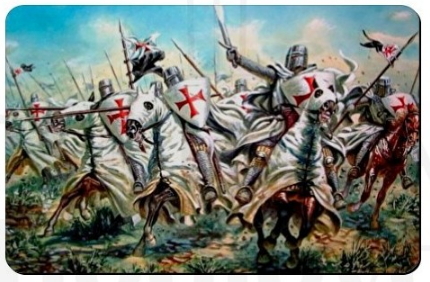
Despite both institutions having a similar hierarchical organization, headed by a Grand Master, their operational approaches varied significantly. Templar and Hospitaller symbols served not only as a badge but reflected their tactical identities. Templars usually acted as an offensive shock force, being the spearhead in cavalry charges. Their discipline was ironclad; they were forbidden from retreating from combat unless the ratio was three to one, giving them a reputation as fearsome and lethal warriors.
On the other hand, the Hospitallers maintained a more versatile profile. Although they were exceptional combatants, their structure never abandoned its welfare core. In the military field, they stood out for a more defensive and logistical mentality, specializing in the fortification and defense of strategic castles. While the Templars invested much of their energy in expanding their financial system, the Hospitallers consolidated their network of infirmaries. These subtle differences between Templars and Hospitallers regarding weaponry and technical deployment allowed the crusading military orders to dominate the Levant. Ultimately, the tactical aggressiveness of one complemented the institutional and hospital solidity of the other, creating a vital military balance for the survival of the Crusader states.
Do you want a replica Templar sword?
Holding a Templar sword in your hands is a unique experience. The weight, the balance, the cold sensation of the steel… it is like holding a fragment of living history. However, the market is saturated with “fantasy” imitations that have little to do with the weapons these warrior monks actually carried. If you are thinking of acquiring a replica, whether for historical reenactment or to display it with pride in your collection, you need to know how to distinguish quality from a simple costume. Here we tell you the keys.


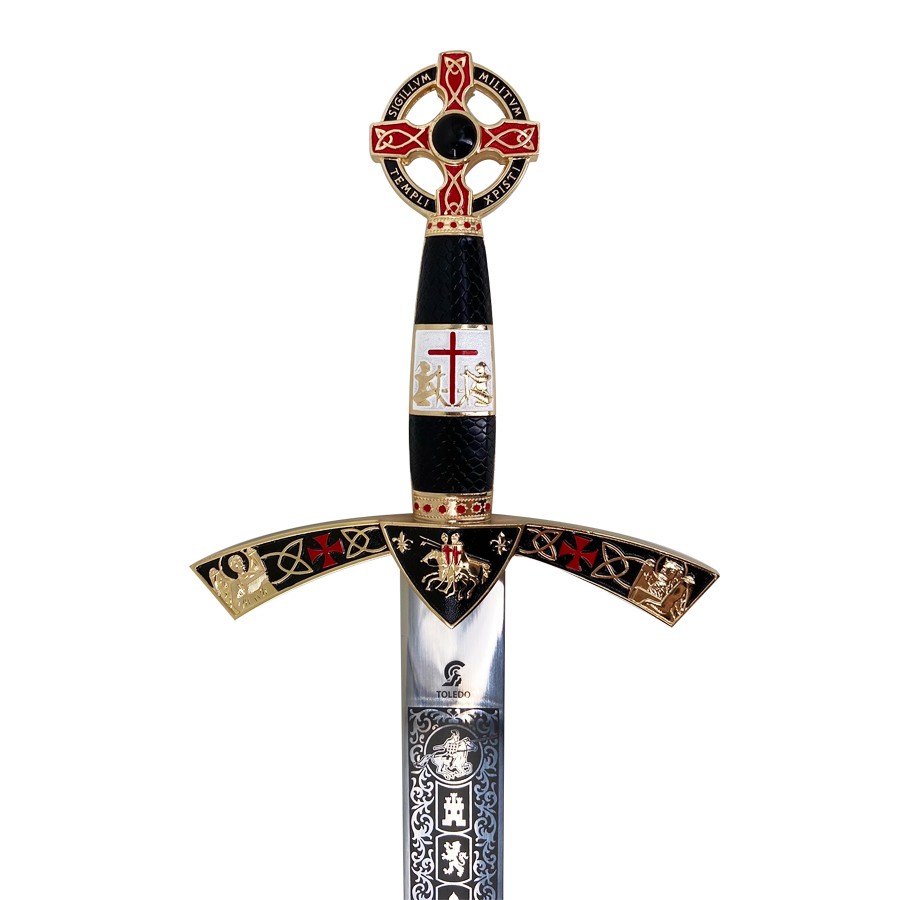


They are the definitive icon of the Middle Ages. The swords of the Knights Templar represent the pinnacle of knighthood, mystery, and military power. But what made these weapons so special in their time? If you are passionate about the history of the Order and dream of having a quality replica hanging on your wall or at your waist, this article is your starting point. We analyze their design and guide you through the world of collecting.
Fortresses, key battles, and rivalries between orders
 The control of territory in Outremer evidenced great differences between Templars and Hospitallers regarding their military architecture. The Hospitallers immortalized their power in the imposing Krak des Chevaliers, a fortress designed to withstand prolonged sieges and serve as a cutting-edge logistical center. For its part, the network of Templar castles prioritized strategic functionality and the control of vital trade routes.
Despite collaborating in disasters like the Battle of Hattin, where both crusading military orders suffered massive losses, their relationship was marked by tense rivalry. They competed fiercely for papal privileges and territorial domains, occasionally leading to direct confrontations that weakened Christian cohesion. This Templars vs Hospitallers dualism defines an era where religious devotion did not prevent political ambition. While the Templars centralized their wealth, the future members of the Order of Malta consolidated territorial sovereignty that would allow them to survive geopolitical changes.
Final fate and legacy: Dissolution vs eternal survival
The outcome of these institutions marks one of the greatest differences between Templars and Hospitallers in European history. The Knights Templar suffered a precipitous fall after the loss of Acre. In 1312, Pope Clement V, under immense pressure from King Philip IV of France, dissolved the order after a process full of accusations of heresy and torture. Their assets were confiscated or transferred, leaving behind a halo of mystery that endures to this day.
In contrast, the Hospitallers showed extraordinary resilience. After leaving the Holy Land, they established themselves in Rhodes and subsequently in Malta, evolving to become the current Order of Malta. This sovereign entity today maintains its original humanitarian vocation, adapting its ancient traditions to global medical needs. While the Templar legacy survives in legends and theories, the Hospitallers remain a tangible institution. Understanding these differences between Templars and Hospitallers teaches us how institutional adaptability can ensure eternal survival in a constantly changing world.