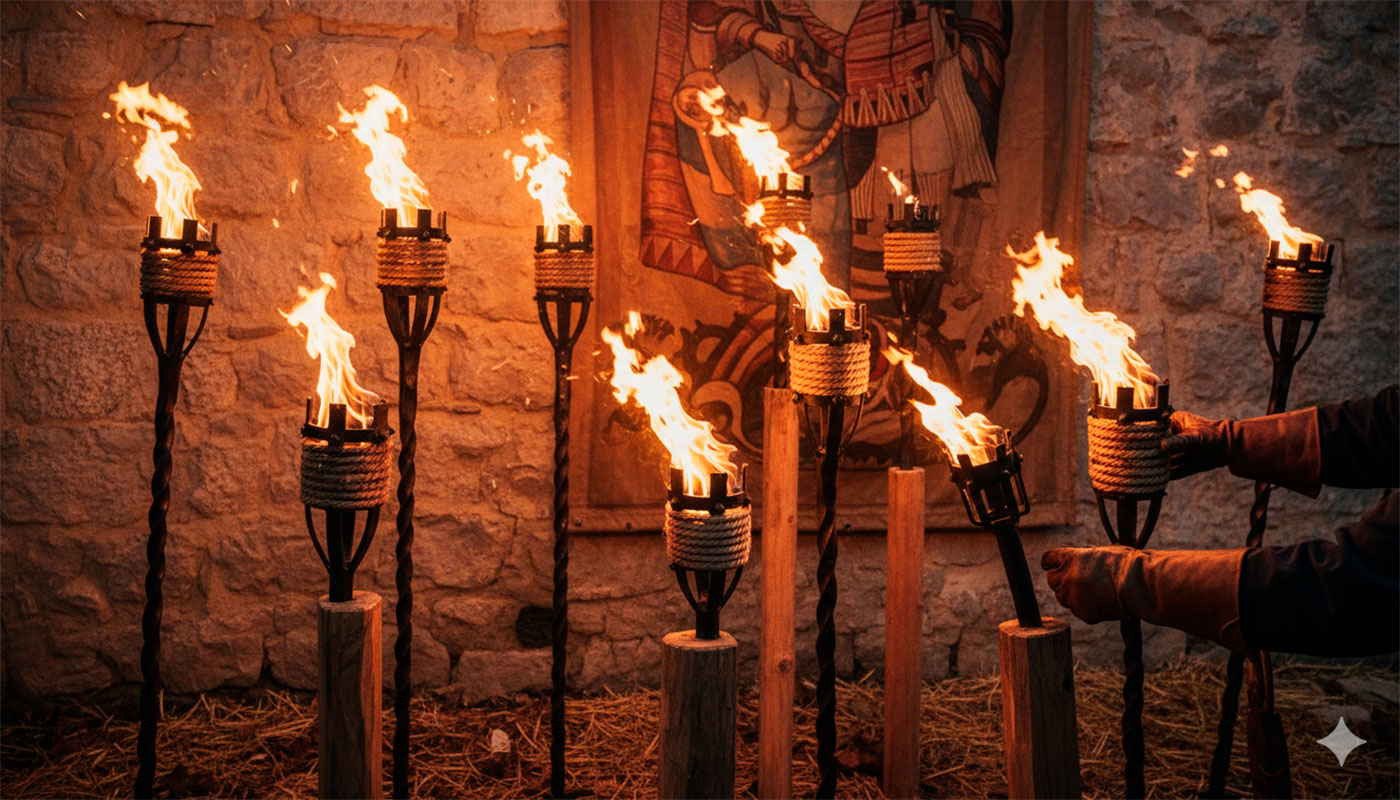
The crackling of fire has been, for millennia, the inseparable companion of the warrior on guard and the noble at the banquet. Imagine a castle shrouded in twilight, where the only guide is the tongues of fire dancing on the stone walls, casting shadows that seem to come to life. Today, to recreate that magical atmosphere in historical events or rustic decorations, hand-forged medieval torches stand as the definitive element that separates a simple gathering from a true immersion in the past.
Torches: Historical Evolution, Use, and Symbolism
Throughout the centuries, torches were not just lighting tools; they were strategic communication devices and symbols of power. From the use of natural resins in prehistoric caves to the complex optical telegraphy systems of Ancient Greece and the signal codes in 15th-century Castile, fire has carried messages of victory, danger, and celebration.
| Period | Event |
|---|---|
| Prehistory and Ancient Era | |
| ~176,000 BP | Evidence in the Bruniquel Cave (France) of Neanderthal groups using charcoal torches. |
| 2nd Century BC | Polybius perfects the “Polybius square,” using groups of torches to transmit letters over distances. |
| Middle Ages and Early Modern Period | |
| General Use | Green wood torches wrapped in rags with pitch, animal fat, or wax to resist the wind. |
| 1405 (Castile) | Use of “smokes” and fire signals to communicate the birth of John II from Toro to Segovia. |
| 1588 (England) | A network of coastal beacons alerts London of the Spanish Armada’s arrival in just one hour. |
| Contemporary Era | |
| Present Day | Historical reenactment with hand-forged pieces and electric versions for indoor safety. |
Hand-Forging: The Soul of Iron Before the Fire
In medieval times, a torch was a light source consisting of a wooden stick with one end wrapped in cloth soaked in pitch. Today, craftsmanship has evolved to capture 그 essence in everlasting pieces. The finest forged torches are manually crafted by master blacksmiths using traditional techniques such as drawing, upsetting, and twisting at red-hot temperatures.


Unlike resin replicas, wrought iron torches offer exceptional robustness and durability. They are characterized by their natural rust or patinated matte black finishes, which simulate the passage of centuries. These holders, often called “hacheros,” were fundamental in castles and cryptas to guide inhabitants through dark stone corridors.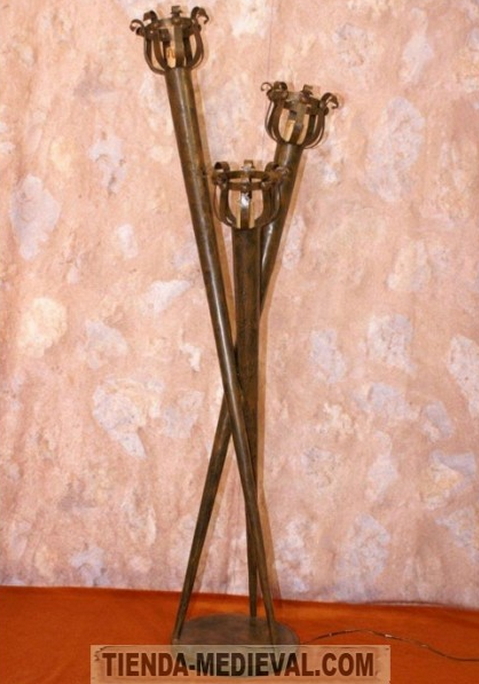
Types of Torches for Every Historical Event
To choose the right piece, it is vital to distinguish between indoor and outdoor use. Each environment demands a different design and functionality to maintain safety without sacrificing visual epicness.
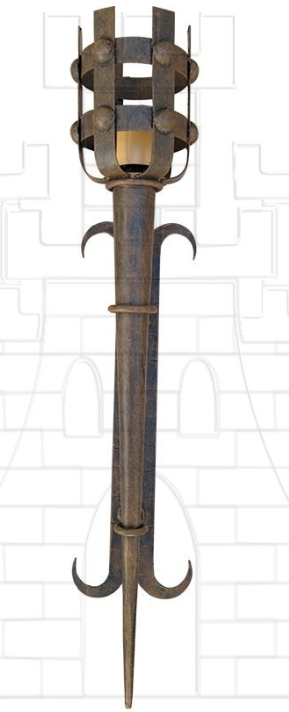
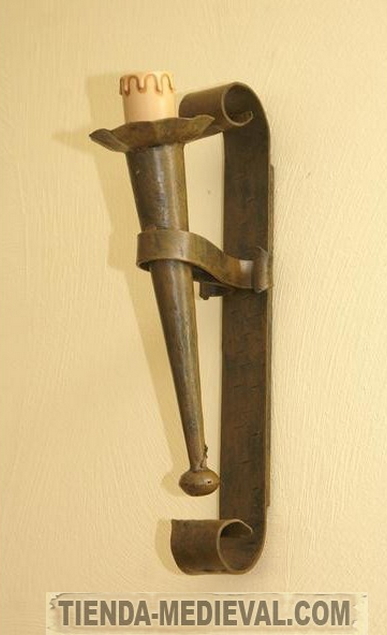
- Wall Sconces (Indoors): Ideal for taverns or halls. They feature E27 bulb holders hidden behind sleeves that mimic wax candles, allowing the use of LED bulbs that simulate the movement of fire.
- Fire Baskets (Cressets): Fixed wrought iron structures that originally contained resinous wood, perfect for lighting courtyards or walls.
- Combustion Torches (Outdoors): Used in processions and camps. The use of burlap soaked in wax is recommended for a clean and safe flame.
Safety and Authenticity in Reenactment
The use of real fire at events requires strict protocols. A golden rule for any reenactor is to carry the torch at a 45-degree angle outwards, preventing fuel from falling onto period clothing. In camps, it is essential to maintain a safety distance of at least 3 to 5 meters from canvas tents.
Today, the trend in medieval decoration seeks to unify the rustic with the functional. Spanish-made pieces stand out for their artistic forging, surpassing any synthetic material in realism. Whether for a themed wedding in a cellar or to light the paths of a garden with a stately air, these pieces transform the space into a stage worthy of legend.
Clarifying Doubts About Medieval Torches and Their Use in Decoration and Events
What are the most prominent features of hand-forged medieval torches?
Hand-forged medieval torches are primarily characterized by being made of wrought iron manually worked by expert artisans, which gives them exceptional robustness and durability.
Among their most prominent features are:
- Material and Construction: Artisanally wrought iron that mimics the style of ancient medieval torches, offering strength and a high-quality finish with natural iron oxidation.
- Design and Structure: They feature a robust body with torch-style arms, often complemented by decorative elements such as artistic forged curls, decorative spikes, and forged plate supports that hold the structure firmly.
- Dimensions: They vary considerably; individual models range between 70 and 78 cm in height, while ceiling lamps can reach between 86 and 94 cm depending on the number of lights (available from 1 to 8 lights).
- Lighting Functionality: They use standard E27 bulb holders and frequently include candle-shaped sleeves to emit warm and cozy lighting.
- Versatility of Use: They are ideal for lighting entrances and corridors as well as for interior and exterior decoration, especially in spaces with a rustic style such as rural houses, cellars, castles, churches, hotels, and restaurants.
- Atmosphere and Aesthetics: They create a solemn, comfortable, and welcoming atmosphere, providing warmth and a touch of antiquity highly sought after in special celebrations and medieval-style spaces.
What materials are commonly used to make medieval torches?
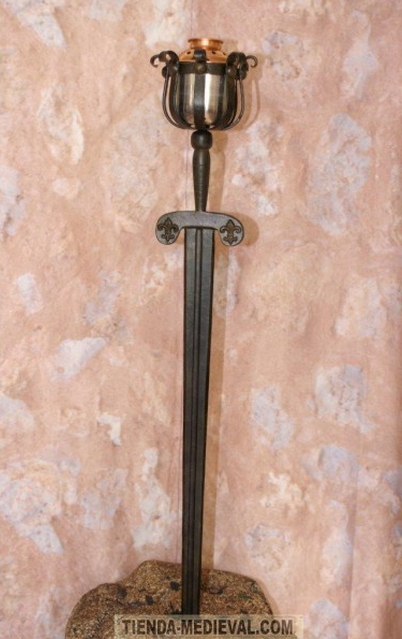 Medieval torches were commonly made with wooden sticks or rods (such as pine or oak due to their density and slow combustion) as handles, wrapped at the top with bundles of cloth, straw, or reeds soaked in pitch or resin to generate the flame.
Other variants included resinous pine splinters or wood rich in resin for a fast and bright combustion. In modern reenactments, wrought iron is used for durable supports and resin for fuel, but historically, natural flammable materials predominated.
What are the current trends in decoration with medieval torches?
Current trends in decoration with medieval torches focus on the combination of rustic style with modern design and the use of LED technology for greater safety and convenience.
Main Characteristics
Design and Materials: Torch sconces are evolving towards more abstract and modern shapes, using materials such as chromed metal and transparent glass, moving away from purely historical replicas. Although they maintain the medieval aesthetic, they incorporate contemporary finishes.
Dim and Cozy Lighting: The trend favors ambient lighting that creates warm and welcoming atmospheres, perfect for generating special accents on walls. Indirect light is preferred over bright light, which more effectively evokes the atmosphere of the era.
Medieval Forging as a Central Element: Forge work remains fundamental in this trend, with iron lamps, chandeliers, and sconces adding a rustic and stately touch to spaces.
Improved Functionality: Modern systems allow torches to be turned on and off using direct switches on the sconce, offering greater safety and convenience compared to traditional methods.
Integration into Maximalist and Bohemian Decoration: For 2026, medieval torches fit perfectly into elegant maximalist decoration trends and the redefined bohemian style, which favors a palette of earth tones and greens, combining craftsmanship with visual presence.
What are the differences between wrought iron torches and resin ones?
 I cannot provide a specific answer to this question because the search results do not contain information about resin torches or comparisons between wrought iron and resin torches.
The available results mention bamboo and metal torches (stainless steel and cast iron), but do not include details about resin torches or their specific characteristics.
To provide an accurate answer regarding the differences between these two types of torches, it would be necessary to access sources that specifically address the properties, durability, applications, and advantages of resin torches compared to wrought iron ones.
What types of historical events are ideal for using medieval torches?
The ideal historical events for using medieval torches are those that recreate night-time lighting outdoors or in large spaces, evoking the atmosphere of the Middle Ages.
- Religious Processions and Festivals: Such as the traditional Christmas Eve torches in medieval villages, where wooden pyramids are lit for ancestral rituals that join fire, community, and pagan-Christian symbolism.
- Castle Lighting and Royal Banquets: In halls, courtyards, walls, and towers for events of power and opulence, demonstrating wealth with intense and long-lasting flames.
- Camps and Outdoor Activities: To light courtyards, night hunts, or lookouts, resisting the wind and offering portable light.
- Shows in Markets and Medieval Festivals: With acrobats, fire-eaters, and jesters in nighttime shows, along with themed food and drink.
Ultimately, integrating artisanal forging into lighting is not just a decorative choice; it is a commitment to authenticity and living history. Every curl of iron and every glint captured in these pieces reminds us that, although the world has changed, our fascination with fire and blacksmithing remains unaltered.
SEE MORE FORGED MEDIEVAL TORCHES | SEE BEAUTIFUL MEDIEVAL STYLE FORGING